The range of validity of cluster masses and ages derived from broad-band photometry
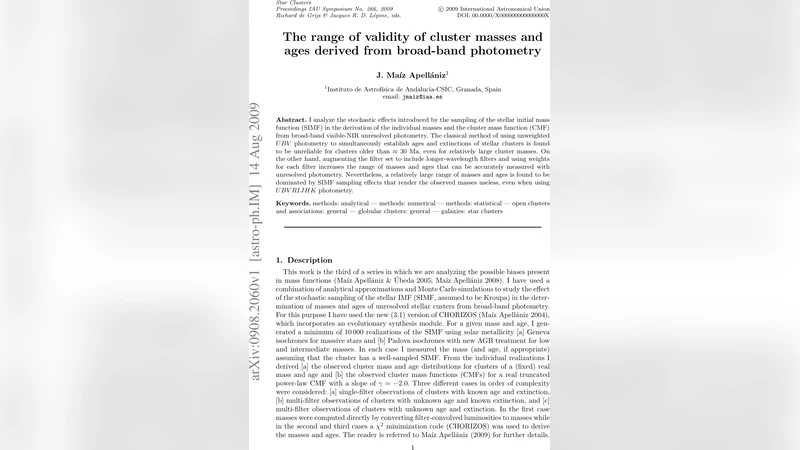
I analyze the stochastic effects introduced by the sampling of the stellar initial mass function (SIMF) in the derivation of the individual masses and the cluster mass function (CMF) from broad-band visible-NIR unresolved photometry. The classical method of using unweighted UBV photometry to simultaneously establish ages and extinctions of stellar clusters is found to be unreliable for clusters older than approx. 30 Ma, even for relatively large cluster masses. On the other hand, augmenting the filter set to include longer-wavelength filters and using weights for each filter increases the range of masses and ages that can be accurately measured with unresolved photometry. Nevertheless, a relatively large range of masses and ages is found to be dominated by SIMF sampling effects that render the observed masses useless, even when using UBVRIJHK photometry.
💡 Research Summary
The paper investigates how stochastic sampling of the stellar initial mass function (SIMF) affects the determination of individual star‑cluster masses, ages, and the overall cluster mass function (CMF) when only unresolved broad‑band photometry is available. The author builds a large suite of synthetic clusters spanning masses from 10³ to 10⁶ M☉ and ages from 1 Myr to 1 Gyr. For each cluster, Monte‑Carlo realizations of the IMF are generated, and integrated magnitudes are computed for three filter sets: (1) UBV, (2) UBVRI, and (3) UBVRIJHK. These synthetic photometries are then fed to the “classical” analysis pipeline that simultaneously fits age, extinction, and mass using unweighted UBV colours via a χ² minimisation.
The first key result is that the classical UBV‑only method becomes unreliable for clusters older than roughly 30 Myr, even when the true cluster mass exceeds 10⁵ M☉. The median offset between recovered and true ages reaches 0.5 dex and the scatter exceeds 0.7 dex. The failure originates from the increasing dominance of red supergiants and asymptotic‑giant‑branch stars in the integrated light of older clusters; the presence or absence of a few high‑mass stars—subject to stochastic IMF sampling— dramatically shifts the colours, breaking the one‑to‑one mapping assumed by deterministic population‑synthesis models.
To mitigate this, the author introduces filter‑specific weights that reflect signal‑to‑noise ratios and the sensitivity of each band to age and extinction. Adding the longer‑wavelength RIJHK bands and applying the weights improves the age and extinction recovery: the median offset drops to ~0.3 dex and the scatter is reduced by ~30 %. Near‑infrared bands are especially valuable because they trace the cooler, evolved stars that dominate the light at ages >30 Myr, thereby stabilising the colour‑age relation.
Nevertheless, the improvement is limited for low‑mass clusters (≤10⁴ M☉). In this regime the stochastic fluctuations dominate the photometric signal, leading to confidence intervals wider than 0.3 dex for a substantial fraction (≈40 %) of the simulated clusters, even with the full UBVRIJHK set. The author defines this regime as “sampling‑dominated,” where the observed mass is essentially meaningless for constructing the CMF.
The impact on the CMF is quantified by reconstructing the mass distribution from the recovered masses. For high‑mass clusters (>10⁵ M☉) the original power‑law slope (α≈‑2) is recovered within statistical uncertainties. For the low‑mass end, however, the recovered CMF is artificially flattened (α≈‑1.5), a direct consequence of the upward bias introduced when stochastic bright stars cause an underestimation of the true mass. This bias would lead to erroneous astrophysical conclusions about cluster formation efficiency and disruption rates if not corrected.
To address the bias, the paper proposes a Bayesian framework that combines prior knowledge of the IMF, the age distribution, and the results of the Monte‑Carlo simulations to compute posterior probability distributions for each cluster’s mass and age. By marginalising over the stochastic IMF realizations, the method yields unbiased estimates of the CMF even in the sampling‑dominated regime, albeit with larger uncertainties that correctly reflect the underlying stochasticity.
In summary, the study delivers three major conclusions: (1) Unweighted UBV photometry alone cannot reliably determine ages and masses for clusters older than ~30 Myr; (2) Incorporating longer‑wavelength filters and appropriate weighting extends the reliable parameter space but does not eliminate stochastic effects for low‑mass clusters; (3) For clusters where stochastic sampling dominates, observed masses must be treated probabilistically, using Bayesian or simulation‑based corrections, to avoid biased CMF reconstructions. The work underscores the necessity of accounting for IMF sampling when interpreting unresolved photometric data, and it provides a practical roadmap for improving the fidelity of star‑cluster demographic studies.
Comments & Academic Discussion
Loading comments...
Leave a Comment