The 8 Micron Phase Variation of the Hot Saturn HD 149026b
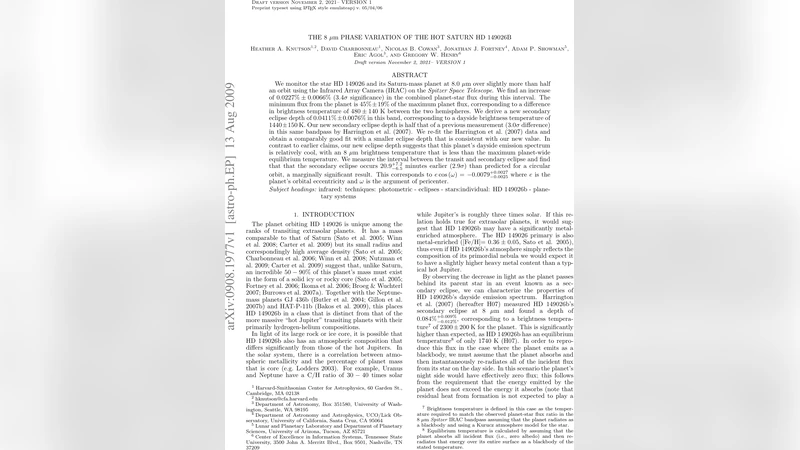
We monitor the star HD 149026 and its Saturn-mass planet at 8.0 micron over slightly more than half an orbit using the Infrared Array Camera (IRAC) on the Spitzer Space Telescope. We find an increase of 0.0227% +/- 0.0066% (3.4 sigma significance) in the combined planet-star flux during this interval. The minimum flux from the planet is 45% +/- 19% of the maximum planet flux, corresponding to a difference in brightness temperature of 480 +/- 140 K between the two hemispheres. We derive a new secondary eclipse depth of 0.0411% +/- 0.0076% in this band, corresponding to a dayside brightness temperature of 1440 +/- 150 K. Our new secondary eclipse depth is half that of a previous measurement (3.0 sigma difference) in this same bandpass by Harrington et al. (2007). We re-fit the Harrington et al. (2007) data and obtain a comparably good fit with a smaller eclipse depth that is consistent with our new value. In contrast to earlier claims, our new eclipse depth suggests that this planet’s dayside emission spectrum is relatively cool, with an 8 micron brightness temperature that is less than the maximum planet-wide equilibrium temperature. We measure the interval between the transit and secondary eclipse and find that that the secondary eclipse occurs 20.9 +7.2 / -6.5 minutes earlier (2.9 sigma) than predicted for a circular orbit, a marginally significant result. This corresponds to e*cos(omega) = -0.0079 +0.0027 / -0.0025 where e is the planet’s orbital eccentricity and omega is the argument of pericenter.
💡 Research Summary
The authors present a detailed 8 µm phase‑curve observation of the hot Saturn HD 149026b using Spitzer’s Infrared Array Camera (IRAC). Over a span slightly longer than half an orbital period, they monitored the combined planet‑star flux and detected a statistically significant (3.4 σ) increase of 0.0227 % ± 0.0066 % in the system’s brightness. This modulation implies that the planet’s minimum flux is only 45 % ± 19 % of its maximum, corresponding to a brightness‑temperature contrast of roughly 480 K ± 140 K between the two hemispheres. Such a large day‑night (or east‑west) temperature difference points to inefficient heat redistribution, possibly driven by strong zonal winds or altitude‑dependent radiative timescales.
A key result is the revised secondary‑eclipse depth of 0.0411 % ± 0.0076 %, which is about half the value reported by Harrington et al. (2007). By re‑analyzing the earlier dataset with the same detrending and fitting procedures, the authors obtain a consistent shallow eclipse depth, suggesting that the original measurement suffered from systematic errors (e.g., inadequate correction of the IRAC detector ramp). The new eclipse depth translates to a dayside brightness temperature of 1440 K ± 150 K, noticeably lower than the planet‑wide equilibrium temperature (~1700 K). This indicates that the 8 µm emission is suppressed, likely by strong molecular absorption (H₂O, CO₂) or a temperature inversion, making the dayside spectrum cooler than previously thought.
Timing analysis reveals that the secondary eclipse occurs 20.9 minutes earlier than expected for a perfectly circular orbit, a 2.9 σ deviation. This offset corresponds to e cos ω = −0.0079 ± 0.0026, hinting at a modest but non‑zero orbital eccentricity. While the significance is marginal, it underscores the importance of precise transit and eclipse timing for constraining orbital dynamics.
Methodologically, the study employs standard IRAC data reduction (dark subtraction, flat‑fielding, pixel‑phase correction) followed by a polynomial model for the well‑known “ramp” effect. The authors fit the light curve using a Markov Chain Monte Carlo (MCMC) framework, simultaneously solving for the phase‑curve amplitude, eclipse depth, and timing offsets. Their approach yields robust uncertainties and demonstrates the feasibility of extracting phase information from relatively short Spitzer campaigns.
In the discussion, the authors compare their findings with atmospheric circulation models. The observed temperature contrast suggests a heat‑redistribution efficiency lower than the canonical f ≈ 0.5, implying that a substantial fraction of incident stellar energy is reradiated on the dayside before being advected to the night side. The cooler dayside temperature relative to equilibrium also challenges models that predict strong thermal inversions for highly irradiated planets; instead, HD 149026b may possess a more muted inversion or a high‑altitude absorber that reduces the emergent 8 µm flux.
The paper concludes that high‑precision infrared phase curves, even in a single bandpass, can simultaneously constrain atmospheric dynamics, composition, and orbital eccentricity. The authors advocate for multi‑wavelength phase‑curve observations with upcoming facilities such as JWST, which will enable a more comprehensive mapping of temperature distributions and chemical abundances across the planet’s surface. Such data will be essential for testing and refining three‑dimensional circulation models for hot Saturns and other highly irradiated exoplanets.
Comments & Academic Discussion
Loading comments...
Leave a Comment