Quantum Picturalism
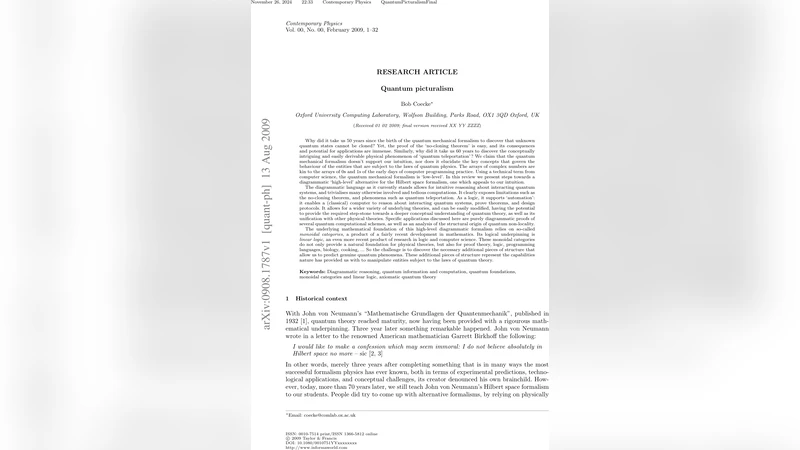
The quantum mechanical formalism doesn’t support our intuition, nor does it elucidate the key concepts that govern the behaviour of the entities that are subject to the laws of quantum physics. The arrays of complex numbers are kin to the arrays of 0s and 1s of the early days of computer programming practice. In this review we present steps towards a diagrammatic high-level' alternative for the Hilbert space formalism, one which appeals to our intuition. It allows for intuitive reasoning about interacting quantum systems, and trivialises many otherwise involved and tedious computations. It clearly exposes limitations such as the no-cloning theorem, and phenomena such as quantum teleportation. As a logic, it supports automation’. It allows for a wider variety of underlying theories, and can be easily modified, having the potential to provide the required step-stone towards a deeper conceptual understanding of quantum theory, as well as its unification with other physical theories. Specific applications discussed here are purely diagrammatic proofs of several quantum computational schemes, as well as an analysis of the structural origin of quantum non-locality. The underlying mathematical foundation of this high-level diagrammatic formalism relies on so-called monoidal categories, a product of a fairly recent development in mathematics. These monoidal categories do not only provide a natural foundation for physical theories, but also for proof theory, logic, programming languages, biology, cooking, … The challenge is to discover the necessary additional pieces of structure that allow us to predict genuine quantum phenomena.
💡 Research Summary
The paper confronts the long‑standing mismatch between the abstract, matrix‑heavy formalism of quantum mechanics and the intuitive ways physicists and engineers think about quantum systems. It proposes a high‑level, diagrammatic alternative called “Quantum Picturalism,” built on the modern mathematical framework of monoidal categories, in particular †‑compact closed categories. In this categorical view, physical systems are objects, physical processes are morphisms, and the tensor product of systems corresponds to the categorical tensor, allowing composite systems to be represented by simple graphical connections.
The authors demonstrate how basic quantum notions translate into pictures: a qubit is a single line, quantum gates are boxes attached to lines, entanglement appears as wires that join or cross, and special structures called cups and caps represent state preparation and measurement. Using these elements, they give a fully diagrammatic proof of quantum teleportation, showing that the protocol’s measurement, classical communication, and reconstruction steps collapse into a single, easily readable network. The no‑cloning theorem emerges naturally because a “copy” box cannot be drawn within the allowed rewrite rules.
A central technical contribution is the set of rewrite rules that govern diagram manipulation. For example, a SWAP gate is just a crossing of two wires, and the braid move permits the crossing to be moved freely, eliminating the need for explicit matrix multiplication. These rules can be encoded in automated theorem‑proving or circuit‑optimization tools, enabling formal verification of circuit equivalence, synthesis of more efficient circuits, and even the discovery of novel protocols.
Beyond computation, the paper analyses the structural origin of quantum non‑locality. Entangled states correspond to specific wiring patterns (spines and cores) that make the non‑local correlations manifest without reference to underlying Hilbert‑space vectors. This visual perspective clarifies why Bell‑type inequalities are violated and how the correlations are rooted in the topology of the diagram rather than in hidden variables.
The authors acknowledge that the current categorical toolkit, while powerful, is not yet sufficient to capture all quantum phenomena. They argue that additional structures—such as probabilistic effects, higher‑order morphisms, or enrichment over more general base categories—are required to model open‑system dynamics, quantum field interactions, or potential quantum‑gravity effects. Extending the framework in these directions could provide a unified language for disparate physical theories.
In conclusion, the paper positions Quantum Picturalism as a bridge between rigorous quantum theory and human intuition. By replacing arrays of complex numbers with manipulable diagrams, it simplifies calculations, makes key theorems transparent, and opens the door to automation and cross‑disciplinary applications. Nevertheless, the authors stress that further mathematical development and experimental validation are essential before the approach can claim predictive power on par with the traditional formalism.
Comments & Academic Discussion
Loading comments...
Leave a Comment