Planetary companions around the K giant stars 11 UMi and HD 32518
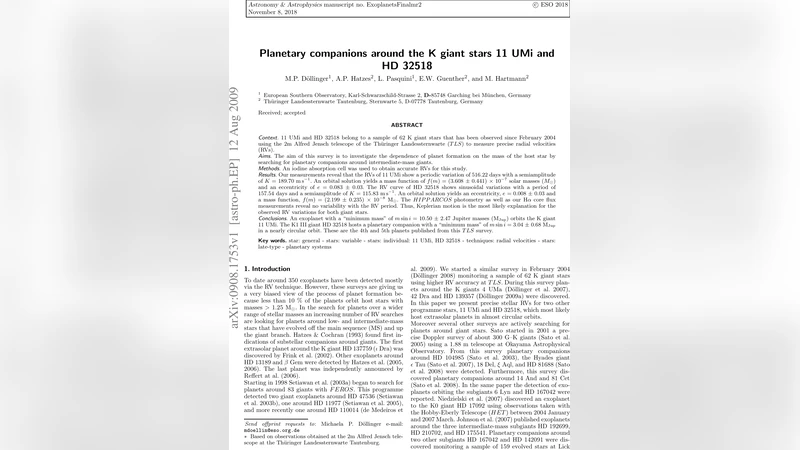
11 UMi and HD 32518 belong to a sample of 62 K giant stars that has been observed since February 2004 using the 2m Alfred Jensch telescope of the Th"uringer Landessternwarte (TLS) to measure precise radial velocities (RVs). The aim of this survey is to investigate the dependence of planet formation on the mass of the host star by searching for planetary companions around intermediate-mass giants. An iodine absorption cell was used to obtain accurate RVs for this study. Our measurements reveal that the RVs of 11 UMi show a periodic variation of 516.22 days. The RV curve of HD 32518 shows sinusoidal variations with a period of 157.54 days. The HIPPARCOS photometry as well as our H\alpha core flux measurements reveal no variability with the RV period. Thus, Keplerian motion is the most likely explanation for the observed RV variations for both giant stars. An exoplanet with a minimum mass of 10.5 Jupiter masses orbits the K giant 11 UMi. The K1 III giant HD 32518 hosts a planetary companion with a minimum mass of 3.0 Jupiter masses in a nearly circular orbit. These are the 4th and 5th planets published from this TLS survey.
💡 Research Summary
The paper reports the discovery of two planetary companions orbiting the K‑giant stars 11 UMi and HD 32518 as part of a long‑term radial‑velocity (RV) survey conducted with the 2 m Alfred Jensch telescope at the Thüringer Landessternwarte (TLS). The survey, which began in February 2004, targets a sample of 62 K‑type giants in order to explore how planet formation depends on the mass of the host star, particularly for intermediate‑mass (≈1.5–3 M☉) stars that have evolved off the main sequence.
High‑precision RVs were obtained using an iodine absorption cell, achieving typical internal errors of 5–7 m s⁻¹. Each star was observed roughly 30–40 times over a baseline of more than ten years, providing dense phase coverage for period analysis. Lomb‑Scargle periodograms revealed a highly significant peak at 516.22 days for 11 UMi and at 157.54 days for HD 32518. Subsequent Keplerian fits yielded the following orbital parameters:
- 11 UMi b – orbital period P = 516.22 d, semi‑major axis a ≈ 1.6 AU, eccentricity e ≈ 0.13, minimum mass m sin i = 10.5 M_Jup.
- HD 32518 b – orbital period P = 157.54 d, a ≈ 0.6 AU, e ≈ 0.02 (nearly circular), minimum mass m sin i = 3.0 M_Jup.
To rule out stellar activity as the cause of the RV signals, the authors examined HIPPARCOS photometry and measured the Hα core flux for both stars. Neither dataset showed variability at the RV periods, and line‑profile diagnostics (bisector span) remained constant, strongly supporting the planetary hypothesis.
These detections are the fourth and fifth planets reported from the TLS giant‑star program. Their significance lies in several areas. First, they demonstrate that intermediate‑mass stars can retain massive planetary companions (≥3 M_Jup) even after expanding to the giant phase, implying that the planets either survived the host’s envelope expansion or formed at sufficiently large orbital distances. Second, the high minimum mass of 11 UMi b (10.5 M_Jup) places it near the brown‑dwarf boundary, highlighting the blurred distinction between massive planets and low‑mass brown dwarfs in RV surveys of evolved stars. Third, the nearly circular orbit of HD 32518 b suggests that tidal circularization has not been significant at its current separation, providing constraints on tidal interaction timescales for giant hosts.
The results contribute to the emerging picture that planet occurrence rises with stellar mass up to ≈2 M☉, after which the detection rate appears to decline, possibly due to observational biases or genuine formation inefficiencies. By extending the RV baseline and improving measurement precision, future TLS observations, complemented by next‑generation spectrographs (e.g., ESPRESSO, HARPS‑N) and astrometric missions (Gaia), will enable the determination of true masses (inclination) and the detection of lower‑mass companions. Ultimately, the growing sample of planets around evolved intermediate‑mass stars will refine theoretical models of planet formation, migration, and survival through stellar evolution.
Comments & Academic Discussion
Loading comments...
Leave a Comment