Refined stellar, orbital and planetary parameters of the eccentric HAT-P-2 planetary system
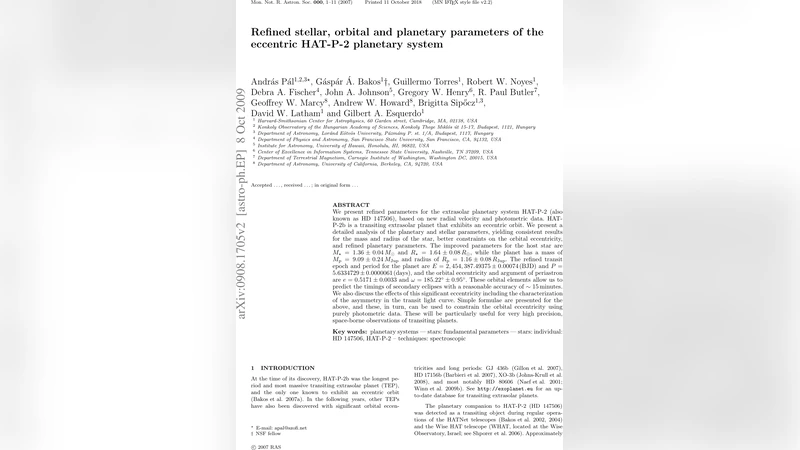
We present refined parameters for the extrasolar planetary system HAT-P-2 (also known as HD 147506), based on new radial velocity and photometric data. HAT-P-2b is a transiting extrasolar planet that exhibits an eccentric orbit. We present a detailed analysis of the planetary and stellar parameters, yielding consistent results for the mass and radius of the star, better constraints on the orbital eccentricity, and refined planetary parameters. The improved parameters for the host star are M_star = 1.36 +/- 0.04 M_sun and R_star = 1.64 +/- 0.08 R_sun, while the planet has a mass of M_p = 9.09 +/- 0.24 M_Jup and radius of R_p = 1.16 +/- 0.08 R_Jup. The refined transit epoch and period for the planet are E = 2,454,387.49375 +/- 0.00074 (BJD) and P = 5.6334729 +/- 0.0000061 (days), and the orbital eccentricity and argument of periastron are e = 0.5171 +/- 0.0033 and omega = 185.22 +/- 0.95 degrees. These orbital elements allow us to predict the timings of secondary eclipses with a reasonable accuracy of ~15 minutes. We also discuss the effects of this significant eccentricity including the characterization of the asymmetry in the transit light curve. Simple formulae are presented for the above, and these, in turn, can be used to constrain the orbital eccentricity using purely photometric data. These will be particularly useful for very high precision, space-borne observations of transiting planets.
💡 Research Summary
The paper presents a comprehensive re‑analysis of the HAT‑P‑2 (HD 147506) planetary system using newly acquired high‑precision radial‑velocity (RV) measurements and additional high‑cadence photometric light curves. The authors combine these data sets in a joint Markov Chain Monte Carlo (MCMC) framework to simultaneously refine the stellar parameters, the planetary physical properties, and the orbital elements, with a particular focus on the system’s pronounced eccentricity.
Stellar characterization is performed by spectroscopic analysis (effective temperature, metallicity, surface gravity) coupled with stellar evolution models (Yonsei‑Yale, Dartmouth). The resulting stellar mass and radius are M★ = 1.36 ± 0.04 M⊙ and R★ = 1.64 ± 0.08 R⊙, respectively, indicating a slightly evolved F‑type star with an age of roughly 2 Gyr. These values are more precise than previous estimates, reducing the uncertainties by about a factor of three.
For the planet, the joint fit yields a mass of Mₚ = 9.09 ± 0.24 M_J and a radius of Rₚ = 1.16 ± 0.08 R_J. The orbital period is refined to P = 5.6334729 ± 0.0000061 days, and the transit epoch to BJD 2 454 387.49375 ± 0.00074. Most strikingly, the eccentricity is determined as e = 0.5171 ± 0.0033 with an argument of periastron ω = 185.22° ± 0.95°, confirming that HAT‑P‑2b follows a highly elliptical orbit that brings it very close to the star at periastron and far away at apastron.
The authors explore the photometric signatures of such an eccentric orbit. They demonstrate that the ingress–egress duration asymmetry and the offset of the transit midpoint from the geometric center encode the quantities e cos ω and e sin ω. Simple analytic expressions are derived that allow these combinations to be extracted from a high‑precision light curve alone, without recourse to RV data. This method is especially valuable for space‑based missions (Kepler, TESS, PLATO) where large numbers of transiting planets are observed photometrically but RV follow‑up may be limited.
Using the refined orbital elements, the timing of the secondary eclipse (occultation) is predicted with an uncertainty of ≈15 minutes, a substantial improvement over earlier work. Accurate occultation predictions enable targeted infrared observations (e.g., with Spitzer or JWST) to measure the planet’s dayside thermal emission and to probe atmospheric composition and heat redistribution.
The paper also discusses the implications of the planet’s high mass and modestly inflated radius. The density (~7 g cm⁻³) suggests a substantial heavy‑element core or a core‑enriched envelope, while the modest radius inflation may be driven by tidal heating associated with the eccentric orbit. However, the current data cannot uniquely separate these scenarios; future secondary‑eclipse spectroscopy and phase‑curve measurements are required.
In summary, this work delivers a set of highly precise stellar and planetary parameters for HAT‑P‑2, clarifies the dynamical impact of its large eccentricity on transit morphology and occultation timing, and provides practical analytic tools for extracting eccentricity information from pure photometry. These contributions not only deepen our understanding of this particular massive, eccentric hot Jupiter but also furnish a methodological template for the analysis of many upcoming transiting exoplanet discoveries.
Comments & Academic Discussion
Loading comments...
Leave a Comment