Pulsar science with the Five hundred metre Aperture Spherical Telescope
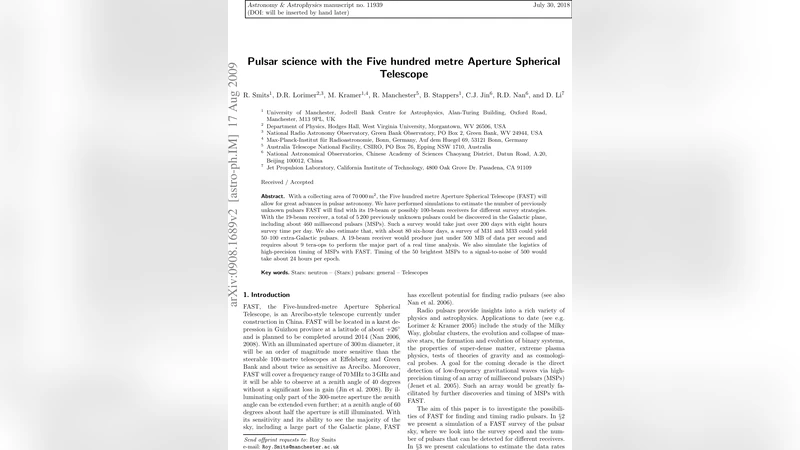
With a collecting area of 70 000 m^2, the Five hundred metre Aperture Spherical Telescope (FAST) will allow for great advances in pulsar astronomy. We have performed simulations to estimate the number of previously unknown pulsars FAST will find with its 19-beam or possibly 100-beam receivers for different survey strategies. With the 19-beam receiver, a total of 5200 previously unknown pulsars could be discovered in the Galactic plane, including about 460 millisecond pulsars (MSPs). Such a survey would take just over 200 days with eight hours survey time per day. We also estimate that, with about 80 six-hour days, a survey of M31 and M33 could yield 50–100 extra-Galactic pulsars. A 19-beam receiver would produce just under 500 MB of data per second and requires about 9 tera-ops to perform the major part of a real time analysis. We also simulate the logistics of high-precision timing of MSPs with FAST. Timing of the 50 brightest MSPs to a signal-to-noise of 500 would take about 24 hours per epoch.
💡 Research Summary
The paper presents a comprehensive simulation‑based assessment of the pulsar discovery potential of the Five‑hundred‑metre Aperture Spherical Telescope (FAST), which boasts a collecting area of 70 000 m² and a 19‑beam receiver as its baseline instrument, with a possible upgrade to a 100‑beam system. Using contemporary Galactic pulsar population models, the authors evaluate three principal survey strategies: (1) a wide‑area Galactic‑plane survey with the 19‑beam receiver, (2) an analogous survey with a hypothetical 100‑beam receiver, and (3) targeted observations of the nearby galaxies M31 and M33.
For the Galactic‑plane survey, the sky region |b| < 5° is tiled in 0.5° × 0.5° cells. Assuming eight hours of observing per day, the simulation predicts that a total of roughly 5 200 previously unknown pulsars would be discovered in about 200 days. Crucially, about 460 of these would be millisecond pulsars (MSPs), representing a substantial increase—potentially over 30 %—in the known Galactic MSP population. The authors note that such a sample would dramatically enhance pulsar timing array (PTA) projects aimed at detecting nanohertz gravitational waves.
When the 100‑beam receiver is considered, the survey efficiency scales roughly with the number of beams, leading to an estimated yield of ~20 000 new pulsars under the same observing time budget. However, the data rate escalates from ~500 MB s⁻¹ (19‑beam) to ~2.5 GB s⁻¹ (100‑beam), imposing stringent requirements on real‑time digital signal processing (DSP). The authors calculate that about 9 tera‑floating‑point‑operations per second (TFLOPS) of compute power would be needed for the bulk of the real‑time analysis, a level achievable with modern GPU clusters but demanding careful system design, including data compression, candidate filtering, and distributed storage solutions.
The extragalactic component focuses on M31 and M33. By allocating six‑hour daily scans over a total of 80 days, the simulations suggest the detection of 50–100 pulsars in these galaxies. Such extragalactic pulsars would provide rare probes of intergalactic medium dispersion, magnetic field structure, and star‑formation histories in external systems.
Beyond discovery, the paper examines the logistics of high‑precision timing of the brightest MSPs discovered by FAST. To achieve a signal‑to‑noise ratio (S/N) of 500 for the 50 brightest MSPs, the authors estimate that each timing epoch would require roughly 24 hours of telescope time. This is feasible thanks to FAST’s multi‑beam capability, allowing simultaneous observations of multiple MSPs. High‑precision timing data of this quality are essential for PTA efforts, tests of general relativity, and refined models of the Galactic gravitational potential.
In summary, the study demonstrates that FAST, even with its current 19‑beam configuration, will dramatically increase the known pulsar census, especially in the MSP regime, and that a future 100‑beam upgrade could multiply this impact. The authors provide concrete estimates of survey duration, data rates, computational load, and storage needs, offering a realistic roadmap for the telescope’s pulsar science program. Their findings underscore FAST’s potential to become a cornerstone facility for pulsar astrophysics, gravitational‑wave detection via PTAs, and extragalactic radio astronomy.
Comments & Academic Discussion
Loading comments...
Leave a Comment