Two Exoplanets Discovered at Keck Observatory
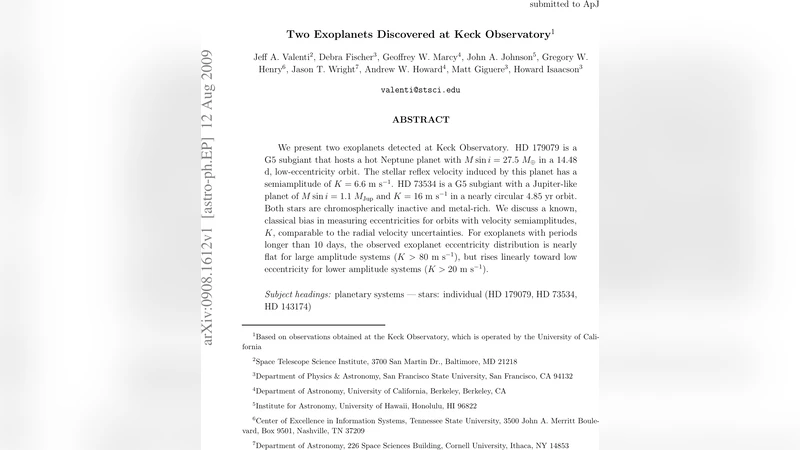
We present two exoplanets detected at Keck Observatory. HD 179079 is a G5 subgiant that hosts a hot Neptune planet with Msini = 27.5 M_earth in a 14.48 d, low-eccentricity orbit. The stellar reflex velocity induced by this planet has a semiamplitude of K = 6.6 m/s. HD 73534 is a G5 subgiant with a Jupiter-like planet of Msini = 1.1 M_jup and K = 16 m/s in a nearly circular 4.85 yr orbit. Both stars are chromospherically inactive and metal-rich. We discuss a known, classical bias in measuring eccentricities for orbits with velocity semiamplitudes, K, comparable to the radial velocity uncertainties. For exoplanets with periods longer than 10 days, the observed exoplanet eccentricity distribution is nearly flat for large amplitude systems (K > 80 m/s), but rises linearly toward low eccentricity for lower amplitude systems (K > 20 m/s).
💡 Research Summary
This paper reports the discovery of two exoplanets using high‑precision radial‑velocity (RV) measurements obtained at the Keck Observatory. The host stars, HD 179079 and HD 73534, are both G5 subgiants that exhibit low chromospheric activity and enhanced metallicities (
Comments & Academic Discussion
Loading comments...
Leave a Comment