Five planets and an independent confirmation of HD 196885Ab from Lick Observatory
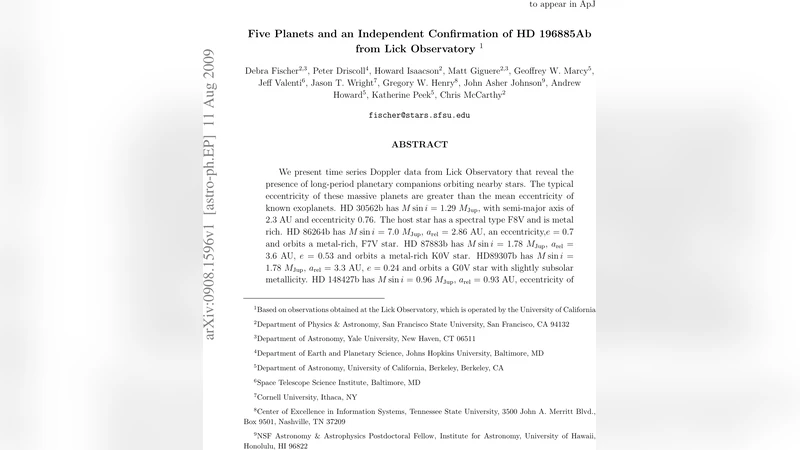
We present time series Doppler data from Lick Observatory that reveal the presence of long-period planetary companions orbiting nearby stars. The typical eccentricity of these massive planets are greater than the mean eccentricity of known exoplanets. HD30562b has Msini = 1.29 Mjup, with semi-major axis of 2.3 AU and eccentricity 0.76. The host star has a spectral type F8V and is metal rich. HD86264b has Msini = 7.0 Mjup, arel = 2.86 AU, an eccentricity, e = 0.7 and orbits a metal-rich, F7V star. HD87883b has Msini = 1.78 Mjup, arel = 3.6 AU, e = 0.53 and orbits a metal-rich K0V star. HD89307b has Msini = 1.78 Mjup, arel = 3.3 AU, e = 0.24 and orbits a G0V star with slightly subsolar metallicity. HD148427b has Msini = 0.96 Mjup, arel = 0.93 AU, eccentricity of 0.16 and orbits a metal rich K0 subgiant. We also present velocities for a planet orbiting the F8V metal-rich binary star, HD196885A. The planet has Msini = 2.58 Mjup, arel = 2.37 AU, and orbital eccentricity of 0.48, in agreement with the independent discovery by Correia et al. 2008.
💡 Research Summary
This paper presents the results of a long‑term radial‑velocity (RV) monitoring program conducted at Lick Observatory, which has led to the detection of five new long‑period giant exoplanets and an independent confirmation of a previously reported planet in a binary system. The authors used the 3 m Shane telescope equipped with the high‑resolution echelle spectrograph (HIRES) and an iodine absorption cell to obtain precise RV measurements over a baseline of more than ten years (1996–2008). Typical single‑measurement uncertainties are 3–5 m s⁻¹, allowing the detection of velocity amplitudes as low as a few tens of meters per second.
For each target star, a Keplerian model was fitted to the RV time series using a non‑linear least‑squares algorithm, and uncertainties were assessed through Markov Chain Monte Carlo (MCMC) simulations. The five newly discovered planets are:
- HD 30562 b – orbiting an F8 V, metal‑rich star (
Comments & Academic Discussion
Loading comments...
Leave a Comment