WASP-17b: an ultra-low density planet in a probable retrograde orbit
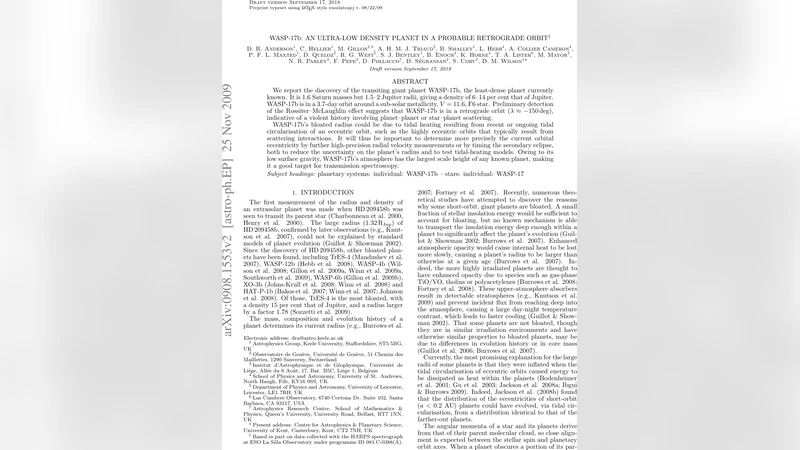
We report the discovery of the transiting giant planet WASP-17b, the least-dense planet currently known. It is 1.6 Saturn masses but 1.5-2 Jupiter radii, giving a density of 6-14 per cent that of Jupiter. WASP-17b is in a 3.7-day orbit around a sub-solar metallicity, V = 11.6, F6 star. Preliminary detection of the Rossiter-McLaughlin effect suggests that WASP-17b is in a retrograde orbit (lambda ~ -150 deg), indicative of a violent history involving planet-planet or star-planet scattering. WASP-17b’s bloated radius could be due to tidal heating resulting from recent or ongoing tidal circularisation of an eccentric orbit, such as the highly eccentric orbits that typically result from scattering interactions. It will thus be important to determine more precisely the current orbital eccentricity by further high-precision radial velocity measurements or by timing the secondary eclipse, both to reduce the uncertainty on the planet’s radius and to test tidal-heating models. Owing to its low surface gravity, WASP-17b’s atmosphere has the largest scale height of any known planet, making it a good target for transmission spectroscopy.
💡 Research Summary
The paper reports the discovery and characterization of WASP‑17b, a transiting gas giant that currently holds the record for the lowest bulk density among known exoplanets. The host star is a bright (V = 11.6 mag), slightly metal‑poor (
Comments & Academic Discussion
Loading comments...
Leave a Comment