Migration of Extrasolar Planets: Effects from X-Wind Accretion Disks
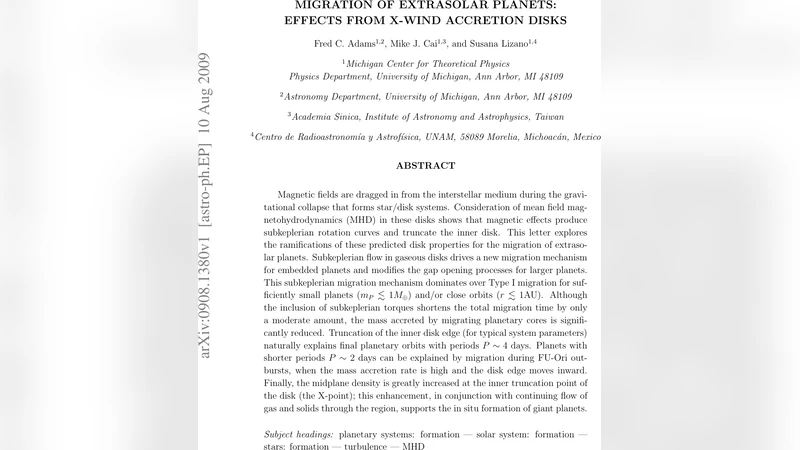
Magnetic fields are dragged in from the interstellar medium during the gravitational collapse that forms star/disk systems. Consideration of mean field magnetohydrodynamics (MHD) in these disks shows that magnetic effects produce subkeplerian rotation curves and truncate the inner disk. This letter explores the ramifications of these predicted disk properties for the migration of extrasolar planets. Subkeplerian flow in gaseous disks drives a new migration mechanism for embedded planets and modifies the gap opening processes for larger planets. This subkeplerian migration mechanism dominates over Type I migration for sufficiently small planets (m_P < 1 M_\earth) and/or close orbits (r < 1 AU). Although the inclusion of subkeplerian torques shortens the total migration time by only a moderate amount, the mass accreted by migrating planetary cores is significantly reduced. Truncation of the inner disk edge (for typical system parameters) naturally explains final planetary orbits with periods P=4 days. Planets with shorter periods P=2 days can be explained by migration during FU-Ori outbursts, when the mass accretion rate is high and the disk edge moves inward. Finally, the midplane density is greatly increased at the inner truncation point of the disk (the X-point); this enhancement, in conjunction with continuing flow of gas and solids through the region, supports the in situ formation of giant planets.
💡 Research Summary
The paper investigates how magnetic fields inherited from the interstellar medium during the gravitational collapse that creates a star–disk system affect the structure of the protoplanetary disk and, consequently, the migration of embedded planets. By applying mean‑field magnetohydrodynamics (MHD) to the disk, the authors demonstrate two fundamental departures from the classical Keplerian, continuous‑disk picture. First, magnetic pressure and tension forces cause the gas to rotate at sub‑Keplerian speeds; the azimuthal velocity is systematically lower than the Keplerian value at a given radius. Second, the magnetic field truncates the inner disk at a radius often called the X‑point, where the field pressure balances the stellar gravity and the gas density drops sharply.
These two disk properties generate new dynamical torques on planets. For low‑mass planets (≲1 M⊕) or planets on tight orbits (r ≲ 1 AU), the sub‑Keplerian flow exerts a head‑wind on the planet that produces a torque distinct from the usual Type I torque generated by density waves. The analysis shows that, under typical disk parameters, the sub‑Keplerian torque dominates over the Type I torque for the smallest planets and for those very close to the star, accelerating their inward drift. Although the total migration time is only modestly reduced (by a few tens of percent), the most important consequence is that a migrating core accretes far less gas and solid material than it would under pure Type I migration. This reduction in accretion can hinder the core’s ability to reach the critical mass needed for runaway gas accretion, thereby influencing the final planetary mass distribution.
For massive planets capable of opening gaps, the sub‑Keplerian environment also modifies the gap‑opening criterion. In a standard viscous disk, a gap forms when the planetary torque exceeds the viscous torque that tries to close the gap. Because the sub‑Keplerian flow reduces the shear and thus the effective viscosity near the planet, the viscous torque is weakened, making gap formation easier than predicted by conventional theory. This effect helps explain why many hot Jupiters appear to halt at orbital periods around four days (≈0.05 AU), where the truncated inner edge of the disk would naturally stop further inward migration.
The inner truncation point (the X‑point) is a region of dramatically enhanced mid‑plane density. Magnetic stresses concentrate material there, creating a reservoir of gas and solids that continuously flows inward. The high density, combined with ongoing supply, makes the X‑point an attractive site for in‑situ formation of giant planets. Moreover, during FU‑Ori outbursts—episodes of dramatically increased mass accretion rates (∼10⁻⁴ M⊙ yr⁻¹)—the truncation radius moves inward. Planets that form or migrate during such outbursts can end up on ultra‑short‑period orbits (P ≈ 2 days), providing a natural explanation for the observed population of “ultra‑hot Jupiters.”
In summary, the authors integrate magnetic field physics into the standard planet‑migration framework and reveal three key implications: (1) a new sub‑Keplerian migration regime that dominates for very low‑mass, close‑in planets; (2) an altered gap‑opening condition that facilitates gap formation for massive planets near the inner disk edge; and (3) a high‑density, magnetically truncated inner disk that both halts migration at ∼4‑day periods and offers a fertile environment for the in‑situ birth of giant planets, especially during high‑accretion FU‑Ori phases. These results reconcile several puzzling observational trends—such as the pile‑up of hot Jupiters at ∼4 days and the existence of planets on periods shorter than 2 days—while also predicting reduced core growth during migration, a factor that could shape the overall planetary mass function. Future high‑resolution MHD simulations and targeted observations of inner‑disk magnetic structures will be essential to test and refine these ideas.
Comments & Academic Discussion
Loading comments...
Leave a Comment