The nature of pulsar radio emission
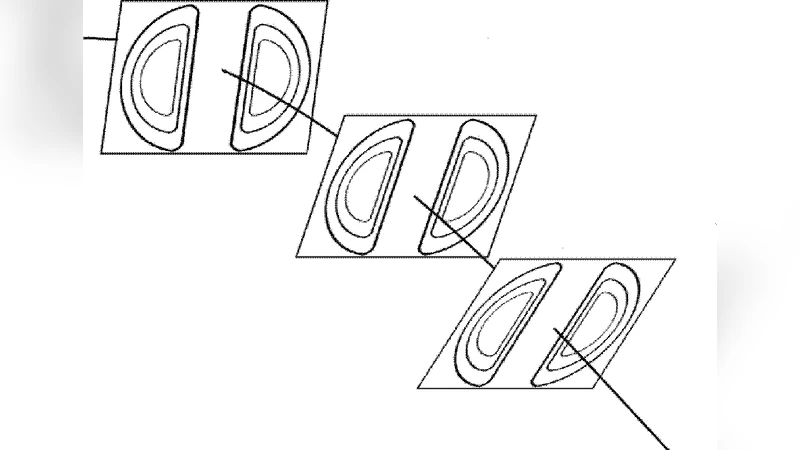
High-quality averaged radio profiles of some pulsars exhibit double, highly symmetric features both in emission and absorption. It is shown that both types of features are produced by a split-fan beam of extraordinary-mode curvature radiation (CR) that is emitted/absorbed by radially-extended streams of magnetospheric plasma. With no emissivity in the plane of the stream, such a beam produces bifurcated emission components (BFCs) when our line of sight passes through the plane. A distinct example of double component created in that way is present in averaged profile of the 5 ms pulsar J1012+5307. We show that the component can indeed be very well fitted by the textbook formula for the non-coherent beam of curvature radiation in the polarisation state that is orthogonal to the plane of electron trajectory. The observed width of the BFC decreases with increasing frequency at the rate that confirms the curvature origin. Likewise, the double absorption features (double notches) are produced by the same beam of the extraordinary-mode CR, when it is eclipsed by thin plasma streams. The intrinsic property of CR to create bifurcated fan beams explains the double features in terms of very natural geometry and implies the curvature origin of pulsar radio emission. (abbreviated)
💡 Research Summary
The paper tackles a long‑standing puzzle in pulsar radio astronomy: the appearance of highly symmetric double features—both emission peaks (bifurcated components) and absorption notches—in high‑quality averaged pulse profiles. The authors propose that both phenomena arise from a single physical mechanism: the extraordinary‑mode curvature radiation (CR) emitted by radially extended streams of magnetospheric plasma. In the extraordinary mode the electric field vector is orthogonal to the plane of the electron trajectory, and the resulting radiation pattern is not a simple cone but a “split‑fan” beam with two symmetric intensity lobes on either side of the trajectory plane.
When the observer’s line of sight cuts through the plane of a plasma stream, the split‑fan beam is sampled twice, producing a bifurcated emission component (BFC). Conversely, if a thin plasma filament eclipses part of the same beam, the observer sees two narrow absorption dips—double notches—at the phases where the beam is blocked. The key geometric element is that the streams are radially extended, so the same beam can be both emitted and partially occulted along the line of sight.
To test the idea, the authors focus on the 5 ms millisecond pulsar J1012+5307, whose average profile contains a clean, isolated BFC. They fit this component with the textbook formula for non‑coherent curvature radiation in the polarization state orthogonal to the electron trajectory. The fit reproduces the observed shape with high precision, and the measured width of the BFC shrinks with increasing frequency following the expected (\Delta\theta \propto \nu^{-1/3}) scaling of curvature radiation. This frequency dependence provides a direct, quantitative confirmation that the emission originates from curvature radiation rather than from ad‑hoc beam shaping or propagation effects.
The same split‑fan beam, when intercepted by a thin plasma stream, naturally generates double notches. The depth and separation of the notches depend on the stream’s thickness and plasma density, but no additional exotic absorption mechanisms are required. The authors argue that this unified picture eliminates the need for separate explanations—such as separate “absorption clouds” or reflective surfaces—that have been invoked in earlier work.
Overall, the study delivers several important insights: (1) The fundamental radio emission mechanism in pulsars is curvature radiation in the extraordinary mode, whose intrinsic beam geometry is a split‑fan rather than a simple cone. (2) Radially extended plasma streams act as both emitters and occulting structures, producing the observed double emission and absorption features through straightforward geometry. (3) The observed frequency evolution of BFC widths matches the theoretical curvature‑radiation scaling, providing strong empirical support for the model. (4) The model’s simplicity—requiring only the known physics of relativistic electrons in curved magnetic fields and realistic plasma streams—makes it broadly applicable to a wide range of pulsars, not just the specific case studied.
By demonstrating that a single, physically motivated beam pattern can account for both bifurcated emission components and double notches, the paper establishes a new paradigm for interpreting pulsar radio profiles. This paradigm promises to guide future high‑frequency observations, detailed magnetospheric simulations, and the development of more accurate emission models that incorporate the extraordinary‑mode curvature radiation and the geometry of plasma streams.
Comments & Academic Discussion
Loading comments...
Leave a Comment