The Bimodality of Accretion In T Tauri Stars and Brown Dwarfs
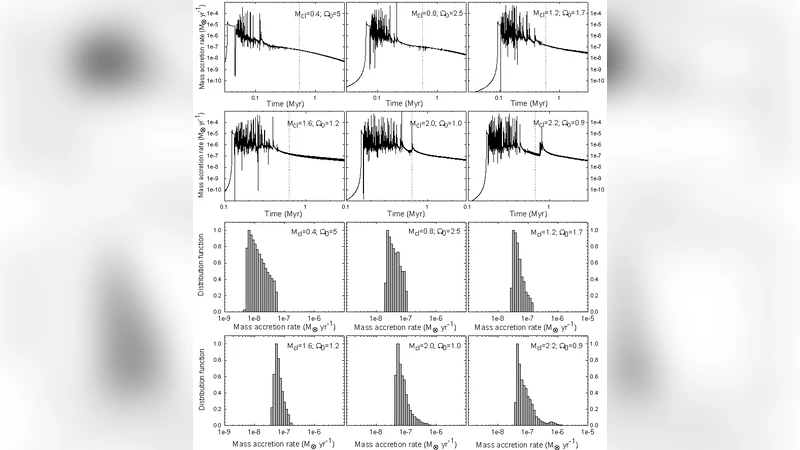
We present numerical solutions of the collapse of prestellar cores that lead to the formation and evolution of circumstellar disks. The disk evolution is then followed for up to three million years. A variety of models of different initial masses and rotation rates allows us to study disk accretion around brown dwarfs and low-mass T Tauri stars, with central object mass $M_st < 0.2 Msun$, as well as intermediate and upper-mass T Tauri stars (0.2 Msun < M_st < 3.0 Msun). Our models include self-gravity and allow for nonaxisymmetric motions. In addition to the self-consistently generated gravitational torques, we introduce an effective turbulent \alpha-viscosity with \alpha = 0.01, which allows us particularly to model accretion in the low-mass regime where disk self-gravity is diminishing. A range of models with observationally-motivated values of the initial ratio of rotational to gravitational energy yields a correlation between mass accretion rate \dot{M} and M_st that is relatively steep, as observed. Additionally, our modeling reveals evidence for a bimodality in the \dot{M}–M_st correlation, with a steeper slope at lower masses and a shallower slope at intermediate and upper masses, as also implied by observations. We show that the neglect of disk self-gravity leads to a much steeper \dot{M}–M_st relation for intermediate and upper-mass T Tauri stars. This demonstrates that an accurate treatment of global self-gravity is essential to understanding observations of circumstellar disks.
💡 Research Summary
The authors present a comprehensive numerical study of the collapse of prestellar cores and the subsequent evolution of the circum‑stellar disks that form around the resulting protostars. A suite of models spanning initial core masses from 0.02 M☉ to 3 M☉ and a range of rotational‑to‑gravitational energy ratios (β = 0.001–0.05) is used to explore the entire spectrum from brown dwarfs (BDs) to low‑mass, intermediate‑mass, and high‑mass T Tauri stars. The simulations are carried out in two dimensions with full self‑gravity, allowing non‑axisymmetric structures such as spiral arms and clumps to develop naturally. In addition to the gravitational torques generated by these structures, an effective turbulent viscosity is introduced using the standard α‑prescription with α = 0.01. This viscous term is essential for reproducing realistic accretion rates in the low‑mass regime where the disk’s self‑gravity becomes weak.
Each model is evolved for up to three million years, during which the authors track the stellar mass (M★), the disk mass, and the mass accretion rate (Ṁ). The results reveal a clear correlation between Ṁ and M★, but with two distinct slopes. For objects with M★ < 0.2 M☉ (the brown‑dwarf and very low‑mass T Tauri regime) the relationship follows roughly Ṁ ∝ M★², indicating a steep dependence. In contrast, for 0.2 M☉ < M★ < 3 M☉ the slope flattens to Ṁ ∝ M★¹·². This “bimodality” matches recent observational compilations that show a steeper Ṁ–M★ trend at low masses and a shallower trend at higher masses.
The authors attribute the two regimes to the relative importance of two transport mechanisms. In the low‑mass regime the disk mass is small, self‑gravity is negligible, and turbulent viscosity dominates the angular‑momentum transport, producing the steep Ṁ–M★ scaling. In the higher‑mass regime the disk remains massive enough for global self‑gravity to generate strong non‑axisymmetric torques, which supplement the viscous transport and moderate the increase of Ṁ with stellar mass. To test this interpretation, a set of control simulations was performed in which self‑gravity was switched off while retaining the same α‑viscosity. In those runs the high‑mass branch steepened dramatically (Ṁ ∝ M★²·⁵), demonstrating that neglecting self‑gravity leads to an unrealistically strong mass‑dependence and confirming the essential role of gravitational torques.
The study also explores how the initial rotation parameter β influences the results. Larger β values produce more massive, more extended disks that sustain spiral structure for longer periods, thereby enhancing the gravitational torque and raising Ṁ in the high‑mass regime by up to ~30 %. Conversely, low β yields thinner disks with weaker torques and lower accretion rates. This sensitivity suggests that variations in core rotation among star‑forming regions can contribute to the observed scatter in the Ṁ–M★ relation.
In summary, the paper provides a physically self‑consistent framework that simultaneously incorporates disk self‑gravity and turbulent viscosity. It shows that the observed bimodal Ṁ–M★ correlation naturally emerges from the transition between viscosity‑dominated transport at low masses and gravity‑dominated transport at higher masses. The findings underscore that any realistic model of circum‑stellar disk evolution and protostellar accretion must treat global self‑gravity accurately, especially for intermediate‑ and high‑mass T Tauri stars. This work bridges the gap between numerical simulations and observations of accretion across the full stellar‑mass spectrum, offering valuable constraints for future theoretical and observational studies of star and planet formation.
Comments & Academic Discussion
Loading comments...
Leave a Comment