Geometric and projection effects in Kramers-Moyal analysis
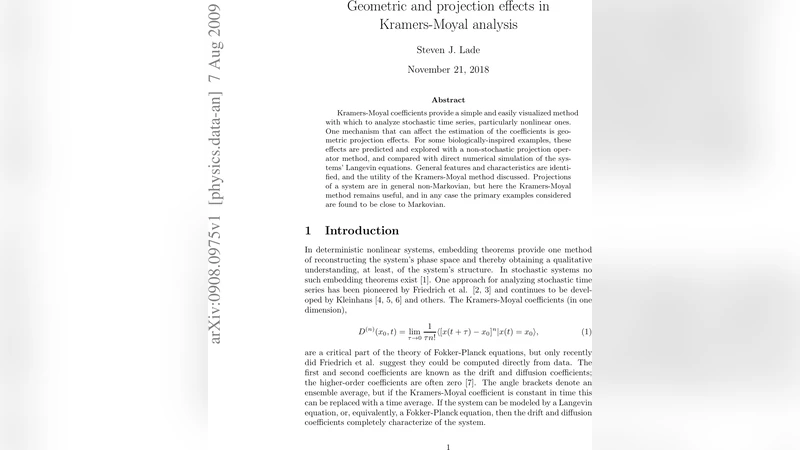
Kramers-Moyal coefficients provide a simple and easily visualized method with which to analyze stochastic time series, particularly nonlinear ones. One mechanism that can affect the estimation of the coefficients is geometric projection effects. For some biologically-inspired examples, these effects are predicted and explored with a non-stochastic projection operator method, and compared with direct numerical simulation of the systems’ Langevin equations. General features and characteristics are identified, and the utility of the Kramers-Moyal method discussed. Projections of a system are in general non-Markovian, but here the Kramers-Moyal method remains useful, and in any case the primary examples considered are found to be close to Markovian.
💡 Research Summary
The paper investigates how geometric projection influences the estimation of Kramers‑Moyal (K‑M) coefficients, which are widely used to characterize stochastic time series through drift (first‑order) and diffusion (second‑order) terms. In many experimental situations only a subset of the full state vector is observable, effectively projecting a high‑dimensional Markov process onto a lower‑dimensional space. Such projections generally introduce non‑Markovian memory, potentially compromising the assumptions underlying the K‑M expansion. To address this, the authors employ a deterministic projection‑operator formalism. By decomposing the full state x into observed variables y and hidden variables z, and applying a conditional averaging operator P, they derive effective drift D^{(1)}(y) and diffusion D^{(2)}(y) functions that incorporate the geometry of the original system.
Two biologically motivated examples illustrate the theory. The first model describes a particle diffusing on a spherical surface. When the polar angle θ is taken as the observable, the projection transforms a linear drift into a sinusoidal form (∝ sin θ cos θ) and yields a diffusion coefficient that varies with sin θ, reflecting the curvature‑induced inhomogeneity. The second model involves a particle moving in a double‑well potential with an additional rotational degree of freedom. Projecting onto the rotational coordinate produces an asymmetric effective potential, again captured by the derived drift and diffusion functions.
For both cases the authors perform direct numerical integration of the underlying Langevin equations to generate synthetic time series. They then estimate K‑M coefficients from the projected data and compare them with the analytical predictions obtained via the projection operator. The agreement is excellent: the shapes of drift and diffusion curves match, and higher‑order K‑M coefficients are negligible, indicating that the projected dynamics remain effectively Markovian.
The paper further discusses criteria for when a projected process can still be treated as Markovian. If the first two K‑M coefficients are time‑independent and higher‑order coefficients are essentially zero, memory effects are weak and the standard K‑M analysis remains valid. The authors argue that many real‑world biological measurements—such as protein orientation angles or intracellular particle trajectories—satisfy these conditions, making the K‑M framework robust even after projection.
In conclusion, the study demonstrates that geometric projection does not necessarily invalidate Kramers‑Moyal analysis. By using a deterministic projection‑operator approach, one can predict and correct for projection‑induced distortions, preserving the utility of drift and diffusion estimates. The work also highlights the importance of testing for residual non‑Markovian behavior (e.g., via Chapman‑Kolmogorov checks) when applying K‑M methods to experimentally projected data, thereby providing a practical roadmap for researchers dealing with high‑dimensional stochastic systems.
Comments & Academic Discussion
Loading comments...
Leave a Comment