Measurements of the Cosmological Evolution of Magnetic Fields with the Square Kilometre Array
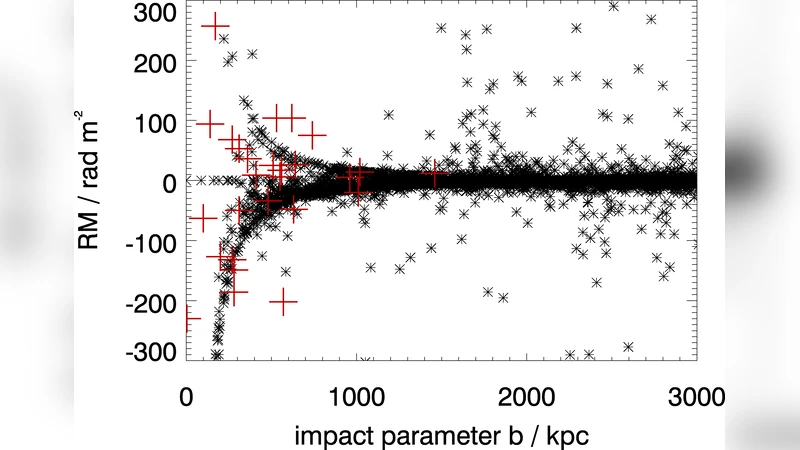
We investigate the potential of the Square Kilometre Array (SKA) for measuring the magnetic fields in clusters of galaxies via Faraday rotation of background polarised sources. […] We find that about 10 per cent of the sky is covered by a significant extragalactic Faraday screen. Most of it has rotation measures between 10 and 100 rad/m/m. We argue that the cluster centres should have up to about 5000 rad/m/m. We show that the proposed mid frequency aperture array of the SKA as well as the lowest band of the SKA dish array are well suited to make measurements for most of these rotation measure values, typically requiring a signal-to-noise of ten. We calculate the spacing of sources forming a grid for the purpose of measuring foreground rotation measures: it reaches a spacing of 36 arcsec for a 100 hour SKA observation per field. We also calculate the statistics for background RM measurements in clusters of galaxies. We find that a first phase of the SKA would allow us to take stacking experiments out to high redshifts (>1), and provide improved magnetic field structure measurements for individual nearby clusters. The full SKA aperture array would be able to make very detailed magnetic field structure measurements of clusters with more than 100 background sources per cluster up to a redshift of 0.5 and more than 1000 background sources per cluster for nearby clusters, and could for reasonable assumptions about future measurements of electron densities in high redshift clusters constrain the power law index for the magnetic field evolution to better than dm=0.4, if the magnetic field in clusters should follow B ~ (1+z)^m.
💡 Research Summary
The paper evaluates the capability of the Square Kilometre Array (SKA) to measure magnetic fields in galaxy clusters through Faraday rotation of background polarized radio sources. Using simulations based on current knowledge of intracluster electron densities and magnetic field strengths, the authors estimate that roughly 10 % of the sky is covered by an extragalactic Faraday screen with rotation measures (RMs) typically between 10 and 100 rad m⁻², while cluster cores can reach up to ~5000 rad m⁻². Two SKA observing modes are considered: the mid‑frequency aperture array (MFAA) and the low‑frequency dish array (LFA). Both provide sufficient sensitivity across the 1–10 GHz band to detect RMs from 10 to 5000 rad m⁻² with a signal‑to‑noise ratio of ten or better.
A key result is the predicted source density achievable with a 100‑hour integration per field. The simulations indicate an average of about one polarized background source per square arcminute, corresponding to a grid spacing of 36 arcseconds. Within a typical cluster radius (≈1 Mpc) this yields 30–50 background sources, enough to sample the spatial RM variation across the cluster. Such a density enables stacking analyses that can extend to high redshift (z > 1) even with the Phase‑1 SKA, providing statistical constraints on the average cluster RM evolution.
With the full SKA aperture array, the dramatically improved sensitivity allows the detection of >100 background sources per cluster out to z ≈ 0.5 and >1000 sources for nearby clusters (z < 0.1). This dense sampling permits three‑dimensional reconstruction of the RM distribution, and when combined with independent electron‑density measurements (e.g., X‑ray or Sunyaev‑Zel’dovich observations) it enables precise determination of the magnetic‑field radial profile B(r) ∝ n_e(r)^η. Moreover, assuming future electron‑density estimates for high‑z clusters, the authors show that the power‑law index m in the evolutionary model B ∝ (1+z)^m can be constrained to within Δm ≈ 0.4. This represents a significant tightening of current uncertainties (m ≈ 0.5–1.0) and provides a critical test of theoretical models for magnetic‑field amplification and cosmological magnetogenesis.
The paper also outlines a practical observing strategy: an initial wide‑area, low‑resolution RM survey to map the foreground Faraday screen, followed by targeted high‑resolution observations of selected clusters. Stacking of many clusters yields average RM trends at high redshift, while individual clusters with sufficient background source density allow detailed magnetic‑field morphology studies. The authors stress that the combination of SKA’s unprecedented sensitivity, angular resolution, and frequency coverage makes it uniquely suited to transform our understanding of intracluster magnetic fields, their scaling with electron density, and their cosmological evolution.
Comments & Academic Discussion
Loading comments...
Leave a Comment