Planet formation in highly inclined binaries
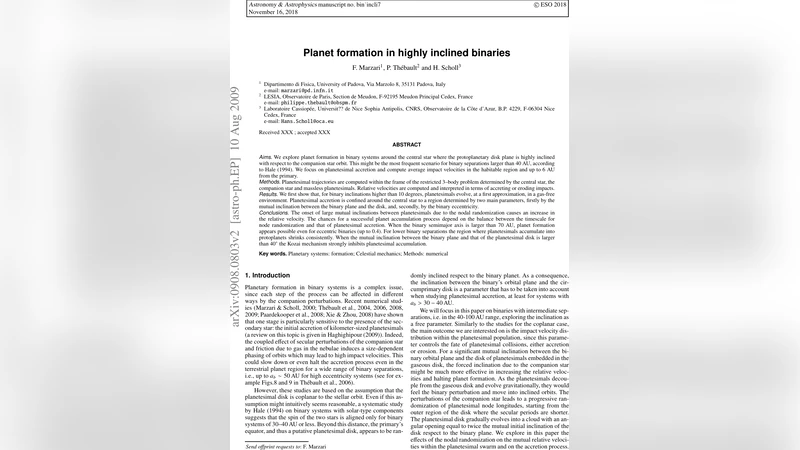
We explore planet formation in binary systems around the central star where the protoplanetary disk plane is highly inclined with respect to the companion star orbit. This might be the most frequent scenario for binary separations larger than 40 AU, according to Hale (1994). We focus on planetesimal accretion and compute average impact velocities in the habitable region and up to 6 AU from the primary.
💡 Research Summary
The paper investigates how planet formation proceeds in binary star systems where the protoplanetary disk around the primary star is highly inclined relative to the orbital plane of the companion star. Drawing on Hale (1994), the authors argue that for binary separations larger than about 40 AU the disk–binary plane misalignment is likely to be random, making large inclinations (30°–150°) a common configuration. Their focus is on the early stage of planetesimal accretion, specifically on whether collisions among kilometre‑scale bodies remain gentle enough to be accretional rather than disruptive.
To address this, the authors perform a suite of three‑dimensional N‑body simulations that include the gravitational perturbations of a secondary star (mass 0.2–0.5 M☉) on circular orbits at 40, 60, 80, and 100 AU, as well as a realistic gas drag model based on a Minimum‑Mass Solar Nebula (MMSN) density profile. Planetesimals of 1–10 km radius are initially placed on near‑circular, coplanar orbits with the primary’s disk, and the simulations track their orbital evolution and mutual impact velocities (Δv) over several hundred thousand years. The authors also analytically examine the Kozai‑Lidov mechanism, which can drive large oscillations in eccentricity and inclination for highly inclined systems, and they compare its characteristic timescale with the damping timescale set by gas drag.
The results reveal three distinct radial regimes. In the habitable zone (0.8–1.5 AU), gas densities remain high enough that aerodynamic drag efficiently damps eccentricities excited by the companion. Consequently, average Δv stays below ~10 m s⁻¹, well under the canonical fragmentation threshold (~30 m s⁻¹). This suggests that planetesimals can continue to grow by accretion even when the disk is tilted by up to ~70°. Between 1.5 and 2 AU, gas drag weakens; Δv rises to 30–50 m s⁻¹. Accretion is still possible for moderate inclinations (≤60°), but as the inclination approaches 90° the Kozai‑Lidov cycles pump eccentricities to e≈0.2–0.4, pushing Δv into the disruptive regime. Beyond 2 AU out to 6 AU, the gas is too tenuous to provide significant damping. Here the Kozai‑Lidov effect dominates, producing eccentricities that drive Δv above 100 m s⁻¹. Such high speeds lead to catastrophic fragmentation, effectively halting planetesimal growth in the outer disk.
The dependence on binary parameters is also clarified. For a companion at 40 AU, the Kozai period is of order 2×10⁵ yr, comparable to or shorter than the gas‑damping timescale, so the perturbation overwhelms drag and Δv spikes. At larger separations (≥80 AU) the Kozai period lengthens to >10⁶ yr, giving gas drag a longer window to suppress eccentricity growth, thereby preserving low‑Δv conditions in the inner disk. Reducing the companion’s mass below ~0.2 M☉ similarly weakens the Kozai amplitude, further favoring accretion.
Overall, the study concludes that highly inclined binaries do not preclude planet formation in the inner regions of the primary’s disk, provided the binary is sufficiently wide or low‑mass so that gas drag can counteract Kozai‑induced excitation. In contrast, the outer disk (beyond ~2 AU) is likely hostile to planetesimal growth under the same conditions. These findings have direct implications for interpreting the observed distribution of exoplanets in binary systems: the presence or absence of planets may be linked to the binary’s separation, mass ratio, and mutual inclination, rather than merely to the existence of a companion. The paper thus adds a nuanced layer to our understanding of planet formation in dynamically complex stellar environments.
Comments & Academic Discussion
Loading comments...
Leave a Comment