The Pulsar Planets: A Test Case of Terrestrial Planet Assembly
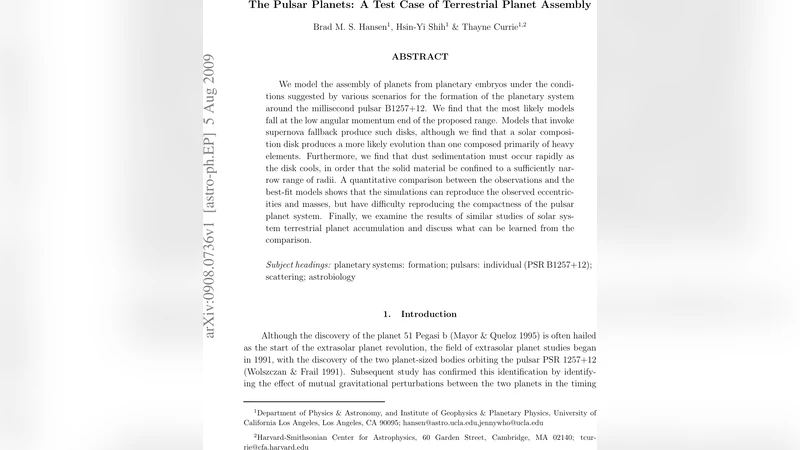
We model the assembly of planets from planetary embryos under the conditions suggested by various scenarios for the formation of the planetary system around the millisecond pulsar B1257+12. We find that the most likely models fall at the low angular momentum end of the proposed range. Models that invoke supernova fallback produce such disks, although we find that a solar composition disk produces a more likely evolution than one composed primarily of heavy elements. Furthermore, we find that dust sedimentation must occur rapidly as the disk cools, in order that the solid material be confined to a sufficiently narrow range of radii. A quantitative comparison between the observations and the best-fit models shows that the simulations can reproduce the observed eccentricities and masses, but have difficulty reproducing the compactness of the pulsar planet system. Finally, we examine the results of similar studies of solar system terrestrial planet accumulation and discuss what can be learned from the comparison.
💡 Research Summary
The paper investigates the origin of the three known terrestrial‑mass planets orbiting the millisecond pulsar PSR B1257+12 by modeling the assembly of planetary embryos within a circum‑pulsar disk. The authors begin by reviewing proposed disk‑formation scenarios, including supernova fallback, re‑accretion of material after the pulsar’s birth, and the influence of the pulsar’s intense radiation and magnetic wind. These scenarios constrain the total angular momentum of the disk to a range of roughly 10⁴⁹–10⁵¹ g cm² s⁻¹ and suggest two extreme compositional possibilities: a solar‑like mixture dominated by hydrogen and helium, and a heavy‑element‑rich mixture dominated by metals and silicates.
Using a hybrid N‑body/continuum code, the study initializes a swarm of planetary embryos (0.01–0.1 M⊕) and planetesimals (∼10⁻⁴ M⊕) distributed between 0.1 and 1 AU. The disk’s temperature and surface‑density profiles evolve as the gas cools, allowing dust to condense. A critical parameter is the dust‑sedimentation timescale; the authors demonstrate that sedimentation must proceed at least an order of magnitude faster than the overall cooling time for solid material to become confined to a narrow annulus (≈0.2–0.5 AU). This confinement is essential to reproduce the observed compact architecture of the pulsar planets.
Four families of models are explored: low‑angular‑momentum versus high‑angular‑momentum disks, each combined with either a solar‑type or a heavy‑element‑rich composition. The simulations show that low‑angular‑momentum, solar‑type disks most successfully generate planets with masses of 3–5 M⊕, orbital eccentricities of 0.02–0.1, and semi‑major axes clustered between 0.2 and 0.4 AU—values that closely match the observed properties of the B1257+12 system. High‑angular‑momentum disks tend to spread the embryos over a wider radial range, producing planets that are too distant and too massive. Heavy‑element‑rich disks can accelerate growth because of the higher solid fraction, but they suffer from rapid gas loss; the disk collapses before embryos can fully accrete, leading to incomplete planetary systems.
Despite these successes, the models struggle to reproduce the extreme compactness of the observed system. The three planets are spaced by only ~0.08 AU, whereas the best‑fit simulations typically yield a minimum spacing of ~0.12 AU. The authors suggest that additional processes—such as strong pulsar wind stripping of outer disk material, magnetic torques that truncate the disk, or an initially steeper surface‑density profile—may be required to concentrate mass more tightly.
The paper concludes by comparing these results with analogous terrestrial‑planet formation studies for the Solar System. Although the pulsar environment is dramatically different (high‑energy radiation, intense magnetic fields, and potentially metal‑rich fallback material), the fundamental dynamics of embryo collisions and accretion appear robust. This similarity supports the idea that terrestrial planet formation is a universal process, capable of operating under a wide variety of astrophysical conditions. The authors recommend future work that incorporates detailed magnetohydrodynamic effects and seeks observational constraints on pulsar‑disk properties to refine the models further.
Comments & Academic Discussion
Loading comments...
Leave a Comment