Broad-Band Soft X-ray Polarimetry
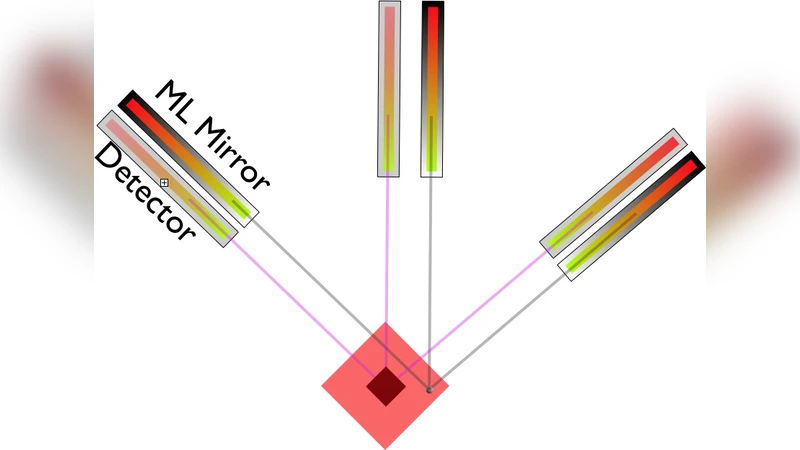
We developed an instrument design capable of measuring linear X-ray polarization over a broad-band using conventional spectroscopic optics. A set of multilayer-coated flats reflects the dispersed X-rays to the instrument detectors. The intensity variation with position angle is measured to determine three Stokes parameters: I, Q, and U – all as a function of energy. By laterally grading the multilayer optics and matching the dispersion of the gratings, one may take advantage of high multilayer reflectivities and achieve modulation factors > 50% over the entire 0.2 to 0.8 keV band. This instrument could be used in a small orbiting mission or scaled up for the International X-ray Observatory. Laboratory work has begun that would demonstrate the capabilities of key components.
💡 Research Summary
The paper presents a novel instrument concept for broadband soft‑X‑ray polarimetry that leverages conventional spectroscopic optics to measure linear polarization across the entire 0.2–0.8 keV band. The core of the design is a combination of a diffraction grating and a set of laterally graded multilayer‑coated flat mirrors. The grating disperses incoming X‑rays spatially according to photon energy, while the multilayer mirrors are engineered so that each point along their surface reflects a narrow energy slice at a near‑Brewster angle. By grading the multilayer period laterally, the Bragg condition is satisfied for the full energy range, yielding reflectivities above 70 % and modulation factors (M) exceeding 50 % throughout the band.
Polarization is extracted without any mechanical rotation. The reflected beam is recorded by an array of low‑energy X‑ray detectors (e.g., back‑illuminated CCDs or CMOS sensors) positioned to sample the intensity as a function of azimuthal angle θ. The measured intensity follows I(θ)=I₀
Comments & Academic Discussion
Loading comments...
Leave a Comment