Density Profiles in Seyfert Outflows
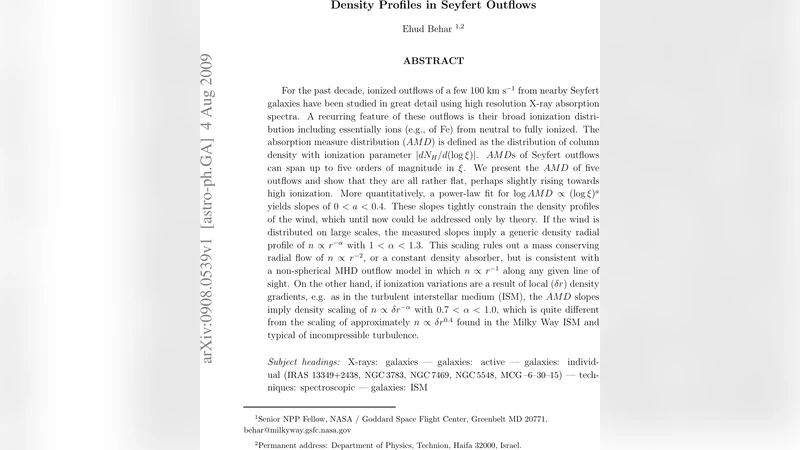
For the past decade, ionized outflows of a few 100 km/s from nearby Seyfert galaxies have been studied in great detail using high resolution X-ray absorption spectra. A recurring feature of these outflows is their broad ionization distribution including essentially ions (e.g., of Fe) from neutral to fully ionized. The absorption measure distribution (AMD) is defined as the distribution of column density with ionization parameter |d N_H/d (log xi)|. AMDs of Seyfert outflows can span up to five orders of magnitude in xi. We present the AMD of five outflows and show that they are all rather flat, perhaps slightly rising towards high ionization. More quantitatively, a power-law fit for log AMD ~ (log xi)^a yields slopes of 0 < a < 0.4. These slopes tightly constrain the density profiles of the wind, which until now could be addressed only by theory. If the wind is distributed on large scales, the measured slopes imply a generic density radial profile of n ~ r^{-alpha} with 1 < alpha < 1.3. This scaling rules out a mass conserving radial flow of n ~ r^{-2}, or a constant density absorber, but is consistent with a non-spherical MHD outflow model in which n ~ r^{-1} along any given line of sight. On the other hand, if ionization variations are a result of local (delta r) density gradients, e.g. as in the turbulent interstellar medium (ISM), the AMD slopes imply density scaling of n ~ delta r^{-alpha} with 0.7 < alpha < 1.0, which is quite different from the scaling of approximately n ~ delta r^{0.4} found in the Milky Way ISM and typical of incompressible turbulence.
💡 Research Summary
This paper presents a quantitative investigation of the density structure of ionized outflows in nearby Seyfert galaxies using high‑resolution X‑ray absorption spectroscopy. The authors introduce the Absorption Measure Distribution (AMD), defined as the differential column density with respect to the logarithm of the ionization parameter (|d N_H/d log ξ|), where ξ = L/(n r²) characterizes the ionization state of the gas. By measuring the column densities of a wide range of ions—from neutral to fully ionized iron—in five representative outflows, they construct AMDs that span up to five orders of magnitude in ξ (10⁰–10⁴).
All five AMDs are found to be essentially flat, with a slight upward trend at high ionization. A power‑law fit of the form log AMD ∝ (log ξ)^a yields slopes a in the narrow interval 0 < a < 0.4. This near‑constancy of AMD across such a broad ionization range imposes strong constraints on the underlying density profile of the wind.
The authors explore two conceptual frameworks. In the first, the wind is assumed to be an extended, large‑scale flow. Combining ξ ∝ L/(n r²) with a radial density law n ∝ r⁻ᵅ leads to AMD ∝ r^{2‑α}·(dr/d log ξ). Inserting the observed a‑values yields α between 1.0 and 1.3, i.e., n ∝ r⁻¹·⁰‑¹·³. This scaling rules out a mass‑conserving spherical outflow (n ∝ r⁻²) and a constant‑density absorber, but aligns with non‑spherical magnetohydrodynamic (MHD) wind models that predict n ∝ r⁻¹ along any given line of sight.
In the second scenario, the ionization spread is attributed to local density fluctuations over a characteristic length Δr, akin to turbulence in the interstellar medium. Here AMD ∝ Δr^{1‑α}·(dΔr/d log ξ), and the measured slopes imply α between 0.7 and 1.0, i.e., n ∝ Δr⁻⁰·⁷‑¹·⁰. This is markedly different from the scaling observed in the Milky Way’s ISM (n ∝ Δr^{0.4}) and from the expectations for incompressible turbulence, suggesting that the Seyfert outflows are not dominated by small‑scale turbulent density structures.
Consequently, the flat AMDs strongly favor a picture in which the ionization structure is governed by a large‑scale, radially decreasing density profile consistent with MHD‑driven, non‑spherical winds rather than by local turbulence or simple spherical expansion. The findings provide the first observationally anchored constraints on Seyfert wind density laws, supporting models where magnetic forces shape the outflow geometry and where the wind carries a broad distribution of ionization states.
The paper concludes by recommending expanded samples, time‑resolved spectroscopy, and direct comparisons with three‑dimensional MHD simulations to further elucidate the acceleration mechanisms, magnetic field configurations, and feedback impact of Seyfert outflows on their host galaxies.
Comments & Academic Discussion
Loading comments...
Leave a Comment