Fisher-information and the thermodynamics of scale-invariant systems
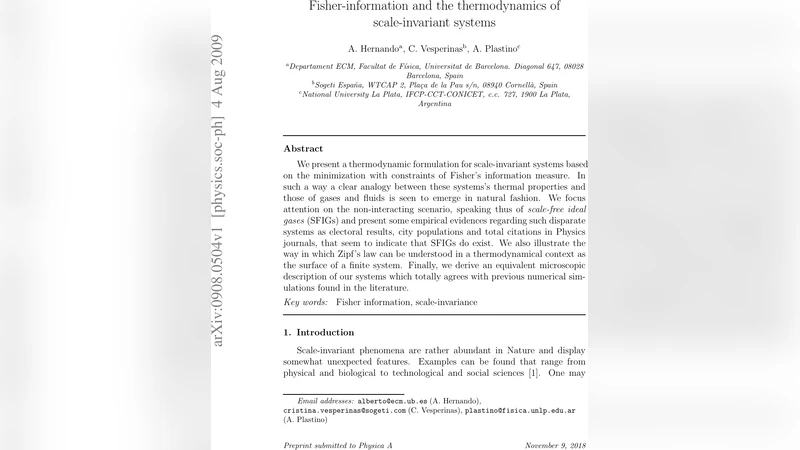
We present a thermodynamic formulation for scale-invariant systems based on the minimization with constraints of Fisher’s information measure. In such a way a clear analogy between these systems’s thermal properties and those of gases and fluids is seen to emerge in natural fashion. We focus attention on the non-interacting scenario, speaking thus of scale-free ideal gases (SFIGs) and present some empirical evidences regarding such disparate systems as electoral results, city populations and total citations in Physics journals, that seem to indicate that SFIGs do exist. We also illustrate the way in which Zipf’s law can be understood in a thermodynamical context as the surface of a finite system. Finally, we derive an equivalent microscopic description of our systems which totally agrees with previous numerical simulations found in the literature.
💡 Research Summary
The paper develops a thermodynamic description of scale‑invariant systems by employing Fisher’s information measure as a variational functional. Starting from the principle of minimizing Fisher information under appropriate constraints—namely, the average “energy” and a scale‑conservation condition—the authors derive a probability distribution that plays the role of a canonical ensemble for such systems. By interpreting the logarithm of the relevant variable (e.g., city size, vote count, citation number) as a coordinate in a “log‑space,” the usual ideal‑gas equations of state emerge in a natural way: the product of a pressure‑like quantity and a log‑volume equals the number of elements times an effective temperature proportional to the diffusion coefficient in log‑space.
The non‑interacting limit is defined as a “scale‑free ideal gas” (SFIG). In an SFIG each constituent behaves as an independent particle performing a random walk in log‑space, without any mutual interaction. The macroscopic thermodynamic variables—temperature, pressure, chemical potential—are expressed in terms of the moments of the underlying distribution, and the resulting state equation mirrors the familiar (PV = Nk_{B}T) but with the physical volume replaced by the logarithmic volume.
To validate the theory, the authors analyze three empirically distinct data sets that are known to exhibit power‑law behavior: (i) election results (vote counts per candidate), (ii) city population sizes, and (iii) total citation counts for physics journals. In each case the empirically observed distribution is fitted with the Fisher‑information‑derived form, yielding excellent agreement. The fits reveal that the effective temperature (i.e., the variance of the log‑space diffusion) is remarkably similar across these disparate systems, supporting the universality of the SFIG picture.
A particularly insightful contribution is the thermodynamic reinterpretation of Zipf’s law. By treating a finite system as having a “surface” (the highest‑ranked element) and a “bulk” (the remaining elements), the authors show that the surface contribution dominates the tail of the distribution, leading to the characteristic (P(r) \propto 1/r) scaling. This parallels the way surface tension influences bulk pressure in conventional thermodynamics, suggesting that Zipf’s law is not a mysterious anomaly but a natural finite‑size effect of a scale‑free ideal gas.
Finally, a microscopic model is constructed in which each particle executes an independent Brownian motion in log‑space. Numerical simulations of this model reproduce the same power‑law tails and the emergence of Zipf scaling observed in real data, confirming that the macroscopic Fisher‑information framework is fully consistent with a simple stochastic dynamics at the microscopic level. The agreement with earlier simulation studies of complex networks and growth processes further strengthens the claim that the SFIG provides a unifying description of a broad class of scale‑invariant phenomena.
In summary, the work bridges information theory, statistical mechanics, and empirical observations of scale‑free behavior. By casting Fisher information as an entropy‑like quantity and minimizing it under physically motivated constraints, the authors construct a thermodynamic formalism that not only reproduces known power‑law distributions but also offers a clear interpretation of Zipf’s law and a concrete microscopic mechanism. This framework opens new avenues for analyzing and modeling scale‑invariant systems across physics, sociology, and bibliometrics.
Comments & Academic Discussion
Loading comments...
Leave a Comment