Survey of Nearby FGK Stars at 160 microns with Spitzer
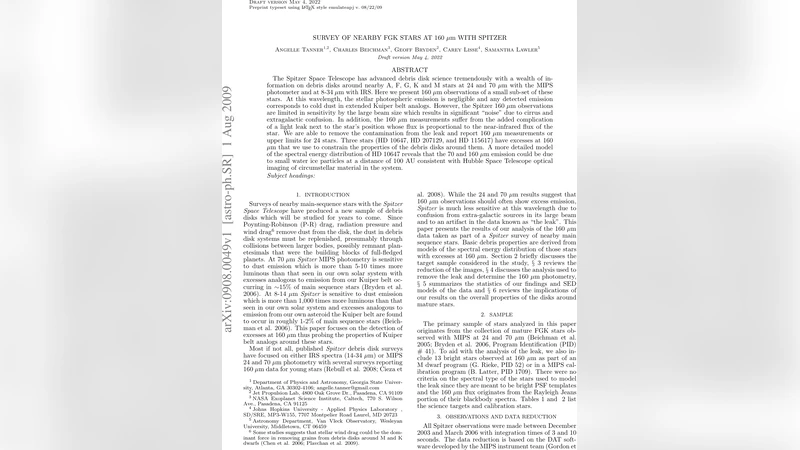
The Spitzer Space Telescope has advanced debris disk science tremendously with a wealth of information on debris disks around nearby A, F, G, K and M stars at 24 and 70 microns with the MIPS photometer and at 8-34 microns with IRS. Here we present 160 micron observations of a small sub-set of these stars. At this wavelength, the stellar photospheric emission is negligible and any detected emission corresponds to cold dust in extended Kuiper belt analogs. However, the Spitzer 160 micron observations are limited in sensitivity by the large beam size which results in significant ‘’noise’’ due to cirrus and extragalactic confusion. In addition, the 160 micron measurements suffer from the added complication of a light leak next to the star’s position whose flux is proportional to the near-infrared flux of the star. We are able to remove the contamination from the leak and report 160 micron measurements or upper limits for 24 stars. Three stars (HD 10647, HD 207129, and HD 115617) have excesses at 160 micron that we use to constrain the properties of the debris disks around them. A more detailed model of the spectral energy distribution of HD 10647 reveals that the 70 and 160 micron emission could be due to small water ice particles at a distance of 100 AU consistent with Hubble Space Telescope optical imaging of circumstellar material in the system.
💡 Research Summary
The paper presents a focused analysis of Spitzer Space Telescope MIPS 160 µm observations for a subset of nearby FGK stars, aiming to detect and characterize cold debris disks analogous to the Solar System’s Kuiper Belt. At 160 µm the stellar photosphere contributes negligibly, so any measured flux must arise from circumstellar dust at temperatures of roughly 30–50 K, located at distances of order 80–120 AU from the host star. The authors first address two major observational challenges: (1) the large beam size (≈40 arcsec) leads to substantial background “cirrus” emission and extragalactic confusion noise, limiting sensitivity; (2) a systematic light‑leak artifact appears adjacent to each target, with a flux that scales linearly with the star’s near‑infrared brightness. By correlating the leak strength with 2MASS K‑band and IRAC 3.6 µm photometry, they construct a predictive model for the leak and subtract it from each image, thereby isolating the genuine astronomical signal.
Out of the 24 stars examined, 21 yield only upper limits at the 3‑σ level, indicating that any cold dust present is below the detection threshold of the Spitzer 160 µm data. Three stars—HD 10647, HD 207129, and HD 115617—show statistically significant excess emission at 160 µm, consistent with the excesses already known at 70 µm. The authors combine the 70 µm and 160 µm fluxes to construct spectral energy distributions (SEDs) for these systems. They fit the SEDs with modified blackbody models, adopting an emissivity law ∝ ν^β with β≈0.8–1.0, and assume a grain size distribution proportional to a^−3.5, typical of collisional cascades.
For HD 10647, the best‑fit model requires a population of small (≲10 µm) water‑ice grains located at ~100 AU, producing a dust temperature of ~35 K. This result aligns with Hubble Space Telescope optical imaging that reveals a faint, extended scattering halo around the star, supporting the interpretation that the far‑infrared excess originates from a cold, icy belt. The other two stars also require cold dust at comparable radii (80–120 AU) and temperatures (~40 K), but the grain composition that best reproduces their SEDs leans toward silicate‑rich material rather than pure ice, suggesting possible differences in the collisional environment or evolutionary stage.
The study underscores that, despite the limitations imposed by beam size and background confusion, 160 µm observations remain a valuable probe of distant, cold debris structures that are invisible at shorter wavelengths. The successful removal of the light‑leak artifact demonstrates a practical methodology that can be applied to other Spitzer datasets. However, the authors acknowledge that the spatial resolution and sensitivity of Spitzer at 160 µm are insufficient to resolve disk morphology or to tightly constrain grain size distributions. They advocate for follow‑up observations with higher‑resolution facilities such as the Atacama Large Millimeter/submillimeter Array (ALMA) and the James Webb Space Telescope (JWST), as well as future far‑infrared missions (e.g., SPICA). Such observations would enable direct imaging of the disks, measurement of spectral features that diagnose composition, and assessment of dynamical interactions with any known planets.
In conclusion, the paper provides a clear demonstration that a small fraction of nearby FGK stars host cold, Kuiper‑belt‑like debris disks detectable at 160 µm. By carefully correcting for instrumental artifacts and background noise, the authors extract meaningful physical parameters—dust temperature, radial location, and plausible grain composition—for three systems. These findings contribute to the broader effort to map the diversity of planetary system architectures and to understand the long‑term evolution of planetesimal belts around Sun‑like stars.
Comments & Academic Discussion
Loading comments...
Leave a Comment