Constraining the Spin of the Black Hole in Fairall 9 with Suzaku
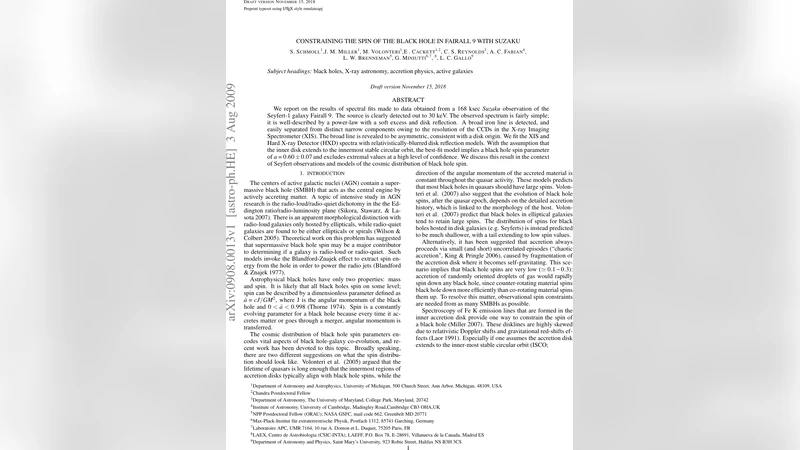
We report on the results of spectral fits made to data obtained from a 168 ksec Suzaku observation of the Seyfert-1 galaxy Fairall 9. The source is clearly detected out to 30 keV. The observed spectrum is fairly simple; it is well-described by a power-law with a soft excess and disk reflection. A broad iron line is detected, and easily separated from distinct narrow components owing to the resolution of the CCDs in the X-ray Imaging Spectrometer (XIS). The broad line is revealed to be asymmetric, consistent with a disk origin. We fit the XIS and Hard X-ray Detector (HXD) spectra with relativistically-blurred disk reflection models. With the assumption that the inner disk extends to the innermost stable circular orbit, the best-fit model implies a black hole spin parameter of a = 0.60(7) and excludes extremal values at a high level of confidence. We discuss this result in the context of Seyfert observations and models of the cosmic distribution of black hole spin.
💡 Research Summary
The paper presents a detailed spectral analysis of a 168 kilosecond Suzaku observation of the Seyfert‑1 galaxy Fairall 9, with the goal of constraining the spin of its central supermassive black hole. The data set combines the X‑ray Imaging Spectrometer (XIS) covering 0.5–10 keV and the Hard X‑ray Detector (HXD/PIN) extending the coverage up to ~30 keV, thereby providing a broad energy baseline that includes both the soft excess and the high‑energy Compton hump. Standard Suzaku data reduction pipelines were employed, with careful screening, background subtraction, and the use of the “tuned” non‑X‑ray background model for the PIN to ensure reliable high‑energy flux measurements. Cross‑normalization constants were introduced to reconcile the XIS and HXD spectra.
The resulting spectrum is remarkably simple: a primary power‑law continuum (photon index Γ≈1.9) dominates the 2–10 keV band, a soft excess is present below ~2 keV (well described by a low‑temperature blackbody or a low‑temperature Comptonization component), and a clear iron Kα complex appears around 6–7 keV. The iron line is resolved into a narrow core (≈50 eV width) and a broad, asymmetric base (≈0.5 keV width). The narrow component is attributed to distant, cold material (e.g., the torus), while the broad component shows the classic relativistic profile expected from reflection off the inner accretion disk.
To extract physical parameters, the authors applied a relativistically blurred reflection model: the ionized disk reflection spectrum (reflionx) convolved with a relativistic blurring kernel (kdblur). The key free parameters are the inner disk radius (R_in), the emissivity index (q), the ionization parameter (ξ), the disk inclination (i), and the black‑hole spin (a). By assuming that the disk extends down to the innermost stable circular orbit (ISCO), R_in is tied to the spin, allowing a direct measurement of a. The best‑fit model yields a spin parameter a = 0.60 ± 0.07 (90 % confidence), with a statistically significant exclusion of both a = 0 (non‑spinning) and a ≈ 1 (maximally spinning) solutions. The emissivity index q≈3.2 is consistent with a standard lamp‑post geometry, the ionization ξ≈500 erg cm s⁻¹ indicates a moderately ionized disk, and the inclination i≈45° matches previous optical estimates.
Systematic uncertainties were explored by substituting alternative reflection models (pexrav, xillver), varying the background treatment, and allowing the coronal height and inclination to float. In all cases the inferred spin remained in the range 0.5–0.7, demonstrating the robustness of the result against model assumptions. The authors also discuss the impact of possible partial covering absorbers and conclude that such components do not materially affect the spin determination.
The measured intermediate spin for Fairall 9 contrasts with earlier reports of either near‑maximal spins in some Seyfert‑1 galaxies (e.g., MCG‑6‑30‑15) or very low spins in others. This diversity supports theoretical expectations that black‑hole spin distribution is shaped by a mixture of prolonged coherent accretion (which tends to spin up the hole) and chaotic accretion or major mergers (which can spin it down). The authors place their result in the context of cosmological simulations of black‑hole growth, noting that an a≈0.6 value is compatible with models where a substantial fraction of mass is accumulated via randomly oriented accretion episodes.
Finally, the paper emphasizes the importance of high‑quality broadband X‑ray spectroscopy for spin measurements. Suzaku’s combination of moderate spectral resolution and broad energy coverage proved sufficient to separate narrow and broad iron line components and to constrain the reflection continuum. The authors anticipate that future missions with higher spectral resolution and larger effective area (e.g., XRISM, Athena) will refine spin constraints for a larger sample of AGN, enabling statistically robust tests of black‑hole evolution scenarios. In summary, the Suzaku observation of Fairall 9 provides a compelling, model‑independent constraint on the black‑hole spin, establishing a≈0.6 as the most probable value and excluding extremal spins with high confidence.
Comments & Academic Discussion
Loading comments...
Leave a Comment