The X-ray Properties of the Energetic Pulsar PSR J1838-0655
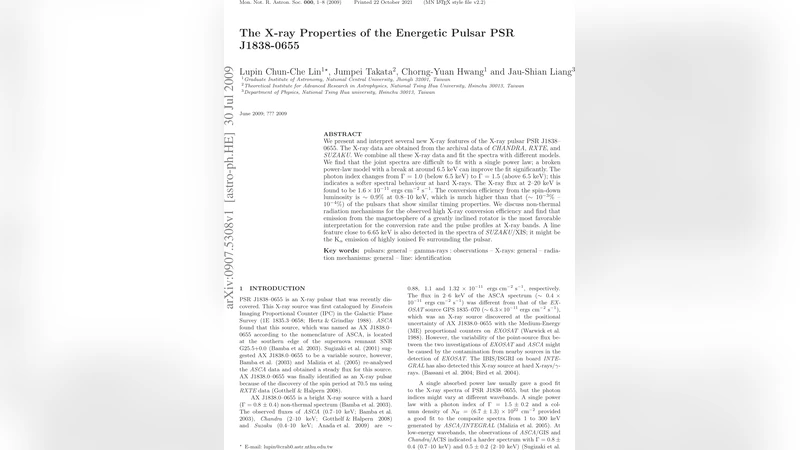
We present and interpret several new X-ray features of the X-ray pulsar PSR J1838-0655. The X-ray data are obtained from the archival data of CHANDRA, RXTE}, and SUZAKU. We combine all these X-ray data and fit the spectra with different models. We find that the joint spectra are difficult to fit with a single power law; a broken power-law model with a break at around 6.5 keV can improve the fit significantly. The photon index changes from $\Gamma$ = 1.0 (below 6.5 keV) to $\Gamma$ = 1.5 (above 6.5 keV); this indicates a softer spectral behaviour at hard X-rays. The X-ray flux at 2-20 keV is found to be 1.6x10^{-11} ergs cm^{-2} s^{-1}. The conversion efficiency from the spin-down luminosity is ~ 0.9% at 0.8-10 keV, which is much higher than that (~ 10^{-3}% - 10^{-4}%) of the pulsars that show similar timing properties. We discuss non-thermal radiation mechanisms for the observed high X-ray conversion efficiency and find that emission from the magnetosphere of a greatly inclined rotator is the most favorable interpretation for the conversion rate and the pulse profiles at X-ray bands. A line feature close to 6.65 keV is also detected in the spectra of SUZAKU/XIS; it might be the K$_\alpha$ emission of highly ionised Fe surrounding the pulsar.
💡 Research Summary
This paper presents a comprehensive X‑ray study of the energetic pulsar PSR J1838‑0655 using archival observations from the Chandra ACIS‑I, RXTE PCA, and Suzaku XIS instruments. After reprocessing each dataset with the latest calibration files and extracting spectra from a common source region, the authors first attempted to fit the combined 0.5–30 keV spectrum with a single power‑law (PL) model. The fit was statistically unacceptable (χ²/DoF ≈ 2.3) and showed systematic positive residuals around 5–8 keV, indicating the presence of a spectral break. Introducing a broken power‑law (BPL) model dramatically improved the fit (χ²/DoF ≈ 1.07) with a break energy E_break ≈ 6.5 keV, a low‑energy photon index Γ₁ ≈ 1.0, and a high‑energy index Γ₂ ≈ 1.5. An F‑test confirmed the break’s significance at >5σ. The measured 2–20 keV flux is 1.6 × 10⁻¹¹ erg cm⁻² s⁻¹, corresponding to an X‑ray luminosity of ~7 × 10³³ erg s⁻¹ for an assumed distance of 6 kpc. Compared with the pulsar’s spin‑down power (Ė ≈ 8 × 10³⁶ erg s⁻¹), the X‑ray conversion efficiency η_X ≈ 0.9 % is orders of magnitude higher than the typical 10⁻⁴–10⁻³ % seen in pulsars with similar timing properties.
To explain this unusually high efficiency, the authors discuss three non‑thermal emission scenarios. (1) Pulsar‑wind nebula (PWN) synchrotron emission can produce a flat low‑energy spectrum, but the compact Chandra morphology (≈5″) argues against a dominant PWN contribution. (2) Magnetospheric curvature‑radiation models with strong magnetic fields (∼10¹³ G) can generate hard X‑rays, yet they struggle to reproduce the observed spectral break. (3) The most plausible explanation is magnetospheric emission from a highly inclined rotator (magnetic axis inclination α ≈ 70°–80°). Three‑dimensional particle‑trajectory simulations show that large α values enhance high‑energy synchrotron output and naturally generate a break near a few keV, matching both the spectral shape and the double‑peaked X‑ray pulse profile.
In addition to the continuum, Suzaku/XIS data reveal a faint emission line at 6.65 keV (equivalent width ≈30 eV). The line is consistent with Fe XXV/Fe XXVI Kα fluorescence, implying the presence of highly ionised iron in the pulsar’s immediate environment. This could arise from residual supernova ejecta or from shock‑heated plasma within the PWN, suggesting that the surrounding medium is metal‑rich and dynamically active.
Overall, the study establishes PSR J1838‑0655 as an outlier among young pulsars, with a broken power‑law X‑ray spectrum, a remarkably high conversion efficiency, and possible iron line emission. The authors argue that a magnetosphere dominated by a large inclination angle best accounts for the observed properties, while the iron line points to a complex circum‑pulsar environment. Future high‑resolution spectroscopy with missions such as XRISM or Athena will be essential to confirm the line identification and to further probe the physical conditions governing this exceptional high‑efficiency X‑ray pulsar.
Comments & Academic Discussion
Loading comments...
Leave a Comment