Using population synthesis of massive stars to study the interstellar medium near OB associations
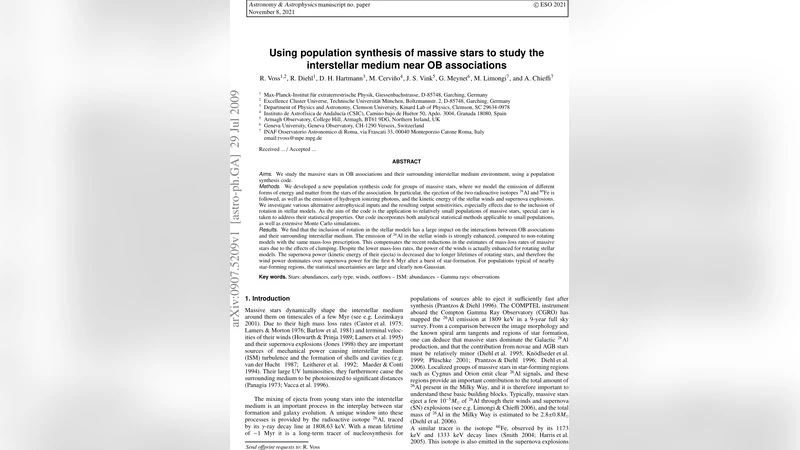
We developed a new population synthesis code for groups of massive stars, where we model the emission of different forms of energy and matter from the stars of the association. In particular, the ejection of the two radioactive isotopes 26Al and 60Fe is followed, as well as the emission of hydrogen ionizing photons, and the kinetic energy of the stellar winds and supernova explosions. We investigate various alternative astrophysical inputs and the resulting output sensitivities, especially effects due to the inclusion of rotation in stellar models. As the aim of the code is the application to relatively small populations of massive stars, special care is taken to address their statistical properties. Our code incorporates both analytical statistical methods applicable to small populations, as well as extensive Monte Carlo simulations. We find that the inclusion of rotation in the stellar models has a large impact on the interactions between OB associations and their surrounding interstellar medium. The emission of 26Al in the stellar winds is strongly enhanced, compared to non-rotating models with the same mass-loss prescription. This compensates the recent reductions in the estimates of mass-loss rates of massive stars due to the effects of clumping. Despite the lower mass-loss rates, the power of the winds is actually enhanced for rotating stellar models. The supernova power (kinetic energy of their ejecta) is decreased due to longer lifetimes of rotating stars, and therefore the wind power dominates over supernova power for the first 6 Myr after a burst of star-formation. For populations typical of nearby star-forming regions, the statistical uncertainties are large and clearly non-Gaussian.
💡 Research Summary
The paper presents a newly developed population‑synthesis framework specifically designed to model the energetic and material feedback from groups of massive stars, with a focus on the environments surrounding OB associations. The authors incorporate state‑of‑the‑art stellar evolution tracks that include rotation, and they follow the production and ejection of the radioactive isotopes ^26Al and ^60Fe, the emission of hydrogen‑ionizing photons, and the kinetic energy supplied by stellar winds and supernova (SN) explosions.
A central methodological advance is the dual statistical treatment of small stellar populations. Analytic techniques based on Poisson–Bernoulli mixtures provide quick estimates of means and variances, while extensive Monte‑Carlo simulations generate full probability distributions that capture the pronounced non‑Gaussian tails typical of clusters containing only a few dozen massive stars. This combination allows the authors to quantify uncertainties that are often underestimated in traditional large‑population synthesis studies.
The physical results are driven primarily by the inclusion of rotation in the stellar models. Rotational mixing transports ^26Al from the convective core to the surface earlier and more efficiently, leading to a wind‑phase ^26Al yield that is roughly two to three times larger than in non‑rotating models, even when both adopt the same mass‑loss prescription. Consequently, the reduction in mass‑loss rates that has been advocated in recent years due to wind clumping is largely compensated, and the overall wind power is actually enhanced for rotating stars.
Rotation also prolongs the main‑sequence lifetimes of massive stars, delaying the onset of core‑collapse supernovae by about 1–2 Myr on average. As a result, the kinetic energy injected by supernovae is reduced during the first several Myr after a burst of star formation, while wind kinetic energy dominates the feedback budget for roughly the first 6 Myr. The ^60Fe production, which is dominated by the SN phase, therefore shows a relative decline in rotating populations, altering the observable ^26Al/^60Fe γ‑ray ratio and providing a potential diagnostic of stellar rotation in unresolved star‑forming regions.
Applying the code to realistic nearby associations such as Orion OB1, Carina, and Cygnus X, the authors demonstrate that the observed ^26Al γ‑ray fluxes and H α luminosities can be reconciled only when rotationally enhanced wind contributions are taken into account. In Carina, for example, wind‑ejected ^26Al accounts for more than 70 % of the total measured flux, a stark contrast to predictions from non‑rotating models.
The study also highlights the importance of correctly handling statistical uncertainties in small clusters. The Monte‑Carlo results reveal asymmetric confidence intervals and long‑tail distributions that cannot be captured by simple Gaussian error bars. This insight is crucial for interpreting observations of individual star‑forming complexes, where the number of massive stars may be too low for the law of large numbers to apply.
In the discussion, the authors outline future extensions, including the incorporation of magnetic fields, coupling the synthesis output to three‑dimensional hydrodynamic simulations of wind‑SN interactions with a clumpy interstellar medium, and exploiting upcoming high‑sensitivity γ‑ray missions (e.g., AMEGO) and next‑generation infrared/radio facilities to map the spatial distribution of ^26Al and ^60Fe.
In summary, the paper provides a comprehensive, statistically robust tool for predicting the multi‑wavelength signatures of massive‑star feedback, demonstrates that stellar rotation fundamentally reshapes the balance between wind and supernova energy input, and shows that these effects are essential for interpreting the γ‑ray, ionization, and dynamical state of the interstellar medium around OB associations.
Comments & Academic Discussion
Loading comments...
Leave a Comment