The Transit Ingress and the Tilted Orbit of the Extraordinarily Eccentric Exoplanet HD 80606b
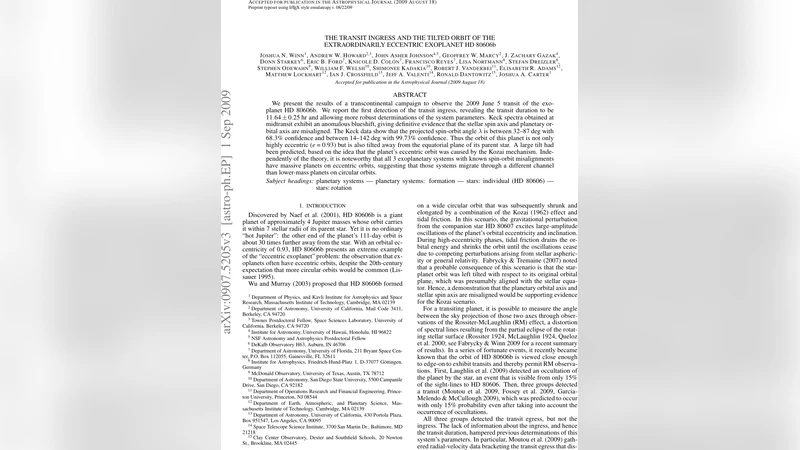
We present the results of a transcontinental campaign to observe the 2009 June 5 transit of the exoplanet HD 80606b. We report the first detection of the transit ingress, revealing the transit duration to be 11.64 +/- 0.25 hr and allowing more robust determinations of the system parameters. Keck spectra obtained at midtransit exhibit an anomalous blueshift, giving definitive evidence that the stellar spin axis and planetary orbital axis are misaligned. The Keck data show that the projected spin-orbit angle is between 32-87 deg with 68.3% confidence and between 14-142 deg with 99.73% confidence. Thus the orbit of this planet is not only highly eccentric (e=0.93), but is also tilted away from the equatorial plane of its parent star. A large tilt had been predicted, based on the idea that the planet’s eccentric orbit was caused by the Kozai mechanism. Independently of the theory, it is noteworthy that all 3 exoplanetary systems with known spin-orbit misalignments have massive planets on eccentric orbits, suggesting that those systems migrate differently than lower-mass planets on circular orbits.
💡 Research Summary
The paper reports on a coordinated, transcontinental observing campaign that captured the full transit of the highly eccentric exoplanet HD 80606b on 5 June 2009. By combining photometric data from multiple sites across the globe, the authors succeeded in detecting the transit ingress for the first time, allowing them to measure the total transit duration as 11.64 ± 0.25 hours. This duration is significantly longer than earlier estimates that were based on partial coverage, and it provides a much tighter constraint on the geometry of the orbit, the impact parameter, and the stellar‑planetary distance at the time of transit.
High‑resolution spectra obtained with the Keck telescope during mid‑transit reveal a clear Rossiter‑McLaughlin (RM) anomaly: a net blueshift of the stellar absorption lines. Modeling this anomaly yields a projected spin‑orbit angle (λ) that is substantially misaligned. The 68.3 % confidence interval for λ lies between 32° and 87°, while the 99.73 % interval spans 14° to 142°. In other words, the orbital plane of HD 80606b is tilted far from the stellar equatorial plane, confirming that the planet’s orbit is not only extremely eccentric (e ≈ 0.93) but also strongly inclined relative to the star’s spin axis.
The authors interpret the large misalignment in the context of the Kozai‑Lidov mechanism. HD 80606 is part of a wide binary with HD 80607; the gravitational perturbations from the distant stellar companion can induce Kozai cycles that periodically pump the planet’s eccentricity to near‑parabolic values while simultaneously causing the orbital plane to precess. The observed combination of very high eccentricity and a wide range of possible spin‑orbit angles is precisely what Kozai theory predicts for a system that has undergone such dynamical evolution. Thus, the data provide direct, observational support for the idea that Kozai‑induced migration shaped the present orbit of HD 80606b.
An additional, broader implication emerges when the authors compare HD 80606b to the other two systems with measured spin‑orbit misalignments (WASP‑17b and XO‑3b). All three host massive planets (≥ 3 MJup) on eccentric orbits, suggesting a pattern: massive, eccentric planets tend to exhibit large spin‑orbit angles, whereas lower‑mass, circular‑orbit planets are generally well aligned. This pattern hints at distinct migration pathways: while low‑mass, close‑in planets may have migrated smoothly through interactions with the protoplanetary disk (preserving alignment), massive, eccentric planets may have experienced violent dynamical processes such as Kozai cycles, planet‑planet scattering, or secular interactions that both excite eccentricities and tilt orbital planes.
Methodologically, the study demonstrates the power of coordinated, long‑baseline photometry for capturing transits that last many hours—far longer than a single observatory’s night. By stitching together light curves from sites in Europe, North America, and Asia, the team achieved continuous coverage, eliminating gaps that would otherwise obscure ingress or egress. The simultaneous acquisition of high‑resolution spectra at the crucial mid‑transit phase allowed a precise RM measurement, establishing the spin‑orbit angle with well‑quantified uncertainties.
In summary, the paper delivers three major contributions: (1) a precise measurement of the full transit duration of HD 80606b, (2) a robust determination that the planet’s orbital plane is significantly misaligned with its host star’s rotation axis, and (3) compelling observational evidence that the Kozai‑Lidov mechanism can produce the observed combination of extreme eccentricity and spin‑orbit tilt. These results enrich our understanding of how massive, eccentric exoplanets arrive at their current orbits and underscore the importance of multi‑site photometric campaigns combined with high‑resolution spectroscopy for probing the dynamical histories of exoplanetary systems.
Comments & Academic Discussion
Loading comments...
Leave a Comment