Benefits of Ground-Based Photometric Follow-Up for Transiting Extrasolar Planets Discovered with Kepler and CoRoT
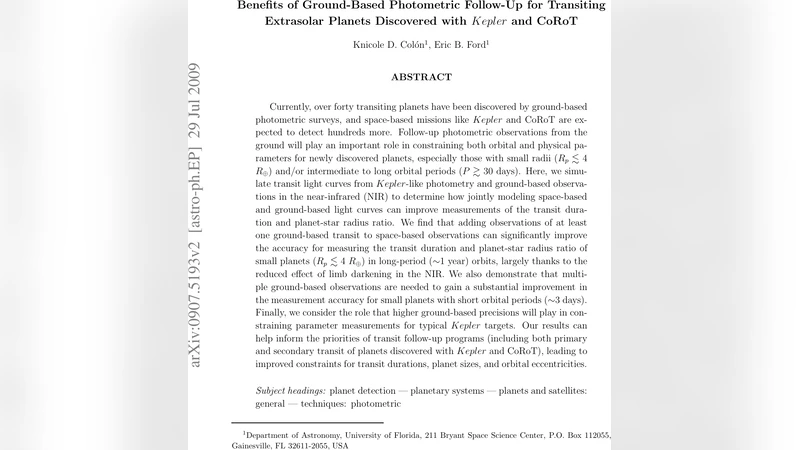
Currently, over forty transiting planets have been discovered by ground-based photometric surveys, and space-based missions like Kepler and CoRoT are expected to detect hundreds more. Follow-up photometric observations from the ground will play an important role in constraining both orbital and physical parameters for newly discovered planets, especially those with small radii (R_p less than approximately 4 Earth radii) and/or intermediate to long orbital periods (P greater than approximately 30 days). Here, we simulate transit light curves from Kepler-like photometry and ground-based observations in the near-infrared (NIR) to determine how jointly modeling space-based and ground-based light curves can improve measurements of the transit duration and planet-star radius ratio. We find that adding observations of at least one ground-based transit to space-based observations can significantly improve the accuracy for measuring the transit duration and planet-star radius ratio of small planets (R_p less than approximately 4 Earth radii) in long-period (~1 year) orbits, largely thanks to the reduced effect of limb darkening in the NIR. We also demonstrate that multiple ground-based observations are needed to gain a substantial improvement in the measurement accuracy for small planets with short orbital periods (~3 days). Finally, we consider the role that higher ground-based precisions will play in constraining parameter measurements for typical Kepler targets. Our results can help inform the priorities of transit follow-up programs (including both primary and secondary transit of planets discovered with Kepler and CoRoT), leading to improved constraints for transit durations, planet sizes, and orbital eccentricities.
💡 Research Summary
The paper addresses a critical bottleneck in the characterization of transiting exoplanets discovered by space‑based missions such as Kepler and CoRoT: the difficulty of obtaining precise orbital and physical parameters for small planets (Rp ≲ 4 R⊕) that have intermediate to long orbital periods (P ≳ 30 days). While Kepler‑type photometry provides continuous, high‑cadence light curves, the intrinsic limb‑darkening in the optical band introduces strong correlations between the transit duration (T14), the ingress/egress time (τ), and the planet‑to‑star radius ratio (Rp/R★). These correlations inflate the uncertainties on both the planetary radius and the inferred orbital eccentricity, especially when the signal‑to‑noise ratio is modest, as is typical for long‑period, small planets.
To quantify the benefit of ground‑based follow‑up, the authors simulate a suite of transit light curves that combine Kepler‑like space data with ground‑based observations taken in the near‑infrared (NIR, e.g., J‑band). The NIR regime is advantageous because stellar limb darkening is dramatically reduced (linear coefficients drop from ∼0.3–0.4 in the optical to ∼0.1 in the NIR). The simulations span a realistic range of planetary sizes (1–4 R⊕), orbital periods (3 days to 1 year), and observational scenarios: a single ground‑based transit, multiple transits (up to five), and varying photometric precisions (0.5–2 mmag per minute).
Key findings are as follows:
-
Single NIR Transit Suffices for Long‑Period Small Planets – For planets with P ≈ 1 yr and Rp ≤ 4 R⊕, adding just one NIR ground‑based light curve to the Kepler data reduces the fractional uncertainties on T14 and Rp/R★ by roughly 30 %–40 %. The improvement stems almost entirely from the weaker limb‑darkening, which decouples the duration and depth parameters in the joint fit.
-
Multiple NIR Transits Required for Short‑Period Small Planets – When P ≈ 3 days, the Kepler data already provide high S/N, but the residual limb‑darkening bias remains. The authors show that observing at least three independent NIR transits brings the uncertainties on T14 and Rp/R★ down to the 10 %–15 % level, a substantial gain over the space‑only case.
-
Impact of Photometric Precision – If ground‑based facilities achieve a per‑minute precision of ≤0.5 mmag (a realistic goal for 1–2 m telescopes equipped with modern NIR detectors), the combined analysis can constrain planetary radii to better than 5 % for typical Kepler targets (V ≈ 12–14 mag). This level of precision also translates into tighter constraints on orbital eccentricity because the duration measurement becomes more accurate.
-
Strategic Recommendations – The study proposes a tiered follow‑up strategy: (a) prioritize at least one NIR transit for every long‑period, small‑radius candidate; (b) schedule three or more NIR transits for short‑period, small‑radius candidates; and (c) invest in improving ground‑based photometric stability to reach sub‑mmag precision. Networks such as LCOGT, SPECULOOS, and the upcoming Las Cumbres Observatory NIR capability are highlighted as ideal platforms.
-
Broader Scientific Payoff – By sharpening the measurements of T14 and Rp/R★, ground‑based NIR follow‑up directly improves estimates of planetary bulk density and, consequently, interior composition models. Moreover, more accurate durations enable better determination of orbital eccentricities, which are essential for testing theories of planet migration and dynamical evolution.
In summary, the paper convincingly demonstrates that ground‑based NIR photometry is not merely a supplemental activity but a powerful tool that, when combined with space‑based light curves, can dramatically enhance the precision of key transit parameters for the most scientifically valuable subset of Kepler and CoRoT planets—those that are small and on longer orbits. Implementing the recommended follow‑up program will maximize the scientific return of existing space missions and lay a solid foundation for the interpretation of future surveys such as TESS and PLATO.
Comments & Academic Discussion
Loading comments...
Leave a Comment