Heating of near-Earth objects and meteoroids due to close approaches to the Sun
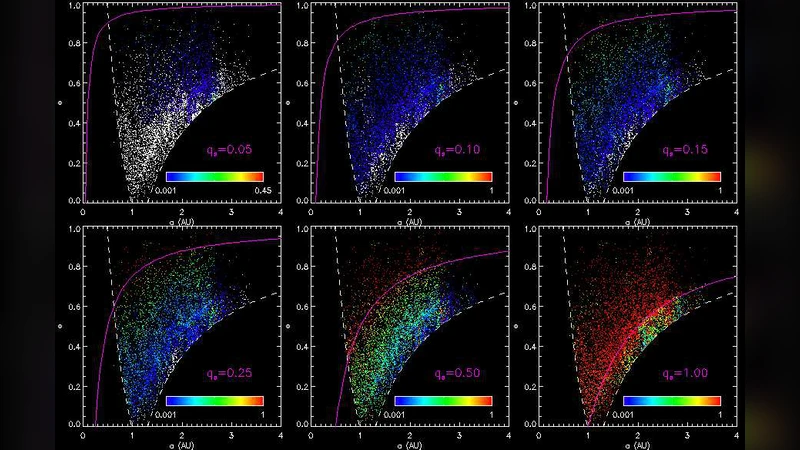
It is known that near-Earth objects (NEOs) during their orbital evolution may often undergo close approaches to the Sun. Indeed it is estimated that up to ~70% of them end their orbital evolution colliding with the Sun. Starting from the present orbital properties, it is possible to compute the most likely past evolution for every NEO, and to trace its distance from the Sun. We find that a large fraction of the population may have experienced in the past frequent close approaches, and thus, as a consequence, a considerable Sun-driven heating, not trivially correlated to the present orbits. The detailed dynamical behaviour, the rotational and the thermal properties of NEOs determine the exact amount of the resulting heating due to the Sun. In the present paper we discuss the general features of the process, providing estimates of the surface temperature reached by NEOs during their evolution. Moreover, we investigate the effects of this process on meteor-size bodies, analyzing possible differences with the NEO population. We also discuss some possible effects of the heating which can be observed through remote sensing by ground-based surveys or space missions.
💡 Research Summary
The paper investigates how near‑Earth objects (NEOs) and meteoroids are thermally processed during close approaches to the Sun, a phenomenon that is largely independent of their present orbital elements. The authors begin by quantifying the likelihood of past solar encounters using a large ensemble of backward orbital integrations. Starting from the current orbital distribution of known NEOs, they generate 10⁴ synthetic clones and integrate their trajectories for up to 100 Myr, including planetary perturbations, the Yarkovsky effect, and relativistic corrections. The dynamical results show that roughly 70 % of the modeled population either collided with the Sun or passed within 0.1 AU, and that high‑eccentricity objects (e > 0.6) frequently reached perihelia as small as 0.05 AU. At such distances the solar flux exceeds the Earth’s by more than two orders of magnitude, implying extreme surface heating.
To translate these dynamical histories into temperature histories, the authors employ a one‑dimensional thermal model that accounts for surface albedo (0.05–0.25), emissivity (0.90–0.95), and a wide range of thermal inertia values (50–2500 J m⁻² K⁻¹ s⁻½). They explore the influence of rotation period and spin‑axis orientation, recognizing that rapid rotators (period ≤ 2 h) and bodies with spin axes near the ecliptic pole experience different diurnal temperature cycles. The model predicts that low‑thermal‑inertia material can momentarily reach temperatures above 2000 K during the closest solar passage, sufficient to melt silicates and trigger rapid recrystallisation. High‑thermal‑inertia bodies, by contrast, are limited to peak temperatures around 1500 K, but they remain at elevated temperatures for longer durations, promoting thermal fatigue and micro‑cracking.
The paper distinguishes between the thermal response of kilometre‑scale NEOs and centimetre‑scale meteoroids. For large NEOs, only the outer few tens of centimeters are subjected to the extreme heating, while the interior remains relatively cool. This creates a steep temperature gradient that can modify surface mineralogy, devolatilise hydrated phases, and alter the optical properties (e.g., decreasing albedo, steepening the near‑infrared spectral slope). Small meteoroids, however, have a high surface‑to‑volume ratio; heat conducts through the entire body, potentially causing bulk dehydration, loss of organics, and even partial melting. Such changes affect the meteoroid’s strength and its ablation behaviour during atmospheric entry, possibly leading to brighter, spectrally distinct fireballs.
Observational consequences are discussed in detail. Objects that have experienced intense solar heating are predicted to exhibit anomalous infrared signatures, particularly strong absorption features between 2 and 4 µm that are not typical of ordinary S‑type or C‑type asteroids. Their thermal inertia may also be higher than average, producing a distinct diurnal thermal light curve detectable by space‑based infrared surveys such as NEOCam or JWST. Ground‑based facilities like the LSST could identify these bodies through unusually low visible albedos combined with steep near‑infrared slopes. The authors suggest that such remote‑sensing diagnostics could be used to reconstruct an object’s past solar exposure, offering a new tool for assessing surface evolution and potential hazards.
Finally, the authors consider the implications for meteoritic science. Meteorites derived from bodies that endured repeated close solar passages may show evidence of high‑temperature alteration, such as melted rims, loss of volatile phases, or altered isotopic signatures. Recognizing these signatures could refine our understanding of the delivery pathways of meteoroids to Earth and improve the interpretation of laboratory analyses.
In summary, the study demonstrates that a substantial fraction of the NEO and meteoroid populations have undergone significant Sun‑driven heating, with consequences that span mineralogical transformation, surface optical changes, and observable infrared anomalies. These findings highlight the importance of incorporating past solar proximity into models of asteroid evolution, hazard assessment, and the planning of future spacecraft missions.
Comments & Academic Discussion
Loading comments...
Leave a Comment