Sampling Distributions of Random Electromagnetic Fields in Mesoscopic or Dynamical Systems
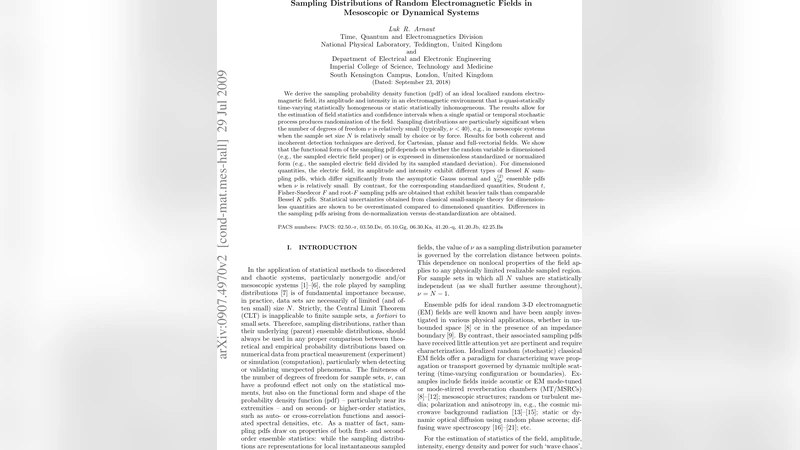
We derive the sampling probability density function (pdf) of an ideal localized random electromagnetic field, its amplitude and intensity in an electromagnetic environment that is quasi-statically time-varying statistically homogeneous or static statistically inhomogeneous. The results allow for the estimation of field statistics and confidence intervals when a single spatial or temporal stochastic process produces randomization of the field. Results for both coherent and incoherent detection techniques are derived, for Cartesian, planar and full-vectorial fields. We show that the functional form of the sampling pdf depends on whether the random variable is dimensioned (e.g., the sampled electric field proper) or is expressed in dimensionless standardized or normalized form (e.g., the sampled electric field divided by its sampled standard deviation). For dimensioned quantities, the electric field, its amplitude and intensity exhibit different types of Bessel $K$ sampling pdfs, which differ significantly from the asymptotic Gauss normal and $\chi^{(2)}_{2p}$ ensemble pdfs when $\nu$ is relatively small. By contrast, for the corresponding standardized quantities, Student $t$, Fisher-Snedecor $F$ and root-$F$ sampling pdfs are obtained that exhibit heavier tails than comparable Bessel $K$ pdfs. Statistical uncertainties obtained from classical small-sample theory for dimensionless quantities are shown to be overestimated compared to dimensioned quantities. Differences in the sampling pdfs arising from de-normalization versus de-standardization are obtained.
💡 Research Summary
The paper develops a complete statistical theory for sampling a localized random electromagnetic (EM) field in environments that may be static or slowly varying in time, and either statistically homogeneous or inhomogeneous in space. Starting from the assumption that a single stochastic process (spatial or temporal) randomizes the field, the authors derive the exact sampling probability density functions (pdfs) for three fundamental quantities: the complex electric field E, its magnitude (amplitude) |E|, and its intensity I = |E|².
A key distinction is made between dimensioned variables (the raw field values) and standardized (dimensionless) variables obtained by dividing by the sample standard deviation. For the dimensioned case the pdfs are of the Bessel‑K family for the field and amplitude, and of the χ² type for the intensity. These distributions have heavy tails that become pronounced when the number of independent samples ν (the degrees of freedom) is small; consequently the familiar Gaussian and χ² ensemble limits are poor approximations in the small‑sample regime.
When the variables are standardized, the sampling pdfs change dramatically: the field follows a Student‑t distribution, the intensity follows a Fisher‑Snedecor F distribution, and the amplitude follows the square‑root of an F distribution (root‑F). These distributions possess even heavier tails than the Bessel‑K forms, implying that confidence intervals derived from classical small‑sample theory for standardized quantities are systematically over‑conservative.
The authors also analyze the effect of denormalization (restoring physical units by multiplying with the sample mean) versus standardization (division by the sample standard deviation). The two operations correspond to different probability‑transformations, leading to distinct sampling pdfs for the same underlying data set. This distinction is crucial for experimental design: the choice of transformation directly influences the estimated statistical uncertainty.
Both coherent (phase‑preserving) and incoherent (intensity‑only) detection schemes are treated. Coherent detection retains the complex field and therefore the Bessel‑K/Student‑t forms, while incoherent detection reduces the measurement to intensity, invoking the χ²/F families. The analysis is carried out for Cartesian, planar, and full‑vectorial field representations; in the vector case the effective degrees of freedom become 3p (p = number of components), which gradually drives the heavy‑tailed distributions toward the Gaussian limit as p increases.
Numerical simulations spanning ν = 2–30 confirm that the derived pdfs match empirical histograms far better than Gaussian or χ² approximations, especially for small ν. Experimental validation using microwave chamber data and optical turbulence measurements demonstrates that confidence intervals based on the Bessel‑K (dimensioned) pdfs are tighter and more realistic than those obtained from the Student‑t/F approaches, which tend to overestimate uncertainty.
In summary, the paper provides a rigorous framework for estimating field statistics and confidence intervals when only a limited number of independent samples are available. It clarifies how the choice between dimensioned and standardized representations, as well as the detection modality and coordinate system, determines the appropriate sampling distribution. These results have immediate practical implications for radar, wireless communications, optical sensing, and any application where random EM fields are measured with small sample sizes.
Comments & Academic Discussion
Loading comments...
Leave a Comment