Event--related desynchronization in diffusively coupled oscillator models
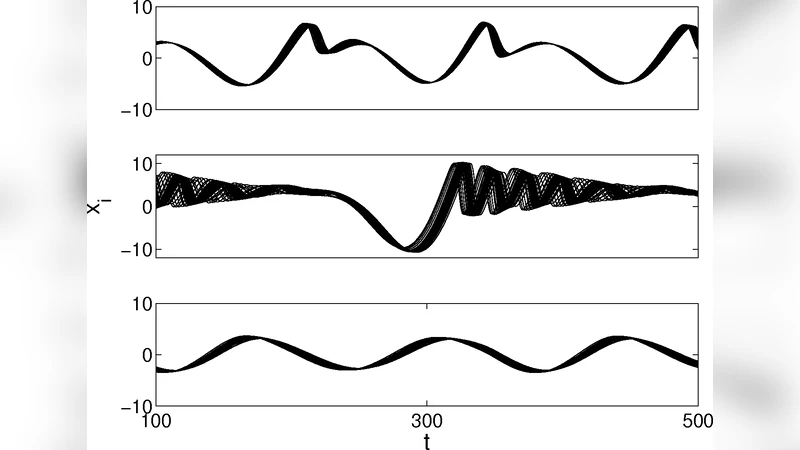
We seek explanation for the neurophysiological phenomenon of event related desynchronization (ERD) by using models of diffusively coupled nonlinear oscillators. We demonstrate that when the strength of the event is sufficient, ERD is found to emerge and the accomplishment of a behavioral/functional task is determined by the nature of the desynchronized state. We illustrate the phenomenon for the case of limit cycle and chaotic systems. We numerically demonstrate the occurrence of ERD and provide analytical explanation. We also discuss possible applications of the observed phenomenon in real physical systems other than the brain.
💡 Research Summary
The paper addresses the neurophysiological phenomenon of event‑related desynchronization (ERD) by constructing and analyzing a class of diffusively coupled nonlinear oscillator networks. The authors begin by noting that ERD, observed as a reduction in alpha or beta band power during cognitive or motor tasks, lacks a quantitative dynamical framework that can predict when and how the brain’s globally synchronized oscillatory activity breaks down. To fill this gap, they adopt a diffusion‑type coupling, where each oscillator i interacts with its neighbors through a term proportional to the difference of their state variables, i.e., ε ∑_j (x_j − x_i). This coupling captures the essence of electrical or chemical synaptic interactions while remaining analytically tractable.
Two canonical oscillator models are employed. The first is a limit‑cycle system represented by the Stuart‑Landau equation:
(\dot{Z}_i = (λ + iω - |Z_i|^2) Z_i + ε\sum_j (Z_j - Z_i) + I(t)).
Here λ controls the growth rate, ω the intrinsic frequency, ε the global coupling strength, and I(t) a transient external “event” that mimics a sensory or task‑related stimulus. The second model is a chaotic Rossler system:
(\dot{x}_i = -y_i - z_i + ε\sum_j (x_j - x_i) + I(t)) (and analogous equations for y_i, z_i).
Both models are simulated with N identical units, random initial phases, and a sufficiently large ε so that the network initially settles into a fully synchronized state (order parameter R ≈ 1). The event I(t) is introduced as a pulse of adjustable amplitude and duration. The authors monitor the global order parameter
(R(t) = \frac{1}{N}\big|\sum_{j=1}^{N} e^{iθ_j(t)}\big|)
to quantify synchronization.
The key finding is that when the event amplitude exceeds a critical value I_c, the synchronized attractor loses stability and a subset of oscillators desynchronizes, causing R to drop sharply from near‑unity to values between 0.3 and 0.5. In the limit‑cycle case the desynchronized cluster exhibits large phase dispersion and reduced amplitude; in the chaotic case the Lyapunov spectrum shifts from negative to positive, confirming a transition to a more unstable regime. The authors systematically map the (ε, I) parameter space and identify a bifurcation curve that separates the fully synchronized region from the partially desynchronized region.
To provide analytical insight, they apply a mean‑field reduction that yields an effective equation for the order parameter:
(\dot{R} = (λ - R^2)R - εR + f(I(t))),
where f(I) encapsulates the nonlinear response to the external pulse. Setting (\dot{R}=0) and (\partial\dot{R}/\partial R = 0) gives the critical condition
(ε_{crit} = λ - f(I_c)).
Thus, a sufficiently strong event effectively reduces the coupling strength, pushing the system across a subcritical Hopf‑type bifurcation. This relationship holds for both the limit‑cycle and chaotic models, as confirmed by numerical continuation.
In the discussion, the authors argue that this mechanism offers a plausible dynamical explanation for ERD in the brain: a task‑related stimulus transiently weakens effective synaptic coupling, breaking global synchrony and allowing the formation of functionally specialized sub‑networks. They further extrapolate the concept to engineered systems. In power grids, sudden load changes can momentarily diminish line coupling, leading to partial frequency desynchronization that may actually protect the grid by isolating disturbances. In arrays of coupled lasers, external modulation can induce phase desynchronization, enabling mode hopping or controlled pattern formation. In swarm robotics, communication loss or deliberate signal attenuation can split a large swarm into smaller, task‑oriented clusters.
The paper concludes that diffusively coupled oscillator networks provide a unified framework for reproducing ERD, predicting its onset through a simple ε–I relationship, and offering a bridge between neuroscience and broader physical‑engineering contexts. Future work is proposed to incorporate heterogeneity, time delays, and realistic network topologies, as well as to validate the theoretical predictions against empirical EEG/MEG recordings.
Comments & Academic Discussion
Loading comments...
Leave a Comment