Phase transition and information cascade in a voting model
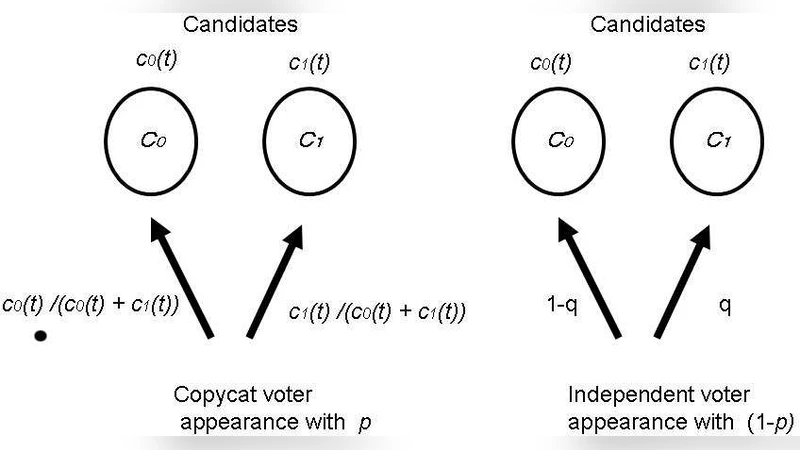
We introduce a voting model that is similar to a Keynesian beauty contest and analyze it from a mathematical point of view. There are two types of voters-copycat and independent-and two candidates. Our voting model is a binomial distribution (independent voters) doped in a beta binomial distribution (copycat voters). We find that the phase transition in this system is at the upper limit of $t$, where $t$ is the time (or the number of the votes). Our model contains three phases. If copycats constitute a majority or even half of the total voters, the voting rate converges more slowly than it would in a binomial distribution. If independents constitute the majority of voters, the voting rate converges at the same rate as it would in a binomial distribution. We also study why it is difficult to estimate the conclusion of a Keynesian beauty contest when there is an information cascade.
💡 Research Summary
The paper presents a mathematically rigorous voting model inspired by the Keynesian beauty contest, incorporating two distinct voter types—independent voters who decide based solely on an intrinsic preference, and copycat voters who base their choice on the current tally of votes. The system involves two candidates, A and B, and evolves over discrete time steps t, each representing a single vote. Independent voters follow a classic binomial process B(t, p), where p is the intrinsic probability of choosing candidate A. Copycat voters, in contrast, observe the cumulative proportion of votes for A up to time t, denoted θₜ = Xₜ/t, and choose A with probability equal to the expected value of a Beta distribution parameterized by (α, β). Consequently, the overall vote count Xₜ follows a Beta‑Binomial mixture: a binomial component (independents) doped into a Beta‑Binomial component (copycats).
The authors derive recursive equations for the expectation and variance of Xₜ/t. The expectation converges to p regardless of the proportion r of copycats, reflecting that the average bias remains unchanged. However, the variance exhibits a phase‑dependent scaling. When copycats constitute a majority (r > ½), the feedback loop created by imitation amplifies fluctuations, and the variance decays as Var
Comments & Academic Discussion
Loading comments...
Leave a Comment