Ultraluminous X-ray Source Correlations with Star-Forming Regions
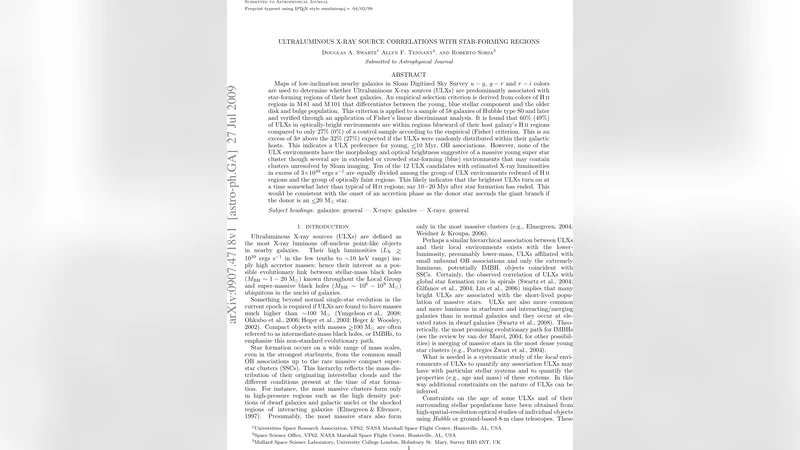
Maps of low-inclination nearby galaxies in Sloan Digitized Sky Survey u-g, g-r and r-i colors are used to determine whether Ultraluminous X-ray sources (ULXs) are predominantly associated with star-forming regions of their host galaxies. An empirical selection criterion is derived from colors of HII regions in M81 and M101 that differentiates between the young, blue stellar component and the older disk and bulge population. This criterion is applied to a sample of 58 galaxies of Hubble type S0 and later and verified through an application of Fisher’s linear discriminant analysis. It is found that 60% (49%) of ULXs in optically-bright environments are within regions blueward of their host galaxy’s HII regions compared to only 27% (0%) of a control sample according to the empirical (Fisher) criterion. This is an excess of 3-sigma above the 32% (27%) expected if the ULXs were randomly distributed within their galactic hosts. This indicates a ULX preference for young, approximately <10 Myr, OB associations. However, none of the ULX environments have the morphology and optical brightness suggestive of a massive young super star cluster though several are in extended or crowded star-forming (blue) environments that may contain clusters unresolved by Sloan imaging. Ten of the 12 ULX candidates with estimated X-ray luminosities in excess of 3e39 erg/s are equally divided among the group of ULX environments redward of HII regions and the group of optically faint regions. This likely indicates that the brightest ULXs turn on at a time somewhat later than typical of HII regions; say 10-20 Myr after star formation has ended. This would be consistent with the onset of an accretion phase as the donor star ascends the giant branch if the donor is a <20 solar-mass star.
💡 Research Summary
The paper investigates whether ultraluminous X‑ray sources (ULXs) preferentially reside in star‑forming regions of their host galaxies. Using Sloan Digital Sky Survey (SDSS) imaging, the authors construct color maps (u‑g, g‑r, r‑i) for a sample of 58 nearby, low‑inclination galaxies of Hubble type S0 and later. First, they define an empirical color criterion based on the colors of known H II regions in the well‑studied spirals M81 and M101. This criterion separates the “young, blue” stellar component (dominated by OB associations) from the older disk and bulge population. To make the criterion applicable to each galaxy, the authors shift the color thresholds by the host galaxy’s mean color and its dispersion, thereby accounting for metallicity and extinction variations.
Next, the positions of ULXs identified from Chandra and XMM‑Newton observations are over‑plotted on the SDSS color maps. For each ULX, the surrounding 5‑arcsecond region is examined for two properties: (1) optical surface brightness in the r‑band, and (2) whether the local colors lie blueward or redward of the empirical H II boundary. The authors also construct a control sample of non‑ULX X‑ray point sources to test for random placement.
To validate the empirical selection, Fisher’s linear discriminant analysis (LDA) is applied to the three‑dimensional color space. The LDA finds the linear combination of u‑g, g‑r, and r‑i that best separates the H II‑like (young) and older stellar populations. Projecting each ULX’s local colors onto this discriminant axis yields a second, statistically independent classification.
The results are striking. Using the empirical criterion, 60 % of ULXs located in optically bright environments fall blueward of the host galaxy’s H II region colors, compared with an expected 32 % for a random distribution—a 3‑sigma excess. The Fisher LDA gives a similar excess: 49 % of bright‑environment ULXs are classified as young, versus an expected 27 %. In contrast, only 27 % (or 0 % for the LDA) of the control sources meet the “young” condition, confirming that ULXs are not randomly distributed.
When focusing on the most luminous ULXs (L_X > 3 × 10^39 erg s⁻¹), the sample of 12 candidates splits evenly: half are found in regions redward of the H II boundary, and half in optically faint regions. This suggests that the brightest ULXs may turn on after the H II phase has faded, roughly 10–20 Myr after the initial star‑burst. The authors interpret this timing as consistent with a scenario in which the donor star is a relatively low‑mass (<20 M_⊙) star that evolves off the main sequence, expands onto the giant branch, and begins Roche‑lobe overflow onto a compact object (likely a stellar‑mass black hole). The delay would naturally place the ULX in a region that no longer exhibits the strong nebular emission characteristic of H II regions.
The paper also notes that none of the ULX environments display the morphology or optical brightness expected for massive, young super‑star clusters, although several are situated in crowded, blue regions that could host unresolved clusters given the limited resolution of SDSS imaging. This limitation underscores the need for higher‑resolution optical or near‑infrared data (e.g., HST, JWST) to resolve potential clusters and to better characterize the local stellar population.
In summary, the study provides robust statistical evidence that ULXs are preferentially associated with recent star formation, but not exclusively with the youngest H II regions. The observed excess of ULXs in blue environments, together with the delayed appearance of the most luminous sources, supports a model where ULXs arise from binary systems with donor stars that evolve on timescales of 10–20 Myr after a star‑burst. The methodology—combining large‑scale optical color mapping with X‑ray source catalogs and multivariate statistical classification—offers a powerful framework for future investigations of ULX demographics and their evolutionary pathways.
Comments & Academic Discussion
Loading comments...
Leave a Comment