The Sun as a Star: 13 years of SoHO
The best known Solar oscillation-like star is the Sun. During the last 14 years, the ESA/NASA Solar and Heliospheric Observatory (SoHO) has been continuously observing this star from the Lagrange point L1 with an enormous success. Among the 11 instruments placed onboard, 3 of them are dedicated to helioseismology: GOLF, VIRGO and MDI. The first two observe the Sun as a star by integrating the velocity or intensity signal of the visible solar disk into a single point. They are thus similar to any other observation done in asteroseismology. During this review I will present the most important results obtained during the mission concerning the Sun seen as a star and how this results have evolved our thoughts of the inside of our star.
💡 Research Summary
The Solar and Heliospheric Observatory (SoHO) has been operating at the L1 Lagrange point since 1995, delivering an uninterrupted 13‑year record of the Sun observed as a star. Three helioseismic instruments—GOLF (Global Oscillations at Low Frequency), VIRGO (Variability of solar IRradiance and Gravity Oscillations), and MDI (Michelson Doppler Imager)—provide complementary measurements: disk‑integrated velocity, broadband photometry, and full‑disk Doppler images. GOLF’s ultra‑stable velocity time series reach sub‑nanometer precision in the 0.1–5 mHz range, enabling detection of low‑frequency p‑modes and tentative g‑mode signatures that probe the solar core’s rotation. VIRGO’s three‑color photometers deliver micro‑mag precision in integrated solar brightness, allowing a direct comparison with space‑based asteroseismic missions that use single‑point photometry. MDI supplies high‑resolution Doppler maps and magnetograms, from which the global rotation profile, convective flows, and magnetic structures are inferred, and it supplies high‑ℓ mode information that complements the low‑ℓ data from GOLF and VIRGO.
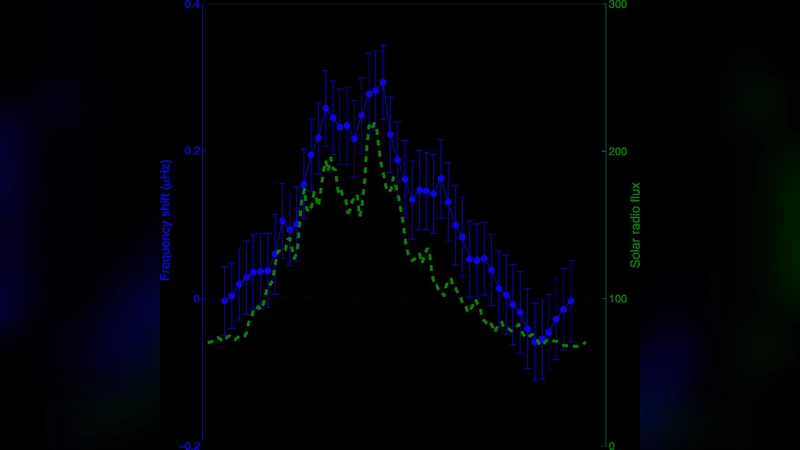
The combined dataset has led to several landmark results. First, the solar sound‑speed profile has been refined to better than 0.1 % relative to the Standard Solar Model, forcing a modest revision of core helium abundance and metallicity. Second, low‑amplitude g‑mode candidates suggest the core rotates roughly 5 % faster than the surface. Third, a clear activity‑cycle dependence of p‑mode frequencies has been quantified: during solar maximum, high‑frequency modes (≈3 mHz) shift upward by ~0.4 µHz, while low‑frequency modes shift downward by ~0.1 µHz. These variations provide a benchmark for interpreting similar frequency shifts in other stars observed by Kepler, TESS, and PLATO.
Crucially, SoHO demonstrates that “Sun‑as‑a‑star” observations are directly applicable to asteroseismology. The simultaneous velocity and intensity time series enable measurement of amplitude ratios and phase differences, diagnostics that can reveal non‑spherical rotation, structural asymmetries, and internal magnetic fields in distant stars. The near‑continuous coverage eliminates data gaps, making the series ideal for advanced time‑series techniques, Bayesian inference, and machine‑learning pattern recognition, and the public archive encourages worldwide collaboration.
In summary, SoHO’s 13‑year mission has transformed our understanding of the solar interior, validated the star‑as‑a‑point‑source approach, and provided a high‑fidelity reference for the broader asteroseismic community. Its legacy will continue to shape the design of future helio‑ and asteroseismic missions and the analytical tools used to probe stellar interiors across the Galaxy.
Comments & Academic Discussion
Loading comments...
Leave a Comment