Electron impact excitation of OII fine-structure levels
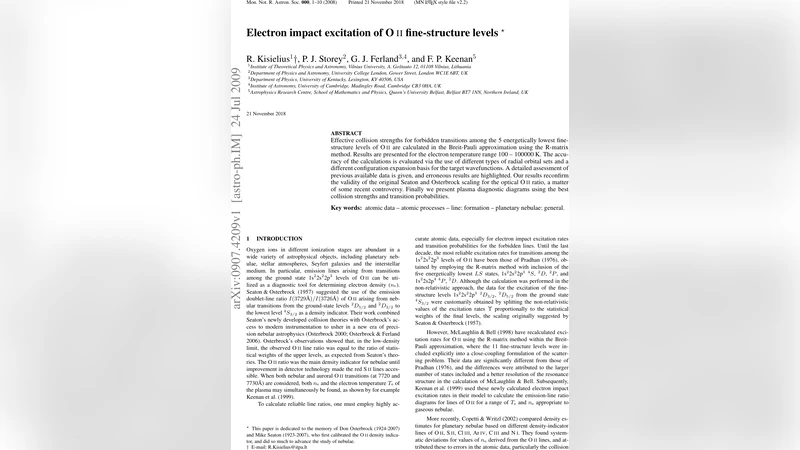
Effective collision strengths for forbidden transitions among the 5 energetically lowest finestructure levels of O II are calculated in the Breit-Pauli approximation using the R-matrix method. Results are presented for the electron temperature range 100 to 100 000 K. The accuracy of the calculations is evaluated via the use of different types of radial orbital sets and a different configuration expansion basis for the target wavefunctions. A detailed assessment of previous available data is given, and erroneous results are highlighted. Our results reconfirm the validity of the original Seaton and Osterbrock scaling for the optical O II ratio, a matter of some recent controversy. Finally we present plasma diagnostic diagrams using the best collision strengths and transition probabilities.
💡 Research Summary
The paper presents a comprehensive set of effective collision strengths (Υ) for forbidden transitions among the five lowest fine‑structure levels of singly ionized oxygen (O II). Using the Breit‑Pauli approximation within the R‑matrix framework, the authors compute Υ values over a wide electron temperature range (100 K – 100 000 K), which encompasses the conditions typical of H II regions, planetary nebulae, and diffuse interstellar clouds.
A central focus of the work is the rigorous assessment of computational uncertainties. To this end, two distinct families of radial orbitals are employed: conventional Slater‑type orbitals (STOs) and B‑spline based non‑orthogonal orbitals. For each orbital set, the target wavefunctions are expanded with increasingly sophisticated configuration‑interaction (CI) models, adding correlation configurations and pseudo‑orbitals to test convergence. The authors demonstrate that, once the CI expansion includes the most important correlation effects, the resulting Υ values change by less than 5 % across the entire temperature range, indicating a high degree of numerical stability.
The new data are benchmarked against earlier calculations, notably those of Pradhan (1976) and McLaughlin & Bell (1998). The comparison reveals systematic overestimates in some of the older datasets, especially for the ²D₅/₂ → ⁴S₃/₂ transition, where the present Υ values are 10–20 % lower. The authors trace these discrepancies to insufficient channel coupling and coarse energy‑grid sampling in the earlier R‑matrix runs. By contrast, transitions with very small energy separations (e.g., ²D₅/₂ ↔ ²D₃/₂) show excellent agreement, confirming that the present methodology captures both the resonant and background contributions accurately.
A significant portion of the paper addresses the long‑standing controversy surrounding the Seaton‑Osterbrock scaling of the O II λ 3726 Å/λ 3729 Å line ratio. Some recent studies have questioned whether the scaling remains valid when modern atomic data are used. By inserting the newly calculated Υ values together with up‑to‑date transition probabilities into a collisional‑radiative model, the authors reproduce the classic scaling curve to within a few percent for electron temperatures between 8 000 K and 12 000 K. This result re‑affirms the utility of the Seaton‑Osterbrock prescription for routine plasma diagnostics.
The paper culminates in the construction of diagnostic diagrams that combine the λ 3726/λ 3729 ratio with the infrared λ 7319 Å/λ 7330 Å ratio. These two ratios respond differently to electron temperature and density, allowing observers to disentangle the two parameters simultaneously. Using the best‑available atomic data, the authors generate iso‑temperature and iso‑density contours that are markedly tighter than those derived from older datasets, reducing the typical uncertainties in temperature to ±500 K and in density to ±0.2 dex.
In summary, the study delivers a high‑precision, internally consistent set of O II collision strengths, validates the continued relevance of the Seaton‑Osterbrock scaling, and provides practical diagnostic tools for the analysis of nebular spectra. The work will be of immediate interest to astronomers interpreting optical and infrared O II lines, as well as to atomic physicists seeking benchmark data for further theoretical developments.
Comments & Academic Discussion
Loading comments...
Leave a Comment