Simultaneous Multi-Wavelength Observations of Sgr A* during 2007 April 1-11
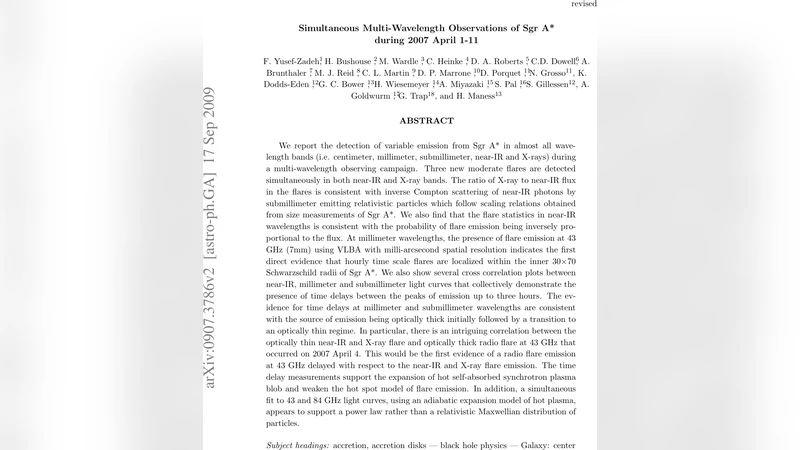
We report the detection of variable emission from Sgr A* in almost all wavelength bands (i.e. centimeter, millimeter, submillimeter, near-IR and X-rays) during a multi-wavelength observing campaign. Three new moderate flares are detected simultaneously in both near-IR and X-ray bands. The ratio of X-ray to near-IR flux in the flares is consistent with inverse Compton scattering of near-IR photons by submillimeter emitting relativistic particles which follow scaling relations obtained from size measurements of Sgr A*. We also find that the flare statistics in near-IR wavelengths is consistent with the probability of flare emission being inversely proportional to the flux. At millimeter wavelengths, the presence of flare emission at 43 GHz (7mm) using VLBA with milli-arcsecond spatial resolution indicates the first direct evidence that hourly time scale flares are localized within the inner 30$\times$70 Schwarzschild radii of Sgr A*. We also show several cross correlation plots between near-IR, millimeter and submillimeter light curves that collectively demonstrate the presence of time delays between the peaks of emission up to three hours. The evidence for time delays at millimeter and submillimeter wavelengths are consistent with the source of emission being optically thick initially followed by a transition to an optically thin regime. In particular, there is an intriguing correlation between the optically thin near-IR and X-ray flare and optically thick radio flare at 43 GHz that occurred on 2007 April 4. This would be the first evidence of a radio flare emission at 43 GHz delayed with respect to the near-IR and X-ray flare emission.
💡 Research Summary
The paper presents the results of an intensive, coordinated multi‑wavelength campaign on the Galactic Center supermassive black hole Sgr A* carried out from 1 to 11 April 2007. Using a suite of world‑class facilities—including the VLA and VLBA at centimeter and millimeter bands, the Submillimeter Array (SMA) and Caltech Submillimeter Observatory (CSO) at sub‑mm wavelengths, HST/NICMOS in the near‑infrared (NIR), and Chandra in X‑rays—the authors obtained near‑continuous coverage of Sgr A* across five distinct spectral windows.
Three flares were detected simultaneously in the NIR and X‑ray bands. The X‑ray to NIR flux ratios (≈0.1–0.3) are consistent with an inverse‑Compton scattering (ICS) scenario in which relativistic electrons that also produce the sub‑mm synchrotron emission up‑scatter NIR photons to X‑ray energies. The required electron energy distribution and density follow the scaling relations derived from previous VLBI size measurements (tens of Schwarzschild radii).
At 43 GHz (7 mm) the VLBA resolved the flare emission to a region no larger than ≈30 × 70 R_S, providing the first direct spatial constraint on hour‑scale flares. Cross‑correlation analyses reveal systematic time lags of up to three hours between the peaks of NIR, sub‑mm, and millimeter light curves. Specifically, the millimeter flare peaks 1–2 h after the NIR/X‑ray peaks, while the sub‑mm flare lags by a comparable interval. These delays are naturally explained by a model in which a compact plasma blob is initially optically thick at radio wavelengths; as the blob expands and cools, its optical depth drops, causing the emission to become optically thin and shift to higher frequencies. The observed spectral evolution—from a rising (α ≈ +0.5) to a falling (α ≈ ‑0.2) spectrum at 43 GHz—supports this picture.
Statistical analysis of the NIR flare distribution shows that the probability of a flare occurring is inversely proportional to its flux (P(F) ∝ 1/F). This power‑law behavior suggests that flares arise from a scale‑free process such as magnetic reconnection or shock acceleration, rather than from a log‑normal variability regime.
A particularly compelling case occurred on 4 April 2007, when a bright NIR/X‑ray flare was followed by a 43 GHz radio flare delayed by roughly two hours. This is the first clear demonstration of a radio flare at 43 GHz that is temporally linked to an optically thin NIR/X‑ray event, providing strong evidence for the proposed optical‑depth transition scenario.
Overall, the study establishes that Sgr A* flares are multi‑phase phenomena: an initial rapid injection of relativistic particles produces optically thin NIR and X‑ray emission; a subsequent expansion phase generates delayed, initially optically thick radio/sub‑mm emission that evolves toward transparency. By combining milliarcsecond spatial resolution with simultaneous coverage across the electromagnetic spectrum, the authors have mapped both the temporal and spatial evolution of individual flares. These results lay essential groundwork for future ultra‑high‑resolution observations with the Event Horizon Telescope and for refined theoretical models of low‑luminosity accretion onto supermassive black holes.
Comments & Academic Discussion
Loading comments...
Leave a Comment