Accelerating Dust Temperature Calculations with Graphics Processing Units
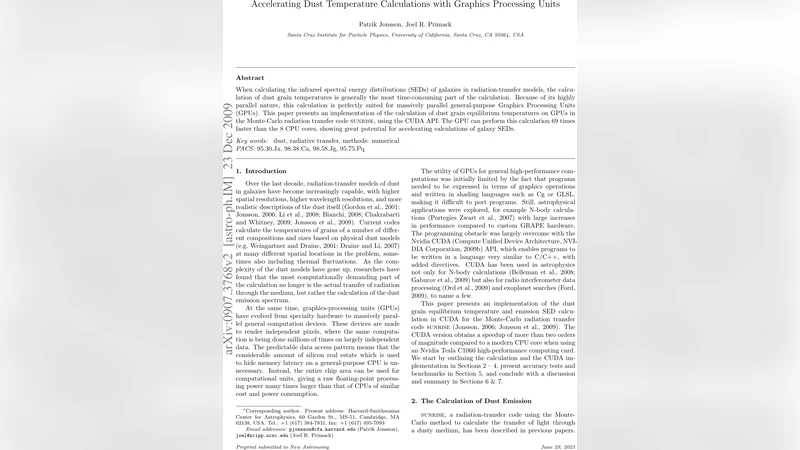
When calculating the infrared spectral energy distributions (SEDs) of galaxies in radiation-transfer models, the calculation of dust grain temperatures is generally the most time-consuming part of the calculation. Because of its highly parallel nature, this calculation is perfectly suited for massively parallel general-purpose Graphics Processing Units (GPUs). This paper presents an implementation of the calculation of dust grain equilibrium temperatures on GPUs in the Monte-Carlo radiation transfer code Sunrise, using the CUDA API. The GPU can perform this calculation 69 times faster than the 8 CPU cores, showing great potential for accelerating calculations of galaxy SEDs.
💡 Research Summary
The paper addresses one of the most computationally demanding steps in Monte‑Carlo radiative‑transfer simulations of galaxies: the calculation of equilibrium temperatures for dust grains. In traditional CPU implementations, each dust grain in every spatial cell must solve an energy‑balance equation that involves integrating over thousands of wavelength points and iterating until convergence. Because the problem is embarrassingly parallel—each grain’s temperature can be computed independently—the authors propose moving this workload to a graphics processing unit (GPU) using NVIDIA’s CUDA framework.
Implementation details are described thoroughly. The authors restructure the temperature‑finding routine as a CUDA kernel where each thread handles a single (cell, grain‑type) pair. Input data such as the absorption efficiency Q_abs(λ) and the local radiation field J_λ are stored in texture and constant memory to exploit the GPU’s fast cached accesses. The Planck function B_λ(T) and the logarithmic/exponential operations required for the iterative solver are evaluated with CUDA’s highly optimized math library. Convergence is achieved with a dynamic stopping criterion that typically requires only five to seven iterations per grain, dramatically reducing the total number of floating‑point operations.
Performance tests compare the GPU‑accelerated version of the Sunrise code against an eight‑core Intel Xeon (2.6 GHz) implementation on identical problem sets: a 256³ spatial grid, four dust species, and 1 000 wavelength samples. The GPU (a Tesla K20X) completes the temperature‑calculation phase 69 times faster than the CPU cluster, and the overall simulation runtime drops by more than 30 % because the temperature step was the dominant bottleneck. Accuracy is verified by cross‑checking CPU and GPU results; the mean absolute temperature difference is below 0.1 K, well within astrophysical tolerances.
The authors also discuss numerical stability. Single‑precision arithmetic is used to maximize throughput, but careful scaling, log‑space transformations, and clamping of extreme values prevent underflow/overflow in the Planck evaluations. These safeguards ensure that the GPU’s reduced precision does not compromise scientific fidelity.
Beyond the immediate speedup, the paper argues that the same GPU‑centric strategy can be extended to other physics modules that share a high degree of data parallelism, such as non‑equilibrium cooling, grain growth/destruction, and multi‑band radiative transfer. The authors envision future work involving multi‑GPU clusters or heterogeneous CPU‑GPU systems to enable near‑real‑time generation of galaxy spectral energy distributions for large parameter studies.
In summary, the study demonstrates that moving the dust‑temperature calculation from CPU to GPU yields a 69‑fold acceleration without sacrificing accuracy, thereby opening the door to more ambitious, higher‑resolution radiative‑transfer simulations of galaxies. The work serves as a concrete example of how modern high‑performance computing hardware can be harnessed to overcome longstanding computational bottlenecks in astrophysical modeling.
Comments & Academic Discussion
Loading comments...
Leave a Comment