State Transitions in Bright Galactic X-ray Binaries: Luminosities Span by Two Orders of Magnitude
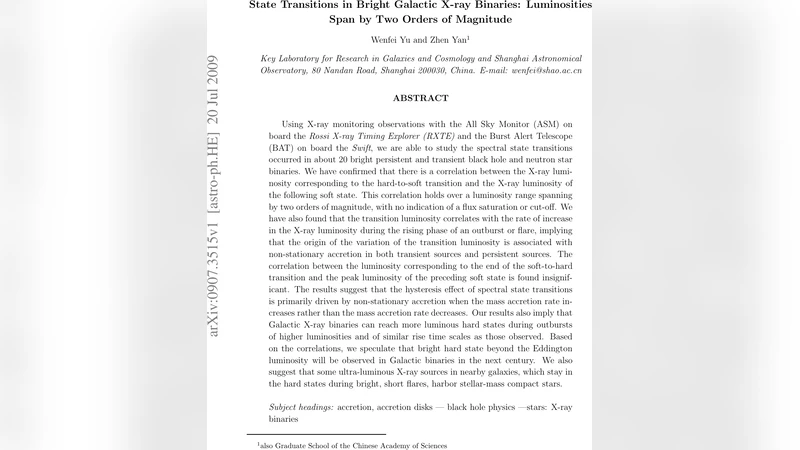
Using X-ray monitoring observations with the ASM on board the RXTE and the BAT on board the Swift, we are able to study the spectral state transitions occurred in about 20 bright persistent and transient black hole and neutron star binaries. We have confirmed that there is a correlation between the X-ray luminosity corresponding to the hard-to-soft transition and the X-ray luminosity of the following soft state. This correlation holds over a luminosity range spanning by two orders of magnitude, with no indication of a flux saturation or cut-off. We have also found that the transition luminosity correlates with the rate of increase in the X-ray luminosity during the rising phase of an outburst or flare, implying that the origin of the variation of the transition luminosity is associated with non-stationary accretion in both transient sources and persistent sources. The correlation between the luminosity corresponding to the end of the soft-to-hard transition and the peak luminosity of the preceding soft state is found insignificant. The results suggest that the hysteresis effect of spectral state transitions is primarily driven by non-stationary accretion when the mass accretion rate increases rather than the mass accretion rate decreases. Our results also imply that Galactic X-ray binaries can reach more luminous hard states during outbursts of higher luminosities and of similar rise time scales as those observed. Based on the correlations, we speculate that bright hard state beyond the Eddington luminosity will be observed in Galactic binaries in the next century. We also suggest that some ultra-luminous X-ray sources in nearby galaxies, which stay in the hard states during bright, short flares, harbor stellar-mass compact stars.
💡 Research Summary
In this work the authors exploit the long‑term monitoring capabilities of the Rossi X‑ray Timing Explorer’s All‑Sky Monitor (ASM, 2–12 keV) and the Swift Burst Alert Telescope (BAT, 15–50 keV) to investigate spectral state transitions in a sample of roughly twenty bright Galactic X‑ray binaries, including both persistent systems and transient outbursts, and covering both black‑hole and neutron‑star accretors. By defining transition epochs through changes in the hardness ratio between the soft and hard bands, they separate hard‑to‑soft (H→S) and soft‑to‑hard (S→H) events and measure the X‑ray luminosity at each transition as well as the peak luminosity of the subsequent soft state.
The first major result is a tight, nearly linear correlation (in log–log space) between the luminosity at the H→S transition (L_H→S) and the maximum luminosity reached during the ensuing soft state (L_S,peak). This correlation spans more than two orders of magnitude, from ∼10⁻³ L_Edd up to ∼10⁻¹ L_Edd, with no evidence for a saturation or cut‑off at high luminosities. The authors interpret this as indicating that the “critical” mass‑accretion rate (Ṁ) that triggers the transition is not a universal constant but depends on the instantaneous, non‑stationary accretion flow of each source.
A second, equally important finding is that L_H→S correlates positively with the rate of increase of the X‑ray luminosity (dL/dt) during the rising phase of an outburst or flare. In other words, the faster the source brightens, the higher the luminosity at which the hard‑to‑soft transition occurs. This suggests that the time derivative of the accretion rate (i.e., the acceleration of Ṁ) plays a crucial role in setting the transition threshold, reinforcing the idea that non‑steady accretion dominates the physics of the H→S switch. By contrast, the luminosity at the soft‑to‑hard transition (L_S→H) shows no statistically significant correlation with the preceding soft‑state peak, implying that the hysteresis effect is largely asymmetric: it is driven by the dynamics of increasing Ṁ rather than decreasing Ṁ.
From these empirical relations the authors draw several astrophysical implications. First, hard states can reach luminosities comparable to, or even exceeding, the Eddington limit for a stellar‑mass compact object, provided the rise time of the outburst is sufficiently short and the overall outburst amplitude is large. Current observations have captured hard‑state luminosities up to ≈0.5 L_Edd; the extrapolation of the L_H→S–dL/dt relation predicts that future outbursts could push hard states above L_Edd. Second, some ultra‑luminous X‑ray sources (ULXs) that display hard spectra during brief, bright flares may in fact be ordinary Galactic binaries with stellar‑mass black holes or neutron stars undergoing extreme, rapid accretion episodes. This challenges the need to invoke intermediate‑mass black holes for all hard‑state ULXs. Third, the dominance of non‑stationary accretion in setting transition thresholds calls for a revision of the classic “critical Ṁ” paradigm. Theoretical models must incorporate time‑dependent disk‑corona interactions, variable inner‑disk truncation radii, and rapid changes in coronal heating to reproduce the observed hysteresis asymmetry.
Finally, the authors speculate that, as monitoring sensitivity improves with upcoming missions such as eROSITA, Athena, and XRISM, the Galactic population will eventually reveal hard‑state episodes that surpass the Eddington luminosity, confirming the extrapolation of their correlations. Detecting such events will provide a unique laboratory for studying radiation‑pressure dominated accretion flows, jet launching at super‑Eddington rates, and the coupling between disk and corona under extreme conditions.
Comments & Academic Discussion
Loading comments...
Leave a Comment