Decay of the toroidal field in magnetically driven jets
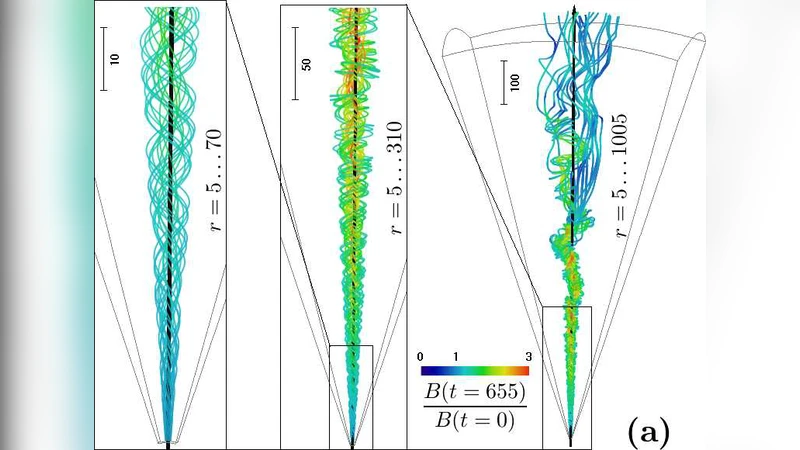
A 3D simulation of a non-relativistic, magnetically driven jet propagating in a stratified atmosphere is presented, covering about three decades in distance and two decades in sideways expansion. The simulation captures the jet acceleration through the critical surfaces and the development of (kink-)instabilities driven by the free energy in the toroidal magnetic field component. The instabilities destroy the ordered helical structure of the magnetic field, dissipating the toroidal field energy on a length scale of about 2-15 times the Alfven distance. We compare the results with a 2.5D (axisymmetric) simulation, which does not become unstable. The acceleration of the flow is found to be quite similar in both cases, but the mechanisms of acceleration differ. In the 2.5D case approximately 20% of the Poynting flux remains in the flow, in the 3D case this fraction is largely dissipated internally. Half of the dissipated energy is available for light emission; the resulting radiation would produce structures resembling those seen in protostellar jets.
💡 Research Summary
The paper presents a comprehensive three‑dimensional magnetohydrodynamic (MHD) simulation of a non‑relativistic, magnetically driven jet propagating through a stratified atmosphere. The authors follow the jet from its launch region out to distances spanning three orders of magnitude and allow for lateral expansion over two orders of magnitude, thereby covering the full acceleration zone, the critical surfaces (slow, Alfvén, and fast), and the region where magnetic instabilities develop.
Two complementary calculations are performed. The first is a fully 3D run that permits all non‑axisymmetric modes, while the second is a 2.5D (axisymmetric) run that suppresses such modes. Both simulations start from a configuration in which a strong poloidal field threads the central object and a toroidal component builds up as the flow rotates. The ambient medium follows a decreasing density profile typical of a stratified stellar wind or protostellar envelope.
In the 3D case the toroidal magnetic field stores a large amount of free energy. This energy drives a kink (m = 1) instability that grows rapidly once the jet passes the Alfvén surface. The instability twists the current channel, destroys the ordered helical field geometry, and dissipates the toroidal field on a length scale of roughly 2–15 Alfvén radii. Approximately half of the dissipated magnetic energy is converted into internal heat and particle acceleration, while the other half becomes available for radiation (e.g., synchrotron or bremsstrahlung). Consequently, a substantial fraction of the original Poynting flux is lost internally; only a few percent of the initial electromagnetic energy survives to large distances.
By contrast, the 2.5D simulation remains stable because the kink mode is prohibited by symmetry. The toroidal field persists, and about 20 % of the initial Poynting flux continues to be carried by the flow to the outer boundary. Acceleration in this case is dominated by the classic magnetic‑slingshot mechanism and pressure gradients, with the electromagnetic energy being directly converted into kinetic energy rather than being internally dissipated.
Both models achieve similar terminal velocities, indicating that the overall jet acceleration is robust against the presence of the instability. However, the underlying physics differs: in 3D the electric field term (E·B) associated with the turbulent, dissipative cascade provides an additional boost, whereas in 2.5D the acceleration is purely magnetocentrifugal.
The authors also explore how lateral expansion influences the instability. Faster expansion thins the toroidal layer, lowering the threshold for kink growth and shortening the dissipation length. This behavior offers a natural explanation for the bright, knotty structures observed in protostellar jets, where localized heating and radiation are expected where the magnetic field decays.
Overall, the study demonstrates that three‑dimensional kink instabilities can efficiently convert toroidal magnetic energy into heat and radiation, fundamentally altering the jet’s energy budget and observable appearance. The results bridge the gap between idealized axisymmetric jet models and real astrophysical jets, suggesting that magnetic dissipation may play a crucial role not only in protostellar outflows but also in more powerful systems such as AGN jets.
Comments & Academic Discussion
Loading comments...
Leave a Comment