Two approaches to testing general relativity in the strong-field regime
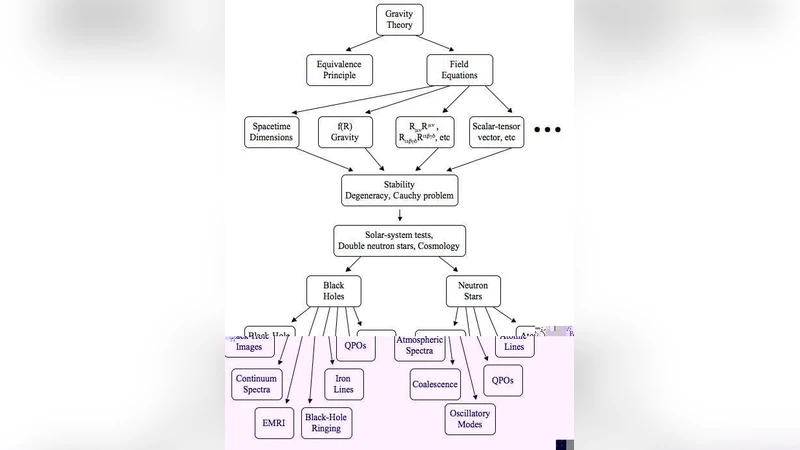
Observations of compact objects in the electromagnetic spectrum and the detection of gravitational waves from them can lead to quantitative tests of the theory of general relativity in the strong-field regime following two very different approaches. In the first approach, the general relativistic field equations are modified at a fundamental level and the magnitudes of the potential deviations are constrained by comparison with observations. In the second approach, the exterior spacetimes of compact objects are parametrized in a phenomenological way, the various parameters are measured observationally, and the results are finally compared against the general relativistic predictions. In this article, I discuss the current status of both approaches, focusing on the lessons learned from a large number of recent investigations.
💡 Research Summary
The paper provides a comprehensive review of two fundamentally different strategies for testing General Relativity (GR) in the strong‑field regime, i.e., in the vicinity of compact objects such as black holes and neutron stars. The first strategy, often called the “theory‑modification” approach, starts from a specific alternative gravitational theory that changes the Einstein field equations at a fundamental level. Typical examples include scalar‑tensor theories, higher‑order curvature corrections, Einstein‑Æther models, and other extensions that introduce a small set of new coupling constants or higher‑dimensional operators. In this framework the deviations from GR are encoded in a handful of theory‑specific parameters (e.g., the Brans‑Dicke coupling ω, the Gauss‑Bonnet coupling αGB, or the Æther coefficients c_i). The paper explains how these parameters affect observable quantities such as orbital precession, X‑ray reflection‑line profiles, quasi‑periodic oscillations, and the phase evolution of gravitational‑wave (GW) signals. By comparing the theoretical predictions with data from X‑ray telescopes (NuSTAR, XMM‑Newton, Chandra, IXPE), very‑long‑baseline interferometry (the Event Horizon Telescope), and GW detectors (LIGO, Virgo, KAGRA), Bayesian inference or frequentist likelihood analyses yield constraints on the magnitude of the new couplings. The main advantage of this approach is its direct link to a concrete physical model, which allows one to test specific predictions (e.g., scalar‑radiation loss, dipole GW emission). Its drawback is the rapid growth of the parameter space when many alternative models are considered, which can dilute statistical power unless multiple, independent observations are combined.
The second strategy, termed “phenomenological parametrization,” does not assume any particular underlying theory. Instead, it treats the exterior spacetime of a compact object as a generic deviation from the Kerr metric, introducing a set of phenomenological parameters that modify the metric components in a model‑independent way. The most widely used frameworks are the Johannsen‑Psaltis metric, the modified gravity bumpy black hole formalism, and the “parameterized post‑Kerr” (PPK) expansions. Parameters such as ε, α13, α22, β, etc., quantify departures in the g_tt, g_tφ, g_rr components, and they can be directly mapped onto observable signatures: the size and shape of the black‑hole shadow, the frequency of innermost stable circular orbits, the timing of pulsar orbits, and the higher‑order multipole moments that influence GW waveforms. Observational data are fitted with these generalized metrics, and the resulting best‑fit values are compared to the GR prediction (all parameters zero). The strength of this approach lies in its theory‑agnostic nature, allowing a single analysis to constrain a broad class of possible deviations. However, the physical interpretation of the fitted parameters requires a posterior mapping to specific theories, and strong correlations among parameters can make the inference challenging.
The review surveys the state of the art up to 2024. In the electromagnetic domain, high‑resolution Fe Kα line spectroscopy, X‑ray continuum fitting, and polarimetric measurements have constrained deviations in the spacetime geometry to the 1–2 % level. The EHT images of M87* and Sgr A* have measured the shadow diameter with an uncertainty of roughly 5 %, consistent with the Kerr prediction within 0.02 M. In the GW sector, the GWTC‑3 catalog (≈90 binary black‑hole and binary‑neutron‑star mergers) has been used to bound post‑Newtonian deviation parameters to |δ| ≲ 10⁻² and to place limits on parameterized post‑Einsteinian (ppE) coefficients at the 10⁻³–10⁻⁴ level. A few events show mild hints of scalar‑dipole radiation, but the statistical significance remains below the conventional detection threshold.
Key lessons highlighted by the author are: (1) Theory‑modification tests are powerful for falsifying specific models but require a careful accounting of model priors and often need multi‑messenger data to break degeneracies. (2) Phenomenological parametrizations provide a clean, model‑independent null test of GR, yet their utility depends on the ability to translate constraints back into physically meaningful statements about alternative theories. (3) Current observations already confirm GR’s validity in the strong‑field regime to an impressive degree, but the next decade promises order‑of‑magnitude improvements. Planned space‑based GW observatories (LISA), third‑generation ground‑based detectors (Einstein Telescope, Cosmic Explorer), and next‑generation EHT campaigns, together with high‑throughput X‑ray missions (Athena, XRISM), will push parameter uncertainties down to the 10⁻⁴–10⁻⁵ level. Such precision will either tighten the no‑deviation window dramatically or uncover subtle signatures of new physics.
In conclusion, the paper argues that the two approaches are complementary rather than competing. A robust program for testing GR in the strong‑field regime should combine theory‑specific predictions with phenomenological null‑tests, exploit the synergy of electromagnetic and gravitational‑wave observations, and continuously refine statistical methods to handle high‑dimensional parameter spaces. While General Relativity continues to pass all current strong‑field tests, the upcoming observational era holds the promise of either confirming its completeness with unprecedented rigor or revealing the first cracks that could point toward a deeper theory of gravity.
Comments & Academic Discussion
Loading comments...
Leave a Comment