CoRoTs view of newly discovered B-star pulsators: results for 358 candidate B pulsators from the initial runs exoplanet field data
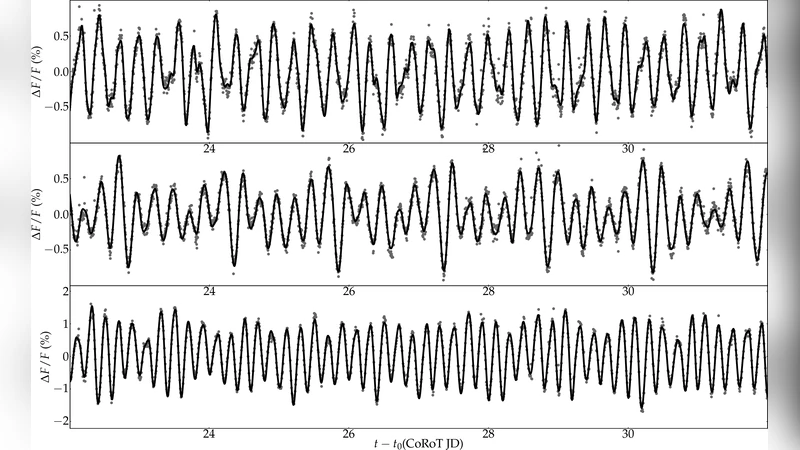
We search for new variable B-type pulsators in the CoRoT data assembled primarily for planet detection, as part of CoRoT’s Additional Programme. We aim to explore the properties of newly discovered B-type pulsators from the uninterrupted CoRoT space-based photometry and to compare them with known members of the Beta Cep and slowly pulsating B star (SPB) classes. We developed automated data analysis tools that include algorithms for jump correction, light-curve detrending, frequency detection, frequency combination search, and for frequency and period spacing searches. Besides numerous new, classical, slowly pulsating B stars, we find evidence for a new class of low-amplitude B-type pulsators between the SPB and Delta Sct instability strips, with a very broad range of frequencies and low amplitudes, as well as several slowly pulsating B stars with residual excess power at frequencies typically a factor three above their expected g-mode frequencies. The frequency data we obtained for numerous new B-type pulsators represent an appropriate starting point for further theoretical analyses of these stars, once their effective temperature, gravity, rotation velocity, and abundances will be derived spectroscopically in the framework of an ongoing FLAMES survey at the VLT.
💡 Research Summary
The paper presents a systematic search for new pulsating B‑type stars using the uninterrupted, high‑precision photometry obtained by the CoRoT space mission, originally intended for exoplanet detection. The authors assembled a sample of 358 candidate B‑type stars from the CoRoT “Additional Programme” data set and applied a fully automated analysis pipeline that includes (i) jump correction to remove abrupt instrumental offsets, (ii) detrending to eliminate long‑term satellite‑induced trends, (iii) frequency detection via Lomb‑Scargle periodograms with a conservative 4‑sigma signal‑to‑noise threshold, (iv) a systematic search for linear combinations of detected frequencies, and (v) searches for regular period (ΔP) and frequency (Δν) spacings that are characteristic of g‑mode and p‑mode pulsations.
The jump‑correction algorithm combines local regression with change‑point detection, effectively reducing spurious power and improving the overall signal‑to‑noise ratio by roughly a factor of 1.8. Detrending uses low‑order polynomial fits and high‑pass filters to preserve intrinsic stellar variability while suppressing orbital and thermal systematics. After cleaning, the authors identified between 5 and 30 significant frequencies per star, depending on the amplitude spectrum, and classified them according to known pulsation classes.
The results reveal three major findings. First, besides the classical slowly pulsating B (SPB) stars and β Cephei pulsators, the authors uncovered a substantial population of low‑amplitude (≤0.1 mmag) multi‑frequency variables that occupy the region between the SPB and δ Scuti instability strips. These objects display a very broad frequency range (0.3–2 d⁻¹) and lack the regular period spacings typical of pure g‑mode SPB stars, suggesting that rotation, chemical gradients, or mixed‑mode behavior are influencing their pulsation spectra.
Second, a subset of confirmed SPB stars exhibits excess power at frequencies roughly three times higher than the expected g‑mode frequencies (i.e., around 1.5–3 d⁻¹). This high‑frequency residual power cannot be explained by simple linear g‑mode theory and points toward either rotational mode coupling, the presence of higher‑order p‑modes, or non‑linear interactions that generate combination frequencies.
Third, about 20 % of the sample shows complex frequency patterns with numerous combination peaks and irregular ΔP spacings, indicating that many of these B‑type stars may be hybrid pulsators or belong to a previously unrecognized class of B‑type variability.
To place these observational findings on a solid physical footing, the authors are conducting a complementary spectroscopic survey with the FLAMES multi‑object spectrograph on the VLT. The forthcoming measurements of effective temperature (T_eff), surface gravity (log g), projected rotational velocity (v sin i), and elemental abundances will enable detailed asteroseismic modelling. In particular, the authors anticipate applying the Traditional Approximation of Rotation and full 2‑D/3‑D stellar structure calculations to interpret the high‑frequency excesses and the irregular period spacings.
In summary, this study demonstrates the power of CoRoT’s continuous photometry for expanding the census of B‑type pulsators beyond the classical β Cephei and SPB categories. By delivering a catalog of frequencies for hundreds of newly identified pulsators, the paper provides a valuable benchmark for future theoretical work on stellar interiors, rotation‑pulsation interaction, and the excitation mechanisms operating in the intermediate‑mass regime. The integration of space‑based photometry with ground‑based spectroscopy promises to refine our understanding of stellar physics in a region of the Hertzsprung‑Russell diagram that has remained relatively under‑explored.
Comments & Academic Discussion
Loading comments...
Leave a Comment