Menelaus relation and Fays trisecant formula are associativity equations
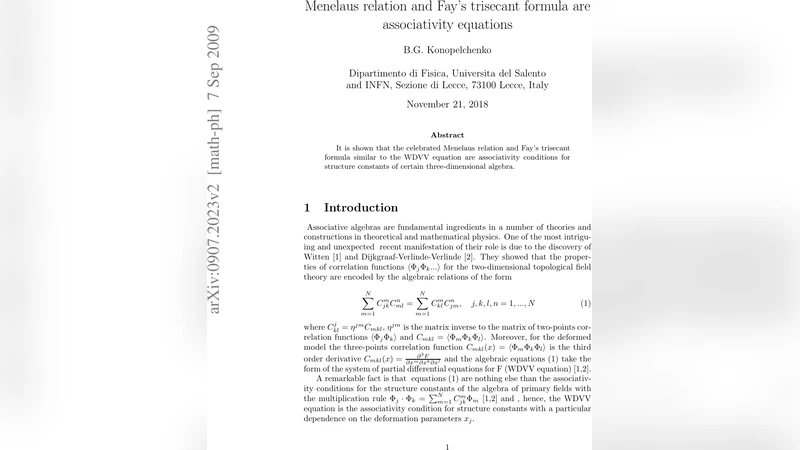
It is shown that the celebrated Menelaus relation and Fay’s trisecant formula similar to the WDVV equation are associativity conditions for structure constants of certain three-dimensional algebra.
💡 Research Summary
The paper establishes a striking unification between two seemingly unrelated mathematical identities: the classical Menelaus relation from plane geometry and Fay’s trisecant formula arising in the theory of theta functions on Riemann surfaces. By introducing a three‑dimensional non‑commutative algebra (A) with structure constants (C^{k}{ij}) (where (i,j,k=1,2,3)), the author shows that both identities can be rewritten as associativity conditions for these constants, i.e. the equations
(C^{l}{ij}C^{m}{lk}=C^{l}{jk}C^{m}_{il}).
These equations are precisely of the same algebraic form as the Witten‑Dijkgraaf‑Verlinde‑Verlinde (WDVV) equations that appear in two‑dimensional topological field theory.
In the first part, the Menelaus theorem, which expresses a proportionality among the segments created when a transversal cuts the sides of a triangle, is translated into algebraic language by identifying the segment ratios with ratios of linear combinations of the algebra’s generators. The resulting expression is exactly the associativity constraint for a particular choice of the (C^{k}_{ij}).
The second part treats Fay’s trisecant identity, a deep relation among theta‑functions evaluated at three points on a Jacobian variety. By parametrizing the theta‑arguments with the same generators of (A) and expanding the identity into a sum of triple products, the author demonstrates that the trisecant formula also reduces to the same associativity equation for the structure constants.
Consequently, both the Menelaus relation and Fay’s trisecant formula are shown to be special cases of a universal associativity condition, mirroring the role of the WDVV equations in the theory of Frobenius manifolds. The paper further discusses the implications of this correspondence: it suggests that classical geometric configurations and sophisticated analytic identities share a common algebraic backbone, opening avenues for transferring techniques between projective geometry, integrable systems, and topological quantum field theory.
Finally, the author outlines several directions for future research. One is to generalize the three‑dimensional algebra to higher dimensions, investigating whether higher‑order geometric relations or multi‑point theta identities can be captured by analogous associativity constraints. Another is to explore the modular and arithmetic aspects of the structure constants, potentially linking them to invariants of elliptic curves or to quantum cohomology. From a physical standpoint, the identification of these classical formulas with WDVV‑type equations hints at new algebraic formulations of integrable hierarchies such as the KP hierarchy, where the associativity of the underlying algebra could provide a fresh perspective on soliton solutions and their moduli spaces. In sum, the work reveals a deep, previously unnoticed algebraic unity among disparate mathematical structures, positioning associativity as a bridge between geometry, analysis, and mathematical physics.
Comments & Academic Discussion
Loading comments...
Leave a Comment