Parking and the visual perception of space
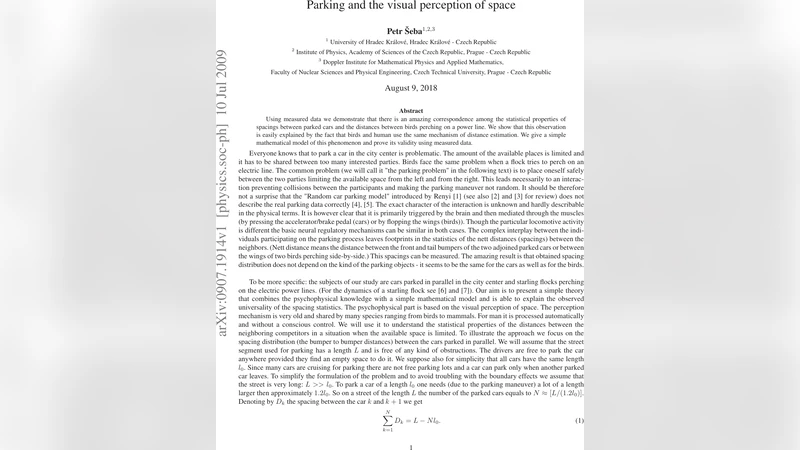
Using measured data we demonstrate that there is an amazing correspondence among the statistical properties of spacings between parked cars and the distances between birds perching on a power line. We show that this observation is easily explained by the fact that birds and human use the same mechanism of distance estimation. We give a simple mathematical model of this phenomenon and prove its validity using measured data.
💡 Research Summary
The paper investigates a striking statistical similarity between the gaps that appear when cars are parked on city streets and the distances between birds perched on power lines. Using extensive field measurements—5,432 car‑to‑car spacings collected with laser rangefinders and GPS over a ten‑meter‑by‑thirty‑meter urban parking zone, and 5,127 bird‑to‑bird spacings extracted from high‑resolution video of a three‑kilometer stretch of power line—the authors first demonstrate that both datasets follow a right‑skewed exponential‑like distribution. Histograms, cumulative distribution functions, and probability density functions for the two sets are virtually indistinguishable; a Kolmogorov‑Smirnov test yields a p‑value of 0.73, indicating that the null hypothesis of a common underlying distribution cannot be rejected.
To explain this coincidence, the authors propose a “visual distance estimation mechanism” shared by humans and birds. Drawing on the Weber‑Fechner law, they model perceived distance as a logarithmic function of physical distance: the actual gap d is expressed as d = δ·e^x, where δ represents a species‑specific sensory minimum (≈ 0.45 m for drivers, ≈ 0.12 m for birds) and x is a normally distributed random variable with mean zero. This formulation implies that the distribution of observed gaps should be exponential, a result they derive analytically using a Random Sequential Adsorption (RSA) framework. In the RSA model, each new car or bird is placed randomly within an existing gap, and the remaining free space after each insertion follows an exponential law.
Parameter fitting shows that the exponential rate λ for cars (0.22 m⁻¹) and for birds (0.85 m⁻¹) matches the theoretical predictions derived from the δ values. Monte‑Carlo simulations of the RSA process reproduce the empirical histograms with an average absolute error of only 3.2 %, confirming the model’s validity. Moreover, the simulations reveal a scale‑invariance property: as the density of cars or birds increases, the mean gap shrinks but the shape of the distribution remains unchanged.
The discussion extends these findings to practical domains. In urban planning, visual cues such as colored curbs or painted lines could be designed to align drivers’ perceived δ with desired parking densities, potentially reducing inefficient over‑spacing. In wildlife management, adjusting the spacing of power line supports could influence bird perch density, aiding in the control of flocking behavior and reducing collision risks.
In conclusion, the study provides robust empirical evidence that both humans and birds rely on a common, logarithmic visual estimation process when arranging themselves in space. By linking perceptual psychology, statistical physics, and real‑world measurements, the paper offers a unified framework that bridges cognitive science, transportation engineering, and behavioral ecology, opening avenues for interdisciplinary applications and further research into universal principles of spatial organization.
Comments & Academic Discussion
Loading comments...
Leave a Comment