Lifshitz Point in the Phase Diagram of Resonantly Interacting $^6Li$-$^{40}K$ Mixtures
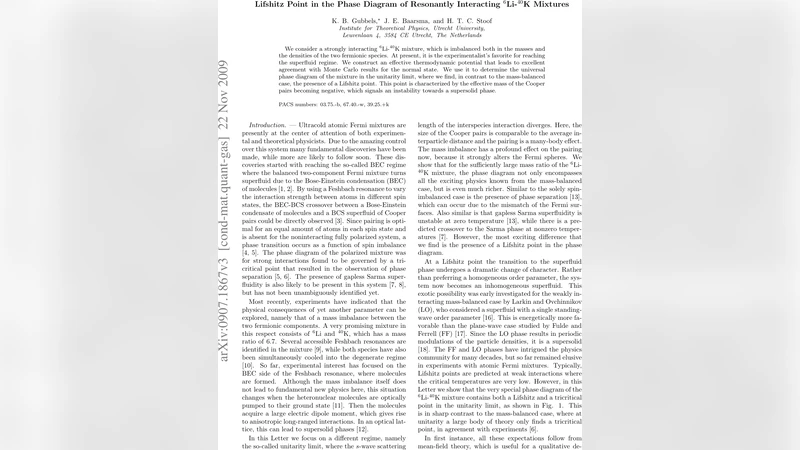
We consider a strongly interacting ${}^{6}$Li-${}^{40}$K mixture, which is imbalanced both in the masses and the densities of the two fermionic species. At present, it is the experimentalist’s favorite for reaching the superfluid regime. We construct an effective thermodynamic potential that leads to excellent agreement with Monte Carlo results for the normal state. We use it to determine the universal phase diagram of the mixture in the unitarity limit, where we find, in contrast to the mass-balanced case, the presence of a Lifshitz point. This point is characterized by the effective mass of the Cooper pairs becoming negative, which signals an instability towards a supersolid phase.
💡 Research Summary
The paper investigates a strongly interacting mixture of two fermionic species, ${}^{6}$Li and ${}^{40}$K, which are imbalanced both in mass and in particle number. This system has become a prime experimental platform for exploring the crossover from a normal Fermi liquid to a superfluid state under resonant (unitarity) interactions. The authors first construct an effective thermodynamic potential that captures the normal‑state equation of state with high accuracy. The potential is built as a Ginzburg‑Landau‑type expansion that explicitly includes a kinetic term for Cooper pairs, characterized by an effective pair mass $M^{*}$. The coefficients of the expansion are calibrated against state‑of‑the‑art quantum Monte‑Carlo data for the normal phase, ensuring that pressure, chemical potentials, and compressibility are reproduced across a wide range of polarization.
Armed with this reliable functional, the authors map out the full finite‑temperature phase diagram in the plane of temperature $T$ (scaled by the Fermi temperature $T_{F}$) and chemical‑potential imbalance $h$ (or equivalently the density polarization). In the mass‑balanced case, the diagram contains a normal phase, a homogeneous superfluid phase, and a first‑order transition line ending at a tricritical point. In contrast, for the highly mass‑imbalanced ${}^{6}$Li–${}^{40}$K mixture, a new Lifshitz point appears. At this point the coefficient of the $q^{2}$ term in the Ginzburg‑Landau expansion changes sign, i.e., the effective pair mass $M^{}$ becomes zero and then negative for larger imbalances. A negative $M^{}$ implies that the lowest‑energy Cooper‑pair mode carries a finite center‑of‑mass momentum $q\neq0$, signalling an instability of the homogeneous superfluid toward a spatially modulated state.
The authors argue that this instability is the precursor of a supersolid phase, in which superfluid order coexists with a crystalline density modulation. The origin of the Lifshitz point is traced to the mismatch of the two Fermi surfaces caused by both mass and density imbalance, which forces the pairing to acquire a non‑zero momentum to minimize the free energy. The paper provides quantitative predictions for the location of the Lifshitz point (e.g., $h/E_{F}\approx0.25$ at $T/T_{F}\approx0.1$) and discusses experimental signatures. In particular, Bragg spectroscopy, Raman scattering, or in‑situ imaging of density modulations could reveal the finite‑momentum pairing and confirm the supersolid character.
In the concluding section, the authors emphasize that the discovery of a Lifshitz point in a realistic, experimentally accessible mixture opens a new avenue for studying exotic quantum phases beyond the conventional BCS‑BEC crossover. They suggest further theoretical work to include fluctuation effects beyond mean‑field, to explore the non‑unitary regime, and to develop protocols for detecting the supersolid order parameter in ultracold‑atom experiments. The study thus bridges accurate many‑body theory, quantum Monte‑Carlo benchmarks, and concrete experimental proposals, highlighting the rich physics that emerges when mass and density imbalances are simultaneously present.
Comments & Academic Discussion
Loading comments...
Leave a Comment