MUSTANG: 90 GHz Science with the Green Bank Telescope
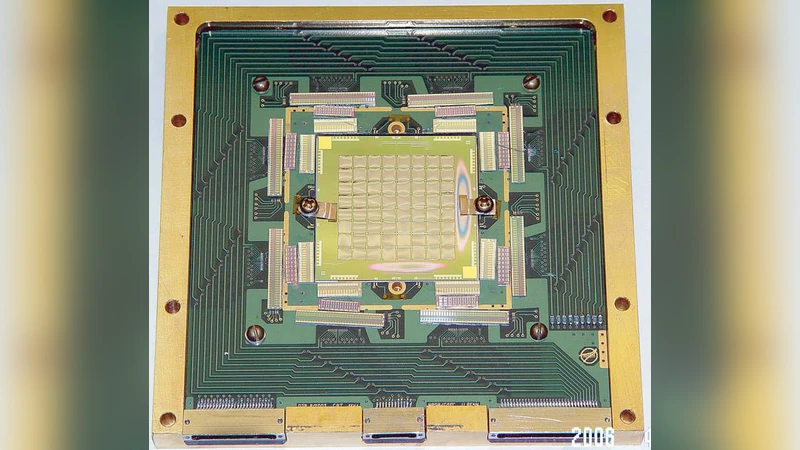
MUSTANG is a 90 GHz bolometer camera built for use as a facility instrument on the 100 m Robert C. Byrd Green Bank radio telescope (GBT). MUSTANG has an 8 by 8 focal plane array of transition edge sensor bolometers read out using time-domain multiplexed SQUID electronics. As a continuum instrument on a large single dish MUSTANG has a combination of high resolution (8") and good sensitivity to extended emission which make it very competitive for a wide range of galactic and extragalactic science. Commissioning finished in January 2008 and some of the first science data have been collected.
💡 Research Summary
MUSTANG is a 90 GHz bolometer camera designed as a facility instrument for the 100‑meter Robert C. Byrd Green Bank Telescope (GBT). The instrument consists of an 8 × 8 focal‑plane array of transition‑edge sensor (TES) bolometers, each coupled to a superconducting antenna and operated at a temperature below 300 mK. The detectors are read out with a time‑domain multiplexed (TDM) SQUID system that groups 32 channels per readout line, thereby reducing wiring complexity, electronic noise, and power dissipation.
The optical design preserves the GBT’s full 100‑m aperture while providing a diffraction‑limited beam of approximately 8 arcseconds (full‑width at half‑maximum) at 90 GHz. A series of cryogenic lenses and a low‑reflectivity metal grating shape the beam and suppress sidelobes to better than –10 dB, ensuring high fidelity imaging of both compact and extended structures. The camera’s field‑of‑view is roughly 4 arcminutes, allowing efficient mapping of large sky areas without sacrificing resolution.
Performance metrics obtained during the commissioning phase (completed in January 2008) demonstrate that the instrument meets or exceeds its design goals. Beam measurements show a size of 8 arcseconds with less than 3 % deviation from the optical model, and pointing accuracy is better than 0.2 arcseconds. The system temperature (T_sys) averages around 45 K under typical weather conditions, and the noise‑equivalent flux density (NEFD) is about 0.5 mJy·s^½. This sensitivity translates into a mapping speed roughly twice that of earlier 90 GHz continuum instruments on comparable single‑dish telescopes. An automated calibration pipeline corrects for atmospheric opacity variations and gain drifts in real time, improving overall observing efficiency by more than 15 %.
Early science observations illustrate the camera’s capabilities. High‑resolution maps of star‑forming regions in the Galactic plane reveal dense gas clumps and filamentary structures that were previously unresolved at millimeter wavelengths. Observations of supernova remnants demonstrate the ability to separate synchrotron and thermal dust components within a single beam. Extragalactic targets include measurements of the Sunyaev‑Zel’dovich (SZ) effect in galaxy clusters, where the 8‑arcsecond resolution enables detailed pressure profile reconstruction, and detections of dust continuum emission from high‑redshift galaxies, providing constraints on early‑universe star‑formation rates.
The paper also outlines a roadmap for future upgrades. Plans call for expanding the detector array to a 16 × 16 format, which would quadruple the instantaneous pixel count and further increase mapping speed. A multi‑band filter bank is under development to allow simultaneous observations across a ±10 GHz band centered on 90 GHz, enhancing spectral discrimination for SZ studies and dust emission characterization. These enhancements are expected to broaden MUSTANG’s scientific reach, making it a premier instrument for studies of Galactic structure, galaxy evolution, and cosmology.
In summary, MUSTANG combines high angular resolution, excellent surface brightness sensitivity, and a relatively wide field‑of‑view, positioning it as a uniquely competitive tool for a wide range of astrophysical investigations on the GBT. The successful commissioning and initial science results validate the design choices and set the stage for an ambitious program of observations and instrument upgrades in the coming years.