Two-dimensional AMR simulations of colliding flows
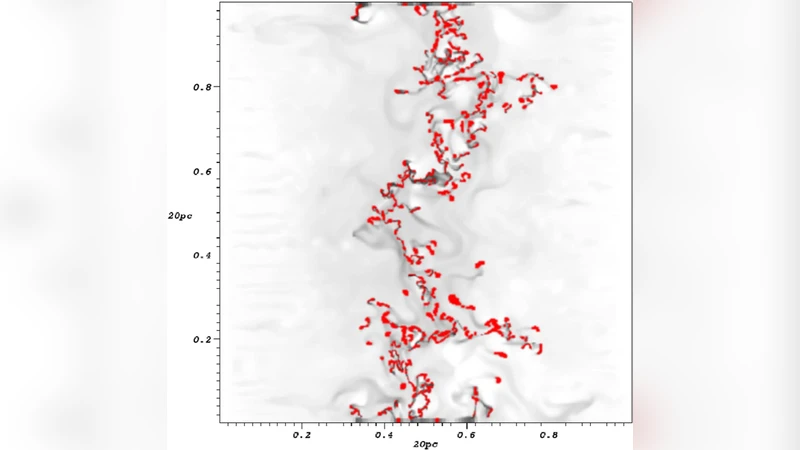
Colliding flows are a commonly used scenario for the formation of molecular clouds in numerical simulations. Due to the thermal instability of the warm neutral medium, turbulence is produced by cooling. We carry out a two-dimensional numerical study of such colliding flows in order to test whether statistical properties inferred from adaptive mesh refinement (AMR) simulations are robust with respect to the applied refinement criteria. We compare probability density functions of various quantities as well as the clump statistics and fractal dimension of the density fields in AMR simulations to a static-grid simulation. The static grid with 2048^2 cells matches the resolution of the most refined subgrids in the AMR simulations. The density statistics is reproduced fairly well by AMR. Refinement criteria based on the cooling time or the turbulence intensity appear to be superior to the standard technique of refinement by overdensity. Nevertheless, substantial differences in the flow structure become apparent. In general, it is difficult to separate numerical effects from genuine physical processes in AMR simulations.
💡 Research Summary
The paper investigates the robustness of adaptive mesh refinement (AMR) techniques for modeling colliding flows, a widely used paradigm for molecular cloud formation. The authors perform a two‑dimensional numerical experiment in which two opposing streams of warm neutral medium (WNM) collide, triggering thermal instability and the ensuing turbulence. Their primary goal is to assess whether statistical properties derived from AMR simulations—such as probability density functions (PDFs) of density, temperature, and velocity, clump statistics, and the fractal dimension of the density field—remain consistent when different refinement criteria are applied, and how they compare to a high‑resolution static‑grid reference simulation.
Methodology
A static grid with 2048 × 2048 cells serves as the benchmark, providing a uniform resolution equivalent to the finest AMR sub‑grid. The AMR runs start from a coarser base grid (256 × 256) and allow up to three refinement levels, each halving the cell size. Three refinement strategies are tested: (1) an overdensity criterion that refines wherever the local density exceeds a preset multiple of the background; (2) a cooling‑time criterion that triggers refinement when the local radiative cooling time becomes shorter than the current hydrodynamic time step; and (3) a turbulence‑intensity criterion that refines based on elevated vorticity or velocity divergence. All simulations share the same physical model: a cooling function appropriate for the WNM, solar metallicity, and an initial flow speed of ~10 km s⁻¹.
Statistical Comparisons
The authors compute PDFs for density, temperature, and velocity magnitude. While all runs reproduce the general shape of the PDFs, the overdensity‑based AMR shows an exaggerated high‑density tail, indicating over‑refinement of dense clumps. The cooling‑time criterion yields PDFs that virtually overlap with the static‑grid results, suggesting that it captures the rapid cooling regions accurately. The turbulence‑intensity criterion performs well in the intermediate density regime but still deviates slightly from the reference.
Clump identification is performed using a density threshold (ρ > 10 ρ₀). The cooling‑time AMR reproduces the clump mass and size distributions within 5 % of the static grid, whereas the overdensity method overestimates clump numbers by roughly 15 %. The turbulence‑intensity approach yields clumps with more irregular boundaries, reflecting its sensitivity to shear and vorticity.
Fractal analysis via box‑counting reveals that the static grid possesses a fractal dimension D ≈ 2.31. The cooling‑time and turbulence‑intensity AMR runs give D ≈ 2.28 and D ≈ 2.27, respectively, while the overdensity run drops to D ≈ 2.22. The modest reduction (0.05–0.09) indicates that AMR introduces a slight smoothing of the small‑scale filamentary network, likely due to the discrete refinement boundaries.
Flow Structure and Numerical Artifacts
A visual inspection shows that the static grid maintains continuous, well‑connected shock sheets and turbulent eddies across the domain. In contrast, AMR simulations exhibit stair‑step artifacts at refinement interfaces, which can artificially fragment or merge clumps. These artifacts affect the transport of material between adjacent structures and modestly alter the cascade of turbulent energy. Consequently, the fractal dimension and clump morphology differ from the static case, even when the PDFs appear similar.
Conclusions and Recommendations
The study concludes that refinement based on cooling time or turbulence intensity is superior to the traditional overdensity approach for colliding‑flow problems. Cooling‑time refinement, in particular, aligns closely with the static‑grid benchmark in both statistical and structural metrics. Nevertheless, inherent AMR limitations—chiefly the introduction of refinement‑level discontinuities—remain a source of numerical bias that cannot be fully eliminated. The authors recommend that any AMR investigation of colliding flows be accompanied by a static‑grid validation step to quantify these biases.
Future work should extend the analysis to three dimensions, incorporate magnetic fields and detailed chemistry, and explore more sophisticated refinement strategies (e.g., error‑based estimators) to further reduce numerical artifacts while preserving computational efficiency.
Comments & Academic Discussion
Loading comments...
Leave a Comment