Master Robotic Net
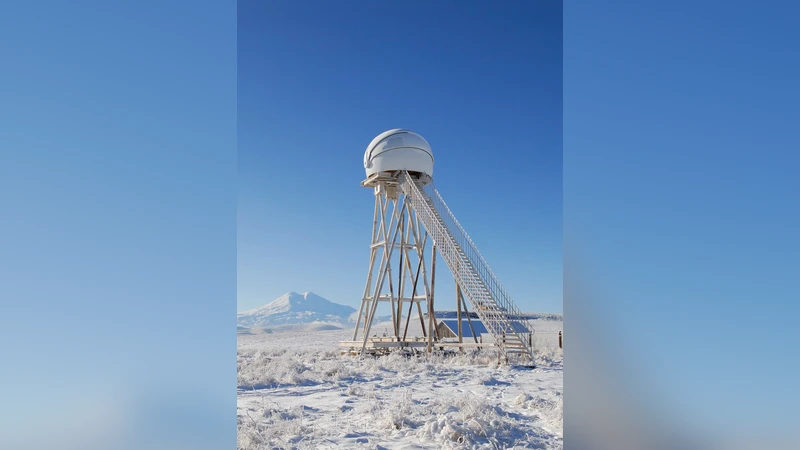
The main goal of the MASTER-Net project is to produce a unique fast sky survey with all sky observed over a single night down to a limiting magnitude of 19 - 20mag. Such a survey will make it possible to address a number of fundamental problems: search for dark energy via the discovery and photometry of supernovas (including SNIa), search for exoplanets, microlensing effects, discovery of minor bodies in the Solar System and space-junk monitoring. All MASTER telescopes can be guided by alerts, and we plan to observe prompt optical emission from gamma-ray bursts synchronously in several filters and in several polarization planes.
💡 Research Summary
The MASTER‑Net paper presents a novel, globally distributed robotic telescope network designed to image the entire visible sky in a single night down to a limiting magnitude of 19–20 mag. The authors argue that existing wide‑field surveys (e.g., Pan‑STARRS, ZTF) either lack the depth, cadence, or real‑time responsiveness needed to address several high‑impact scientific questions: precise measurements of dark energy using Type Ia supernovae, detection of transiting exoplanets and microlensing events, monitoring of minor bodies and space debris, and rapid follow‑up of gamma‑ray bursts (GRBs) with simultaneous multi‑band photometry and polarimetry.
Each MASTER node consists of a 40 cm f/2.5 reflector, a 4 k × 4 k CCD (15 µm pixels) delivering a 2 deg² field of view and ~2 arcsec image quality. A motorised filter wheel holds standard g, r, i, z filters plus four linear polarizers, enabling a single exposure to capture both colour and polarisation information. The network’s fast slewing (≤1 s) and 30 s exposure strategy allow a coverage rate exceeding 20 000 deg² h⁻¹, which translates into a full‑sky survey within a typical night of darkness.
The data pipeline is fully automated. Raw frames are transferred via a dedicated high‑speed fiber link to a central processing centre, where they undergo bias/dark subtraction, flat‑fielding, and astrometric calibration. A reference‑image subtraction algorithm isolates transient sources, and a convolutional‑neural‑network classifier distinguishes genuine astrophysical events from satellites, aircraft, and artefacts. Detected transients are packaged as VOEvent alerts and disseminated instantly to partner facilities. A dynamic scheduler ingests external triggers (e.g., Swift, Fermi GRB alerts) and internal detections, re‑prioritising observations on the fly to guarantee sub‑minute response times for high‑value targets.
Four primary science drivers are outlined. (1) Supernova cosmology: the nightly all‑sky cadence will generate thousands of SNIa light curves, improving statistical constraints on the dark‑energy equation‑of‑state parameter w by a factor of two relative to current samples. (2) Exoplanet and microlensing surveys: continuous high‑precision photometry across the sky enables detection of shallow transits (≤1 %) and short‑duration microlensing spikes, expanding the parameter space for both bound and free‑floating planets. (3) Solar‑system and debris monitoring: the network’s low‑latitude and high‑latitude sites provide near‑continuous coverage of near‑Earth objects, allowing rapid orbit determination and real‑time collision risk assessment. (4) GRB prompt emission: simultaneous multi‑band and polarimetric imaging within seconds of a GRB trigger will yield the first systematic dataset of early‑time optical polarisation, a critical diagnostic of jet composition and magnetic field structure.
Operational plans call for a pilot phase in 2024 with three sites, scaling to ten sites worldwide by 2025. The pilot will produce ~1 TB of raw data per night; the full network is expected to generate ~10 PB per year, stored in a distributed cloud architecture with redundancy and on‑the‑fly compression. Data release policy mandates that transient catalogs be public within 24 h, while calibrated images become available after a 30‑day proprietary period.
Technical challenges include maintaining photometric uniformity across heterogeneous sites, handling petabyte‑scale data streams, and ensuring sub‑second timing accuracy for transient light curves. The authors propose GPS‑disciplined pulse‑per‑second clocks at each node, AI‑driven quality‑control agents that flag weather‑induced anomalies, and a dedicated fiber backbone to minimise latency. They also discuss synergies with next‑generation facilities such as the Vera C. Rubin Observatory (LSST), emphasizing that MASTER‑Net’s high‑cadence, shallow‑depth observations will complement LSST’s deep, lower‑cadence surveys, enabling cross‑validation of transient classifications and joint multi‑wavelength campaigns.
In conclusion, MASTER‑Net is positioned to become a cornerstone of time‑domain astronomy, delivering unprecedented nightly all‑sky coverage, rapid multi‑band and polarimetric data, and a real‑time alert stream that will empower a broad range of astrophysical investigations from cosmology to planetary science.
Comments & Academic Discussion
Loading comments...
Leave a Comment