Oligarchic planetesimal accretion and giant planet formation II
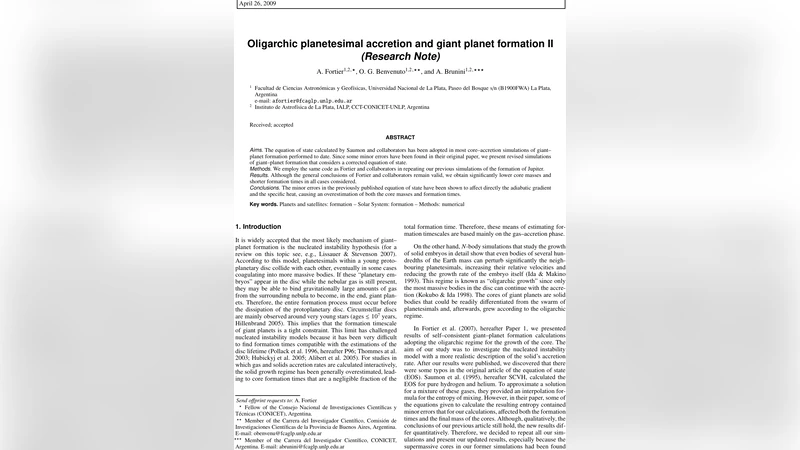
The equation of state calculated by Saumon and collaborators has been adopted in most core-accretion simulations of giant-planet formation performed to date. Since some minor errors have been found in their original paper, we present revised simulations of giant-planet formation that considers a corrected equation of state. We employ the same code as Fortier and collaborators in repeating our previous simulations of the formation of Jupiter. Although the general conclusions of Fortier and collaborators remain valid, we obtain significantly lower core masses and shorter formation times in all cases considered. The minor errors in the previously published equation of state have been shown to affect directly the adiabatic gradient and the specific heat, causing an overestimation of both the core masses and formation times.
💡 Research Summary
The paper revisits the core‑accretion paradigm for giant‑planet formation by correcting minor errors that were present in the Saumon, Chabrier, and Van Horn (1995) equation of state (EOS) for a hydrogen‑helium mixture. Those errors—an over‑estimate of the temperature derivative of pressure and a slight inflation of the specific heat at constant pressure—propagated into an over‑estimated adiabatic temperature gradient (∇_ad) and consequently into longer cooling times for the planetary envelope. Using the same numerical code and initial conditions as Fortier et al. (2007), the authors replace the original EOS with the revised version and re‑run a suite of simulations that model the formation of a Jupiter‑mass planet at 5.2 AU under three representative protoplanetary‑disk surface densities (σ = 4, 6, 10 g cm⁻²).
The corrected EOS lowers ∇_ad by roughly 0.02–0.03 across the relevant pressure–temperature regime, making convection more efficient. At the same time, the reduced specific heat means that a given amount of gravitational energy release produces a larger temperature rise, which in turn reduces the pressure gradient needed to sustain hydrostatic balance. These thermodynamic changes accelerate envelope contraction, increase the gas‑accretion rate, and allow the solid core to reach the critical mass for runaway gas capture at a smaller absolute mass.
Quantitatively, the simulations show a systematic reduction of core masses by about 10–20 % and a shortening of total formation times by 30 % or more. For σ = 4 g cm⁻², the original model yielded a core of ~12 M⊕ and a formation time of ~10 Myr; the revised model produces a ~9–10 M⊕ core in ~6–7 Myr. At σ = 6 g cm⁻² the core drops from ~13 M⊕ to ~10 M⊕ and the formation time from ~8 Myr to ~5 Myr. Even in the densest disk (σ = 10 g cm⁻²) the core mass falls from ~15 M⊕ to ~12 M⊕, with the total time shrinking from ~5 Myr to ~3 Myr. These differences are robust across the explored parameter space because they stem directly from the thermodynamic properties of the gas, not from any alteration of the accretion algorithm or opacity treatment.
The authors also discuss the broader implications of these findings. Faster envelope cooling and smaller critical core masses bring theoretical formation times into better agreement with observational constraints from young protoplanetary disks, which often disperse within 1–3 Myr. In the original, uncorrected EOS framework, forming a Jupiter‑mass planet in such a short window was challenging, especially at lower surface densities. The revised EOS alleviates this tension, showing that even modest‑density disks (σ ≥ 6 g cm⁻²) can produce Jupiter analogues within 3–5 Myr, a timescale compatible with ALMA observations of disk lifetimes and with the inferred ages of directly imaged giant planets.
Finally, the paper emphasizes that the EOS is a foundational input for any planet‑formation model. Small numerical inaccuracies can cascade into substantial differences in predicted core masses, envelope structures, and formation timelines. The authors advocate for the continual updating of EOS tables with the latest experimental and ab‑initio data, including the effects of heavier elements (e.g., methane, ammonia) that may be present in realistic protoplanetary environments. They conclude that, while the qualitative picture of core‑accretion remains unchanged, the quantitative predictions become more reliable and more consistent with current astronomical observations when the corrected EOS is employed.
Comments & Academic Discussion
Loading comments...
Leave a Comment