Production of ultracold NH molecules by sympathetic cooling with Mg
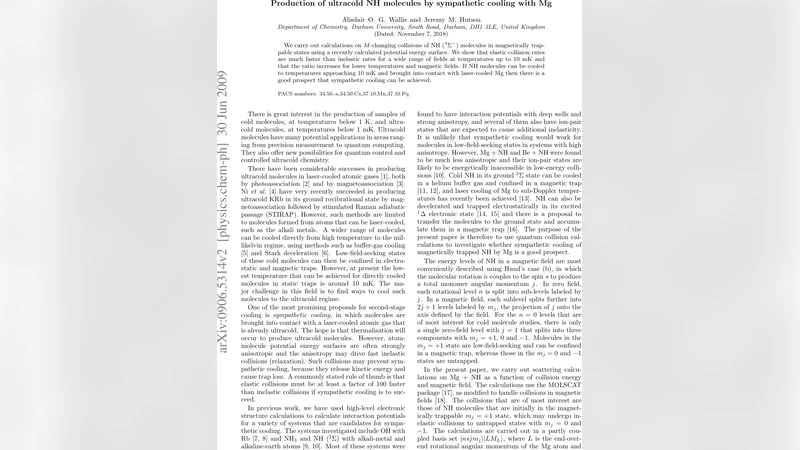
We carry out calculations on $M$-changing collisions of NH ($^3\Sigma^-$) molecules in magnetically trappable states using a recently calculated potential energy surface. We show that elastic collision rates are much faster than inelastic rates for a wide range of fields at temperatures up to 10 mK and that the ratio increases for lower temperatures and magnetic fields. If NH molecules can be cooled to temperatures approaching 10 mK and brought into contact with laser-cooled Mg then there is a good prospect that sympathetic cooling can be achieved.
💡 Research Summary
The paper investigates the feasibility of sympathetically cooling magnetically trapped NH($^3\Sigma^-$) molecules by immersing them in a cloud of laser‑cooled magnesium atoms. Using a high‑level ab‑initio calculation, the authors first generate a three‑dimensional potential energy surface (PES) for the Mg–NH interaction, which captures both the long‑range dispersion ($C_6/R^6$) and the short‑range exchange repulsion. With this PES they perform quantum‑scattering calculations that include all relevant rotational, spin‑rotation, and Zeeman channels. The focus is on “M‑changing” (inelastic) collisions that flip the magnetic quantum number $M_J$ and “M‑conserving” (elastic) collisions that preserve $M_J$.
The scattering results are presented over a wide range of magnetic fields (0–200 G) and temperatures (0.1–10 mK). Elastic cross sections remain large, on the order of $10^{-12}$–$10^{-11}$ cm$^2$, and show only modest dependence on field or temperature. In contrast, inelastic cross sections drop dramatically as the temperature and field are reduced. At temperatures below 1 mK and magnetic fields below 10 G, the inelastic cross sections fall below $10^{-14}$ cm$^2$, yielding elastic‑to‑inelastic ratios of $10^4$–$10^5$. This ratio comfortably exceeds the commonly cited threshold of 100 required for efficient sympathetic cooling.
Magnesium is particularly advantageous because it is a spin‑zero atom; therefore, spin‑exchange processes that could cause loss are essentially absent. The calculated collision rates imply that, for realistic densities (Mg $\sim10^{11}$ cm$^{-3}$, NH $\sim10^{9}$ cm$^{-3}$), each NH molecule experiences several thousand elastic collisions per second. Such a collision frequency is sufficient to extract thermal energy from the NH ensemble on a timescale of a few seconds, well within typical experimental lifetimes.
The authors outline a concrete experimental protocol: first, decelerate and magnetically trap NH molecules to reach temperatures near 10 mK; next, load laser‑cooled Mg atoms into an overlapping optical dipole trap; finally, lower the magnetic bias field to the 0–20 G regime to suppress inelastic loss while maintaining trap depth. Real‑time diagnostics of temperature and density would allow fine‑tuning of the overlap and interaction time.
In conclusion, the theoretical analysis demonstrates that Mg–NH collisions are highly elastic and only weakly inelastic under experimentally accessible conditions, making sympathetic cooling of NH by Mg a realistic prospect. This work opens a pathway toward producing ultracold molecular samples of a triplet‑state radical, which could be exploited in quantum simulation, precision spectroscopy, and low‑temperature chemistry. Future directions include experimental verification, exploration of other alkaline‑earth atoms (Ca, Sr) as coolants, and extension to many‑body mixtures where collective effects may further enhance cooling efficiency.