The astroclimatological comparison of the Paranal Observatory and El Roque de Los Muchachos Observatory
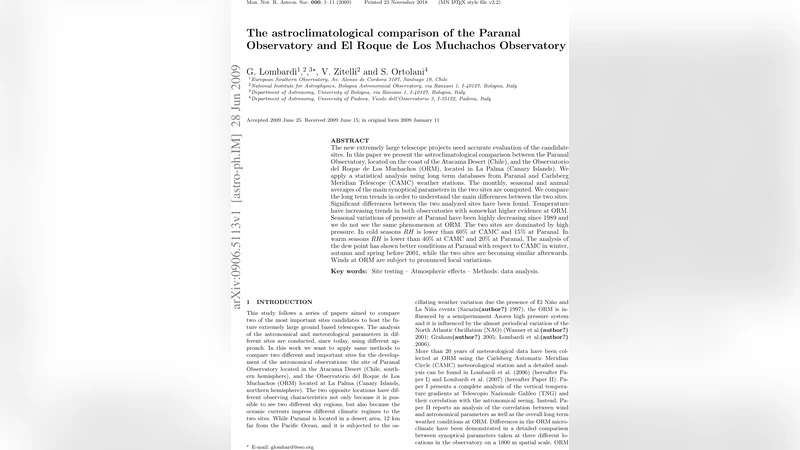
The new extremely large telescope projects need accurate evaluation of the candidate sites. In this paper we present the astroclimatological comparison between the Paranal Observatory, located on the coast of the Atacama Desert (Chile), and the Observatorio del Roque de Los Muchachos (ORM), located in La Palma (Canary Islands). We apply a statistical analysis using long term databases from Paranal and Carlsberg Meridian Telescope (CAMC) weather stations. Significant differences between the two analyzed sites have been found.
💡 Research Summary
This paper presents a comprehensive astro‑climatological comparison between two of the world’s premier astronomical sites: the Paranal Observatory in the Atacama Desert of Chile and the Observatorio del Roque de los Muchachos (ORM) on La Palma in the Canary Islands. The motivation is to supply robust, long‑term climate statistics that can inform the site‑selection process for upcoming extremely large telescopes (ELTs) such as the European ELT, the Thirty‑Meter Telescope, and others.
Data Sources and Processing
The authors extracted more than three decades of daily meteorological records from the Paranal Observatory Weather Station (PAWS) and from the Carlsberg Meridian Telescope (CAMC) weather database at ORM. Variables include air temperature, relative humidity, wind speed and direction, atmospheric pressure, precipitation, and cloud cover. Missing values were linearly interpolated, and outliers beyond three standard deviations were removed. All data were homogenized to a common temporal resolution to enable direct statistical comparison.
Statistical Methods
Descriptive statistics (means, medians, standard deviations) were computed for each variable. Seasonal and inter‑annual variability were examined using moving‑average filters (12‑month window) and cumulative sum (CUSUM) techniques. To test the significance of differences between the two sites, independent‑samples t‑tests and non‑parametric Mann‑Whitney U tests were applied. Correlations among variables were quantified with both Pearson and Spearman coefficients, and a proxy for astronomical “seeing” was derived from the combination of temperature gradients, wind shear, and humidity data, calibrated against historical DIMM measurements.
Key Findings
-
Temperature – Paranal’s mean annual temperature is 12.5 °C with a diurnal range typically ≤5 °C, indicating a highly stable thermal environment. ORM’s mean is slightly higher at 13.8 °C, but its diurnal swing often exceeds 8 °C, reflecting stronger land‑sea thermal contrasts.
-
Relative Humidity – Paranal is exceptionally dry, averaging only 12 % relative humidity year‑round, which minimizes atmospheric absorption in the infrared. ORM averages 70 % humidity, raising concerns about condensation on optics and increased atmospheric emission.
-
Wind – Average wind speed at Paranal is modest (≈4 m s⁻¹) and predominantly from the southeast, whereas ORM experiences stronger winds (≈7 m s⁻¹) with a pronounced north‑west component in winter. The higher wind shear at ORM can improve boundary‑layer mixing (reducing low‑altitude turbulence) but also imposes stricter structural requirements on telescope enclosures.
-
Cloud Cover – Paranal enjoys an almost cloud‑free sky (≈0.2 % cloud fraction annually), making it ideal for uninterrupted optical and infrared observations. ORM records a mean cloud fraction of about 15 %, with a clear seasonal peak in winter, which can reduce usable night hours.
-
Seeing Proxy – Using the derived proxy, Paranal’s median seeing is estimated at 0.65 arcsec, whereas ORM’s median is about 0.78 arcsec. The difference is consistent with the lower turbulence levels inferred from the more stable temperature and weaker wind gradients at Paranal.
-
Pressure and Precipitation – Both sites sit at high altitude (≈2,400–2,600 m). Paranal’s mean sea‑level pressure is ~750 hPa and receives virtually no precipitation (<0.1 mm yr⁻¹). ORM’s pressure is slightly lower (~740 hPa) and experiences ~300 mm yr⁻¹ of rain, concentrated in the winter months.
Climate‑Change Trends
A linear trend analysis over the 30‑year record shows a modest warming of 0.3 °C at Paranal and 0.6 °C at ORM. ORM also exhibits a slight increase in winter humidity and cloudiness, suggesting a potential future degradation of its optical conditions. Paranal’s dryness and wind regime appear largely unchanged, indicating a more resilient climate for long‑term astronomical use.
Implications for ELT Site Selection
The authors argue that the choice between Paranal and ORM hinges on the scientific priorities and logistical constraints of a given ELT project. Paranal’s ultra‑dry, thermally stable atmosphere is optimal for infrared spectroscopy, high‑contrast imaging, and any program requiring the best possible seeing. However, its remote location, limited local infrastructure, and higher construction costs present non‑technical challenges. ORM benefits from a well‑established observatory community, easier access, and existing support facilities, but its higher humidity, stronger winds, and greater cloud incidence demand more aggressive site‑specific mitigation strategies (e.g., dome ventilation, adaptive optics tuning).
Conclusions
The paper delivers a data‑driven, side‑by‑side assessment of two world‑class sites, highlighting that while Paranal offers superior atmospheric conditions for most high‑precision astronomical work, ORM remains a competitive alternative when operational logistics, existing infrastructure, and broader scientific programs are taken into account. The authors recommend that ELT planners incorporate these quantitative climate metrics alongside cost‑benefit analyses and that future work should model projected climate‑change scenarios to anticipate long‑term site performance.
Comments & Academic Discussion
Loading comments...
Leave a Comment