The Dynamics of Neptune Trojan: I. the Inclined Orbits
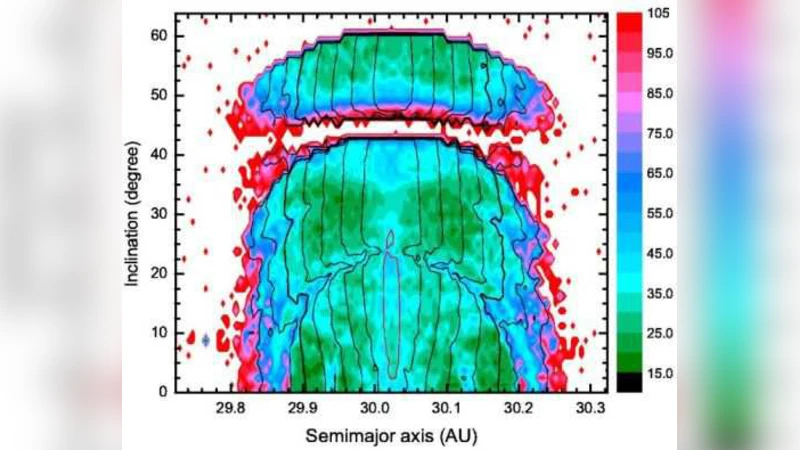
The stability of Trojan type orbits around Neptune is studied. As the first part of our investigation, we present in this paper a global view of the stability of Trojans on inclined orbits. Using the frequency analysis method based on the FFT technique, we construct high resolution dynamical maps on the plane of initial semimajor axis $a_0$ versus inclination $i_0$. These maps show three most stable regions, with $i_0$ in the range of $(0^\circ,12^\circ), (22^\circ,36^\circ)$ and $(51^\circ,59^\circ)$ respectively, where the Trojans are most probably expected to be found. The similarity between the maps for the leading and trailing triangular Lagrange points $L_4$ and $L_5$ confirms the dynamical symmetry between these two points. By computing the power spectrum and the proper frequencies of the Trojan motion, we figure out the mechanisms that trigger chaos in the motion. The Kozai resonance found at high inclination varies the eccentricity and inclination of orbits, while the $\nu_8$ secular resonance around $i_0\sim44^\circ$ pumps up the eccentricity. Both mechanisms lead to eccentric orbits and encounters with Uranus that introduce strong perturbation and drive the objects away from the Trojan like orbits. This explains the clearance of Trojan at high inclination ($>60^\circ$) and an unstable gap around $44^\circ$ on the dynamical map. An empirical theory is derived from the numerical results, with which the main secular resonances are located on the initial plane of $(a_0,i_0)$. The fine structures in the dynamical maps can be explained by these secular resonances.
💡 Research Summary
The paper presents a comprehensive numerical investigation of the long‑term stability of Neptune‑trojan objects on inclined orbits. Using a large ensemble of test particles, the authors integrate each orbit for up to ten million years under the full gravitational influence of the four giant planets. The initial conditions span a fine grid in semimajor axis (a₀ ≈ 29.9–30.5 AU) and inclination (i₀ = 0°–70°) for both the leading (L₄) and trailing (L₅) triangular Lagrange points. After the integrations, a Fast Fourier Transform (FFT) based frequency‑analysis is applied to each trajectory. The dominant proper frequencies and their diffusion rates are extracted, and a “stability index” (the normalized variation of the main frequency) is mapped onto the (a₀, i₀) plane as a colour‑coded dynamical map.
Three broad zones of high stability emerge from the maps. The first lies at low inclination, 0° < i₀ < 12°, corresponding to the classical, nearly planar Neptune trojans already known from observations. The second stable band occupies moderate inclinations, 22° < i₀ < 36°, where the Kozai resonance is present but its amplitude is limited, allowing the argument of perihelion (ω) and longitude of the ascending node (Ω) to circulate in a way that does not destabilise the orbit. The third region, 51° < i₀ < 59°, is a high‑inclination island in which the ν₈ secular resonance (a commensurability between the Trojan’s perihelion precession and Neptune’s eighth eigenfrequency) is effectively suppressed; the orbits remain nearly polar but avoid strong resonant forcing, thus preserving stability.
The maps also reveal a pronounced instability gap around i₀ ≈ 44°. Detailed spectral analysis shows that at this inclination the ν₈ secular resonance becomes exact, driving a rapid increase in eccentricity. As the eccentricity grows, the Trojan’s perihelion distance shrinks enough for close encounters with Uranus, which inject strong, stochastic perturbations that eject the body from the 1:1 resonance. At even higher inclinations (i₀ > 60°) the Kozai mechanism dominates, coupling eccentricity and inclination in a way that quickly pushes the orbit into the planet‑crossing regime, again leading to loss from the Trojan region.
The authors confirm that the dynamical structures are symmetric between L₄ and L₅, reinforcing the theoretical expectation of equal stability for the two triangular points. By fitting the numerically identified resonant locations, they derive an empirical formula that predicts the positions of the main secular resonances on the (a₀, i₀) plane. This formula successfully reproduces the fine‑scale features seen in the dynamical maps, such as narrow stable islands embedded within broader chaotic seas.
In summary, the study demonstrates that Neptune trojans can survive for gigayear timescales only within three specific inclination intervals, while the combined action of the ν₈ secular resonance and the Kozai resonance explains the observed depletion at intermediate (≈44°) and high (>60°) inclinations. The results provide a solid dynamical framework for interpreting the current paucity of high‑inclination Neptune trojans and guide future observational searches by highlighting the most promising regions of phase space.
Comments & Academic Discussion
Loading comments...
Leave a Comment