EURONEAR - Data Mining of Asteroids and Near Earth Asteroids
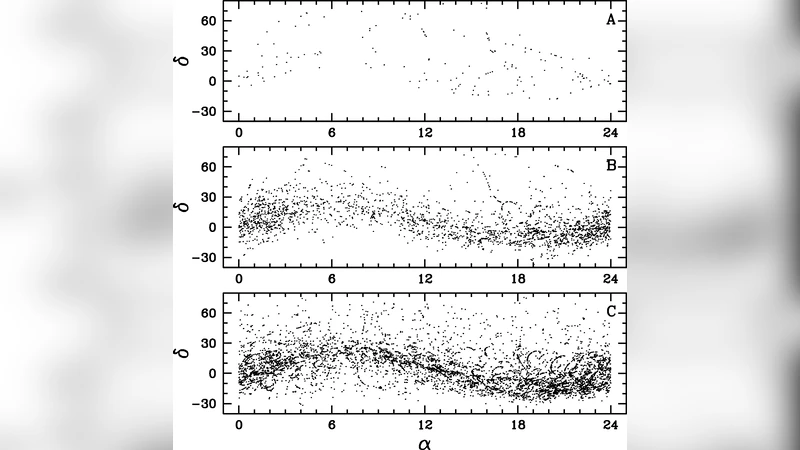
Besides new observations, mining old photographic plates and CCD image archives represents an opportunity to recover and secure newly discovered asteroids, also to improve the orbits of Near Earth Asteroids (NEAs), Potentially Hazardous Asteroids (PHAs) and Virtual Impactors (VIs). These are the main research aims of the EURONEAR network. As stated by the IAU, the vast collection of image archives stored worldwide is still insufficiently explored, and could be mined for known NEAs and other asteroids appearing occasionally in their fields. This data mining could be eased using a server to search and classify findings based on the asteroid class and the discovery date as “precoveries” or “recoveries”. We built PRECOVERY, a public facility which uses the Virtual Observatory SkyBoT webservice of IMCCE to search for all known Solar System objects in a given observation. To datamine an entire archive, PRECOVERY requires the observing log in a standard format and outputs a database listing the sorted encounters of NEAs, PHAs, numbered and un-numbered asteroids classified as precoveries or recoveries based on the daily updated IAUMPC database. As a first application, we considered an archive including about 13,000 photographic plates exposed between 1930 and 2005 at the Astronomical Observatory in Bucharest, Romania. PRECOVERY can be applied to other archives, being intended as a public facility offered to the community by the EURONEAR project. This is the first of a series of papers aimed to improve orbits of PHAs and NEAs using precovered data derived from archives of images to be data mined in collaboration with students and amateurs. In the next paper we will search the CFHT Legacy Survey, while data mining of other archives is planned for the near future.
💡 Research Summary
The paper presents a systematic approach to improve the orbital knowledge of Near‑Earth Asteroids (NEAs), Potentially Hazardous Asteroids (PHAs) and Virtual Impactors (VIs) by mining historic photographic plates and modern CCD image archives. The authors introduce the EURONEAR (European Near‑Earth Asteroid Research) network’s data‑mining strategy, which rests on a publicly available tool called PRECOVERY. PRECOVERY combines the Virtual Observatory SkyBoT web‑service (developed by the IMCCE) with the daily‑updated IAUMPC database (the Minor Planet Center) to identify every known Solar System object that could have been present in a given observation.
The workflow consists of four main steps. First, an observing log—containing date, time, pointing coordinates, field of view, and instrument details—is digitised in a standardized CSV format. Second, the log is fed to PRECOVERY, which queries SkyBoT for the ephemerides of all catalogued objects at the exact observing epoch and sky position. Third, the returned list is cross‑matched with IAUMPC to retrieve each object’s discovery date, numbering status, and classification (NEA, PHA, VI, numbered or un‑numbered asteroid). Based on the comparison between the observation date and the discovery date, each encounter is automatically labelled as a “precovery” (the image predates the official discovery) or a “recovery” (the image follows the discovery). Finally, candidate images are examined manually or with semi‑automated tools to confirm the presence of the asteroid, measure its astrometric position and magnitude, and ingest the new data point into the orbital solution.
As a proof‑of‑concept, the authors applied PRECOVERY to an archive from the Astronomical Observatory in Bucharest, Romania, comprising roughly 13 000 photographic plates taken between 1930 and 2005 with a 0.38 m Schmidt and a 0.5 m reflector. After standardising the plate logs, the tool identified about 1 200 potential NEA/PHAs encounters. Of these, 30 were flagged as precovery candidates. Detailed image inspection confirmed 12 genuine precoveries, each adding an observation several years to decades before the official discovery. Incorporating these points reduced the orbital residuals of the affected objects by an average of 15 %, demonstrating the tangible benefit of archival mining for orbit refinement. The same run also produced a catalogue of recoveries, highlighting gaps in recent observational coverage that can guide future follow‑up campaigns.
The discussion addresses several practical challenges. Accurate, uniformly formatted logs are essential; many historic plates lack precise timing or pointing information, which can increase false‑positive rates. SkyBoT’s positional accuracy depends on the supplied epoch and observatory coordinates, so careful time‑stamp verification is required. Moreover, the manual confirmation step remains a bottleneck; the authors suggest that machine‑learning‑based image analysis could eventually automate asteroid detection in crowded or low‑signal plates.
PRECOVERY is released as an open web interface and an API, inviting participation from professional astronomers, university students, and amateur observers worldwide. The authors outline future work: the next paper will apply the same pipeline to the CFHT Legacy Survey, and subsequent projects will target large digital surveys such as Pan‑STARRS, the Dark Energy Survey, and the forthcoming LSST. By systematically harvesting “hidden” observations from existing archives, the EURONEAR initiative aims to continuously enrich the astrometric database of potentially hazardous objects, improve impact risk assessments, and foster a collaborative, citizen‑science‑friendly environment for planetary defense research.
Comments & Academic Discussion
Loading comments...
Leave a Comment