Effect of Plasma Composition on the Interpretation of Faraday Rotation
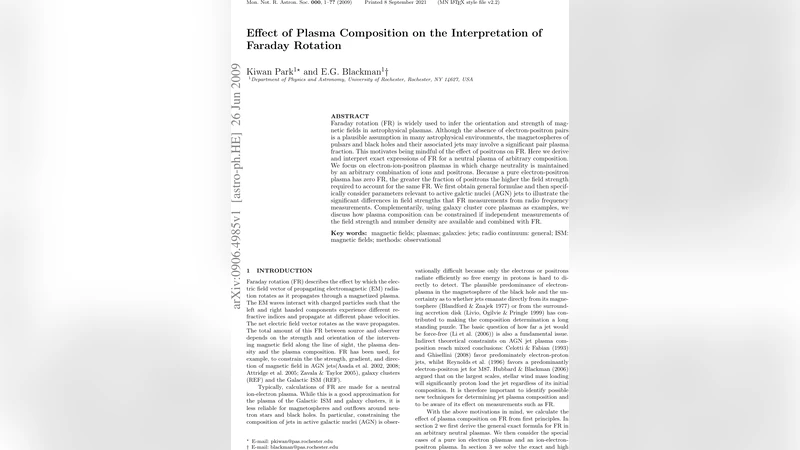
Faraday rotation (FR) is widely used to infer the orientation and strength of magnetic fields in astrophysical plasmas. Although the absence of electron-positron pairs is a plausible assumption in many astrophysical environments, the magnetospheres of pulsars and black holes and their associated jets may involve a significant pair plasma fraction. This motivates being mindful of the effect of positrons on FR. Here we derive and interpret exact expressions of FR for a neutral plasma of arbitrary composition. We focus on electron-ion-positron plasmas in which charge neutrality is maintained by an arbitrary combination of ions and positrons. Because a pure electron-positron plasma has zero FR, the greater the fraction of positrons the higher the field strength required to account for the same FR. We first obtain general formulae and then specifically consider parameters relevant to active galctic nuclei (AGN) jets to illustrate the significant differences in field strengths that FR measurements from radio frequency measurements. Complementarily, using galaxy cluster core plasmas as examples, we discuss how plasma composition can be constrained if independent measurements of the field strength and number density are available and combined with FR.
💡 Research Summary
The paper addresses a fundamental but often overlooked aspect of Faraday rotation (FR) diagnostics in astrophysical plasmas: the influence of plasma composition, specifically the presence of electron‑positron (e⁺e⁻) pairs, on the inferred magnetic field strength. Starting from first principles, the authors derive a general expression for the rotation angle Δχ experienced by a linearly polarized electromagnetic wave propagating through a neutral plasma composed of electrons, ions (typically protons), and positrons. By treating the left‑ and right‑handed circularly polarized eigenmodes separately, they obtain the well‑known result that the net Faraday rotation is proportional to the line‑of‑sight integral of the product of magnetic field and the net charge density, i.e., the difference between electron and positron number densities. The final compact formula is
Δχ = (e³ λ² / 2π mₑ² c⁴) ∫ (nₑ – n₊) B·dl,
where λ is the observing wavelength, e and mₑ are the electron charge and mass, c is the speed of light, nₑ and n₊ are the electron and positron number densities, respectively, and B·dl is the line‑of‑sight magnetic field integral. This expression reduces to the standard electron‑ion result when n₊ = 0 and vanishes for a pure pair plasma (nₑ = n₊), confirming that a symmetric e⁺e⁻ plasma produces no Faraday rotation.
The authors then explore the practical consequences of this composition dependence in two astrophysical contexts.
-
Active Galactic Nucleus (AGN) Jets:
Jets are sites of intense particle acceleration where copious e⁺e⁻ pairs can be generated via photon‑photon collisions or cascade processes. Using typical jet parameters (electron density nₑ ≈ 10⁻³ cm⁻³, path length L ≈ 1 kpc, observing wavelength λ ≈ 6 cm), they compute the magnetic field strength required to reproduce a given rotation measure (RM) for various positron fractions f₊ = n₊/(nₑ + n₊). For f₊ = 0 (pure electron‑ion plasma) a field of ~10 µG suffices to yield RM ≈ 100 rad m⁻². As f₊ increases to 0.9, the required field rises to ~80 µG—an eight‑fold increase. This demonstrates that neglecting positrons can lead to a severe under‑estimate of jet magnetic fields, with implications for jet collimation, stability, and energy transport models. -
Galaxy Cluster Cores:
In hot intracluster media, X‑ray observations provide independent measurements of electron density and temperature, while FR of background radio sources yields RM. The authors illustrate that, if the RM inferred assuming a pure electron‑ion plasma is inconsistent with the X‑ray‑derived magnetic field (e.g., RM lower than expected), the discrepancy can be interpreted as evidence for a non‑zero positron fraction. By applying their formula to the Perseus cluster, they show that a modest positron content (f₊ ≈ 0.1–0.3) can reconcile the observed RM with the magnetic field strength inferred from other techniques (e.g., synchrotron or inverse‑Compton constraints). Thus, FR combined with independent plasma diagnostics can be used to place limits on the pair content in cluster cores.
The paper emphasizes several broader implications. First, FR is intrinsically sensitive to the net charge density, making it a potential probe of plasma composition when used alongside complementary measurements. Second, many previous magnetic field estimates in high‑energy environments may be biased low if a substantial pair plasma component was present but ignored. Third, the authors advocate for a systematic inclusion of a composition parameter in FR modeling, especially for sources where pair production is theoretically expected (pulsar wind nebulae, black‑hole magnetospheres, relativistic jets).
In conclusion, the study provides a rigorous theoretical framework for interpreting Faraday rotation in arbitrary plasma mixtures and demonstrates, through realistic astrophysical examples, that plasma composition can dramatically alter magnetic field inferences. It calls for multi‑wavelength observational strategies that jointly constrain density, temperature, magnetic field, and composition, thereby refining our understanding of magnetized astrophysical plasmas.
Comments & Academic Discussion
Loading comments...
Leave a Comment